
You opened your brokerage app, checked your international ETF, and saw a gain of roughly 5%. Then you looked at headlines saying global equity markets had a stellar year in local-currency terms — up 10 to 12%. The math does not add up. What happened to the other 5 to 7 percentage points? The answer is currency risk, and in Q4 2026, a stubbornly strong US dollar is the single biggest hidden drag on international ETF returns for US-based investors.
This guide explains exactly why the dollar is strong right now, how currency risk erodes your international ETF gains at a mechanical level, which funds are hit hardest, and four concrete strategies you can use to manage your exposure going into the end of the year.
Why the Dollar Is Strong Again in Q4 2026
The US Dollar Index (DXY), which measures the dollar against a basket of six major currencies, has hovered near 108 in Q4 2026 — a level that would have seemed remarkable just 18 months ago. The primary driver is straightforward: interest rate differentials. The Federal Reserve held its benchmark rate in the 5.00–5.25% range through most of 2026, while the European Central Bank cut to 2.75% and the Bank of Japan inched up only modestly to 0.75%. Capital chases yield, and yield lives in the dollar right now.
Fed Policy, Rate Differentials, and the DXY
When US short-term rates are materially higher than those in Europe or Japan, foreign investors buy dollar-denominated assets to capture that yield premium. That buying pressure pushes the dollar up. Meanwhile, US importers, multinationals, and overseas investors holding non-dollar assets all feel the squeeze in the opposite direction. The rate differential between the US and the eurozone alone stood at roughly 225 basis points in October 2026 (Source: Federal Reserve, ECB, as of October 2026).
How Long Can Dollar Strength Last?
Forecasting currencies is notoriously unreliable. The Fed’s dot plot suggests rate cuts could begin in 2027, which would narrow the differential and put downward pressure on the dollar. But “eventually” is not a portfolio strategy. For the next one to two quarters, the consensus points to a dollar that remains elevated. That is the environment your international ETFs are operating in right now.
How Currency Risk Actually Eats Your International ETF Returns
When you own an international ETF like VXUS or EFA, you are not just buying foreign stocks — you are also taking on foreign-currency exposure. The fund holds assets priced in euros, yen, pounds, Swiss francs, and Australian dollars. Every quarter, those foreign-currency values are translated back into US dollars for reporting. When the dollar strengthens, that translation process costs you real money.
The Math: When a 10% Local Gain Becomes 4% in Dollars
Here is a simplified example. Suppose the MSCI EAFE index gained 10% in local-currency terms over the past 12 months. But if the euro depreciated 6% against the dollar over that same period, a US investor in an unhedged European equity fund would receive approximately 3.4% in dollar terms — not 10%. The formula is roughly: (1 + stock return) × (1 + currency return) − 1. Currency drag is not a rounding error. It is a structural component of your return that deserves the same attention as expense ratios or sector allocation.
In 2026 specifically, the estimated currency drag on diversified developed-market funds has ranged from 4 to 6 percentage points year-to-date, depending on the geographic mix of the ETF (Source: MSCI, FactSet, as of September 2026).
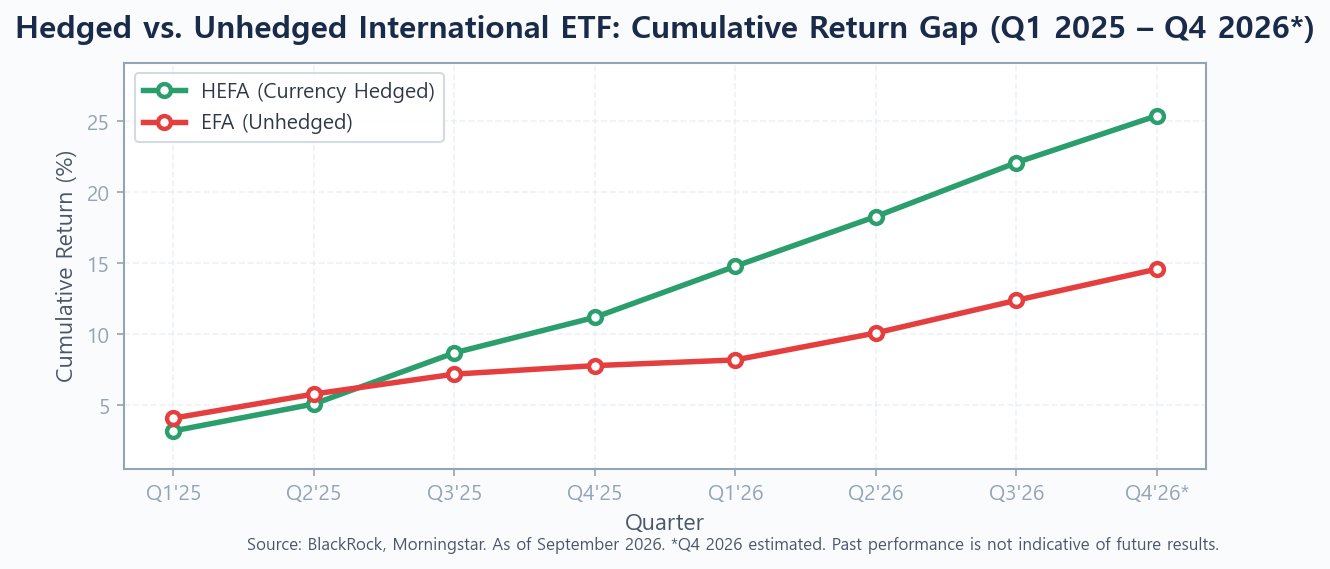
The video below illustrates this mechanism clearly — well worth watching before making any decisions about your international allocation.
Which International ETFs Are Hit Hardest — and Which Are More Resilient
Not all international ETFs carry the same currency profile. Funds heavy in Japanese equities absorbed both equity gains and yen weakness, a particularly painful combination given the yen’s continued slide toward 155 per dollar. Eurozone-heavy funds faced similar headwinds from EUR/USD trading below 1.05. By contrast, funds with meaningful exposure to commodity-exporting economies whose currencies have held up better — such as Canada or Australia — saw smaller drags.
Unhedged vs. Currency-Hedged ETFs: The 2026 Performance Gap
The table below compares unhedged and currency-hedged versions of the most widely held developed-market ETFs, using year-to-date performance through September 2026. The gap is not subtle.
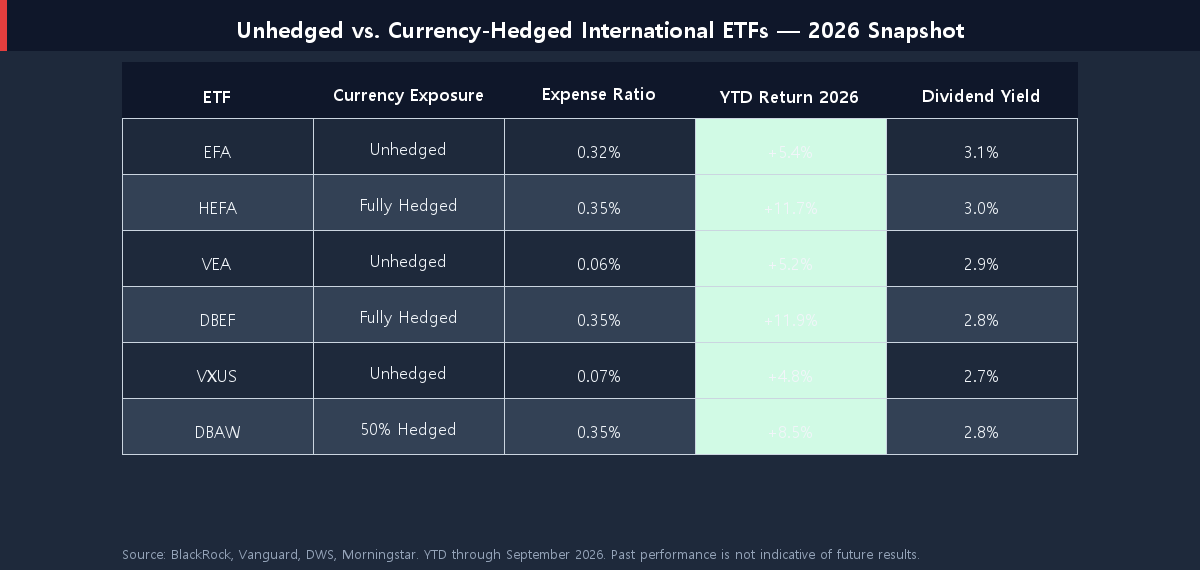
Currency-hedged ETFs like HEFA (iShares Currency Hedged MSCI EAFE ETF) and DBEF (Xtrackers MSCI EAFE Hedged Equity ETF) essentially own the same underlying stocks as their unhedged siblings — EFA and VEA respectively — but layer on currency-forward contracts that neutralize the exchange-rate movement. In 2026, hedged versions outperformed their unhedged equivalents by approximately 6 to 7 percentage points year-to-date.
For a full breakdown of international ETF options and their yield profiles, see Best International Dividend ETFs for 2026 (Beyond SCHD).
Four Strategies to Manage Currency Risk in Your Portfolio
Currency risk is not automatically something to eliminate. There are legitimate arguments on both sides of the hedging debate. The right answer depends on your time horizon, portfolio size, and how much tracking error you are comfortable accepting.
Strategy 1 — Hold and Accept (The Long-Game Case)
Over very long periods — think 20 to 30 years — research by academics including Elroy Dimson and by practitioners like Ben Felix at PWL Capital suggests that currency effects tend to average out. The dollar has periods of sustained strength followed by sustained weakness (as it did in 2002–2007, and again in 2020–2021). A buy-and-hold investor with a long time horizon may reasonably choose to accept currency volatility as a form of diversification, just like accepting equity volatility. This approach works best if you own international stocks as a core permanent holding in a simple 3-fund portfolio and will not panic during dollar-strength cycles.
Strategy 2 — Shift to Currency-Hedged ETFs (HEFA, DBEF, HEZU)
If you believe the dollar will remain strong for the foreseeable future, or if currency volatility is meaningfully distorting your risk-adjusted returns, hedged ETFs are the cleanest tactical solution. HEFA tracks the MSCI EAFE with a full monthly currency hedge and carries an expense ratio of 0.35%. DBEF does the same with a slightly different rebalancing approach at 0.35%. HEZU focuses specifically on eurozone equities and hedges the euro — useful if your thesis is specifically about ECB-vs-Fed divergence.
The trade-off: hedged ETFs cost more in fees (typically 0.25–0.35% versus 0.06–0.32% for unhedged), and when the dollar eventually weakens, hedged funds will underperform. You are essentially making a directional call on the dollar.
Strategy 3 — The 50/50 Partial Hedge
If you are uncertain about the dollar’s direction — which is the honest position for most investors — a 50/50 split between an unhedged fund (VXUS or EFA) and its hedged counterpart (HEFA or DBEF) is a pragmatic middle ground. This approach was institutionalized by DWS with their Xtrackers MSCI EAFE 50% Hedged Equity ETF (DBAW). A partial hedge reduces the binary nature of the bet, smooths return variance, and keeps costs manageable.
Strategy 4 — Tilt Toward Domestic-Revenue Companies
A less obvious approach is to tilt your international equity exposure toward companies that generate most of their revenue in their home market rather than globally. A Japanese consumer staples company selling almost exclusively in Japan earns yen, reports in yen, and its dollar-translated earnings are directly affected by USD/JPY. A Japanese semiconductor exporter, by contrast, prices its products globally in dollars and is far less affected by exchange rates. Smart beta or sector-tilted ETFs let you express this preference, though liquidity and costs vary widely.
Whatever adjustment you make, revisit your overall asset allocation framework first. A useful starting point is A Beginner’s Guide to Asset Allocation, which walks through how international equities fit into a balanced portfolio. And if interest rate movements are also affecting your bond sleeve at the same time, the portfolio rebalancing guide for rising rates covers the full rebalancing decision.
Q4 2026 Action Plan: Steps You Can Take This Week
Currency risk tends to be invisible until it is large enough to sting. By the time most retail investors notice the drag, the environment has often already shifted. The steps below are practical and can be completed without any specialized tools.
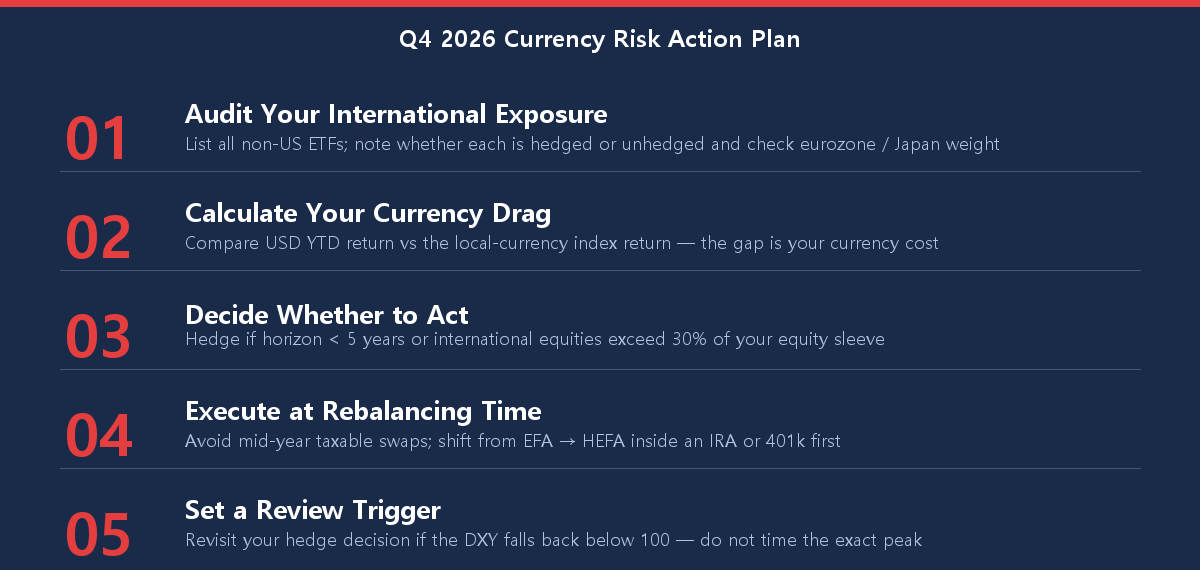
Step 1 — Audit your international exposure. List every ETF in your portfolio that holds non-US stocks. Note whether each is hedged or unhedged, and check its geographic weight (MSCI country breakdown). Focus especially on the eurozone and Japan weights, which have the highest dollar-sensitivity in the current environment.
Step 2 — Calculate your real currency drag. Compare the fund’s YTD return in USD against the YTD return of the underlying local-currency index. The gap is your currency drag. This is available in the fund sponsor’s “returns” tab or on Morningstar’s price vs. NAV analysis page.
Step 3 — Decide whether to act. If your time horizon is under five years, or if international equities represent more than 30% of your equity sleeve, the drag is material enough to warrant a hedging decision. If you are a long-term index investor with a 20-year horizon, the case for staying unhedged remains strong.
Step 4 — If you hedge, do it at rebalancing time. Tax efficiency matters. Switching from EFA to HEFA mid-year in a taxable account triggers a capital gains event. Try to execute the shift inside a tax-advantaged account (IRA, 401k) or wait until your scheduled annual rebalance. See the considerations in How to Rebalance Your Portfolio When Interest Rates Are Rising.
Step 5 — Set a review trigger. Rather than trying to time the dollar’s peak, define a mechanical trigger for reversing your hedge. A useful rule: if the DXY falls back below 100, revisit whether the hedged allocation is still appropriate.
Currency risk is one side of the coin. If you want to understand what a weaker dollar would mean for your portfolio — which is the eventual scenario most economists expect — the companion article How a Weak Dollar Affects Your Investment Portfolio covers that scenario in detail.
Conclusion
The strong US dollar in Q4 2026 is not just a macroeconomic talking point — it is a real, measurable drag on the international ETF returns of millions of investors. Understanding that a 6% currency headwind can cut a 10% local-currency gain in half gives you a cleaner picture of your actual performance, and a more honest basis for deciding whether your global diversification is delivering what you expect from it.
Whether you choose to accept the currency risk for the long run, shift partially to hedged ETFs, or tilt your international allocation toward domestically-oriented companies, the key is to make a deliberate decision rather than discovering the problem in a year-end statement.
Found this useful? Bookmark it so you can revisit when the market moves. Currency dynamics shift over quarters, not weeks — this is worth revisiting at your next scheduled portfolio review.
This article is for informational purposes only and is not investment advice. Do your own research before making any investment decisions.