
US Treasury bonds are widely treated as the world’s safest interest-paying asset, so it is no surprise that investors from Europe, Korea, and across the globe want a piece of them. But a question stops many of them at the door: am I even allowed to buy US Treasury bonds as a foreigner, and if so, how? The short answer is yes — non-US residents can absolutely own Treasuries, just not always through the channel they first assume. This 2026 guide walks through who is eligible, the three realistic ways to buy from abroad, what the current yield curve is telling you, and the tax rule that quietly works in a foreigner’s favor.
Can Foreigners Actually Buy US Treasury Bonds?
Yes. There is no US law barring non-residents from owning Treasury securities, and foreign investors collectively hold trillions of dollars of US government debt. Interest income on bonds issued by the US Treasury is generally exempt from US withholding tax for non-resident aliens, which makes Treasuries unusually friendly to foreign buyers (Source: IRS Publication 515, 2026).
The real catch is the channel. The government’s own platform, TreasuryDirect, requires a US Social Security Number (SSN) or taxpayer ID, a US address, and a linked US bank account. Most foreigners without US ties cannot meet those requirements, so the practical route is a brokerage account rather than buying straight from the government (Source: TreasuryDirect.gov, as of June 2026).
Three Ways to Buy US Treasuries From Abroad
If you live outside the US, you have three realistic paths. Each differs in eligibility, minimum amount, and effort. The table below compares them so you can match one to your situation.
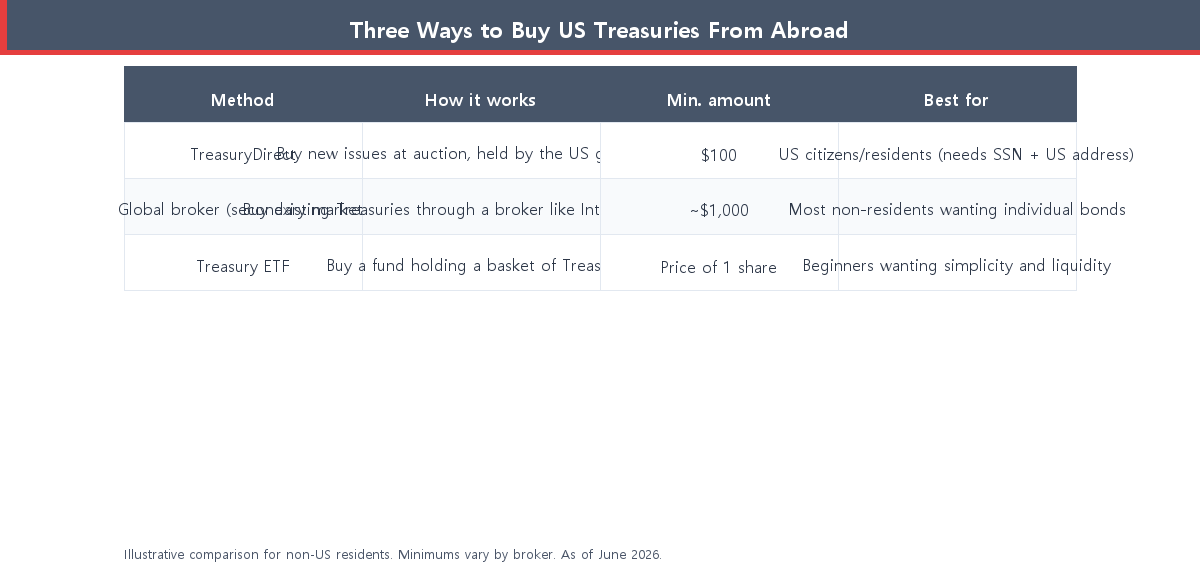
For most non-residents, a global broker that offers secondary-market Treasuries or a Treasury ETF is the path of least resistance. You skip the US-residency hurdle entirely while still owning the same underlying government debt.
TreasuryDirect vs. a Global Broker: Which One Fits You?
TreasuryDirect lets you buy newly issued Treasuries at auction with zero fees and hold them directly with the US government — but only if you qualify with a US SSN and address. It is excellent for US citizens living abroad and green-card holders, and largely closed to everyone else.
A global broker such as Interactive Brokers serves non-residents in most countries and lets you buy existing Treasuries on the secondary market, or buy a Treasury ETF that holds a basket of them. You give up auction pricing and may pay a small commission, but you gain access, liquidity, and the ability to sell before maturity. If you are still deciding how Treasuries fit alongside stocks and cash, our beginner’s guide to asset allocation shows how the pieces fit together.
Reading the 2026 Yield Curve Before You Buy
Before locking in a maturity, it helps to read the yield curve — the line that connects Treasury yields across maturities, from 3-month bills to 30-year bonds. Its shape tells you how the market is pricing future rates. In mid-2026 the curve is close to flat at the short end and rises toward longer maturities, with the 10-year note yielding roughly 4.49% (Source: U.S. Treasury / Federal Reserve H.15, June 4, 2026).
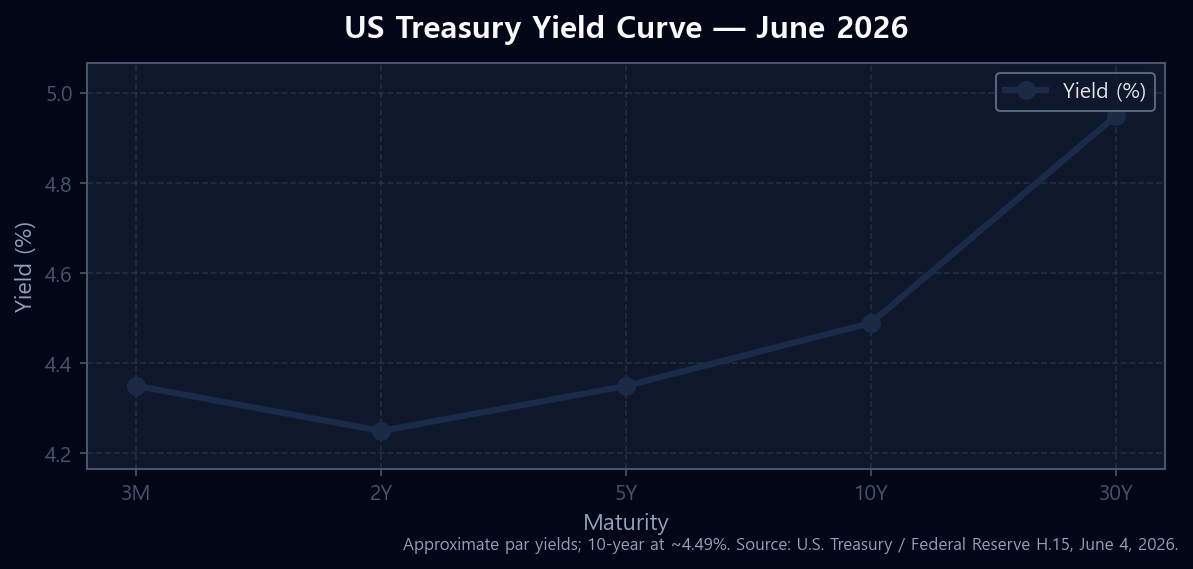
A practical takeaway: short-term T-bills let you capture a competitive yield while keeping your money flexible, whereas longer notes and bonds lock in today’s rate for years — valuable if you expect rates to fall. The video below breaks down how Treasuries work, where to buy them, and their pros and cons.
Taxes for Foreign Investors: The W-8BEN Advantage
This is where Treasuries quietly reward foreign buyers. When you open a US brokerage account as a non-resident, you complete IRS Form W-8BEN, which certifies your foreign tax status and any treaty benefits. With a valid W-8BEN on file, interest from US Treasury securities is generally not subject to US withholding tax (Source: IRS Publication 515, 2026).
- Treasury interest: generally exempt from US withholding for non-residents (still reportable on Form 1042-S).
- W-8BEN validity: valid for the year signed plus the next three calendar years, then must be renewed.
- Your home country: you may still owe tax where you live — check local rules.
The headline point: a foreigner can often receive Treasury interest with no US tax withheld, something many beginner guides skip entirely.
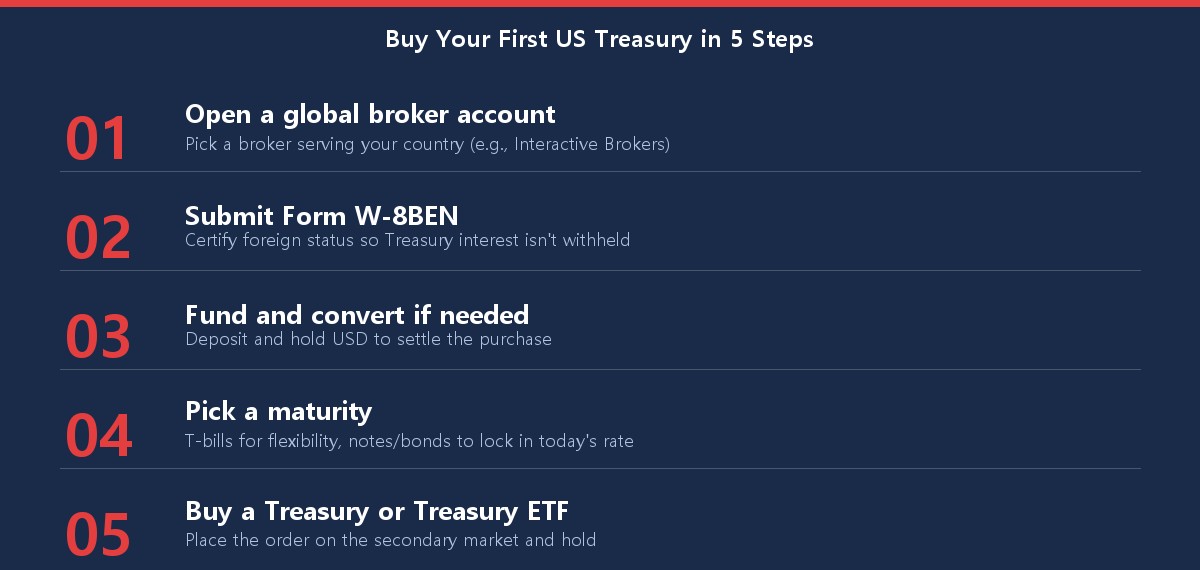
A 5-Step Plan to Buy Your First US Treasury
You do not need to be a bond expert to start. The checklist below turns the process into a sequence you can finish in a week or two.
Three Mistakes Foreign Buyers Make
- Assuming TreasuryDirect is the only way. For most non-residents it is closed; a global broker is the realistic route.
- Ignoring the W-8BEN. Skipping or letting it expire can trigger unnecessary withholding on other income.
- Reaching for the longest maturity by default. A 30-year bond locks in today’s rate for decades — match the maturity to when you need the money.
Conclusion: Safe Yield, Open to the World
Learning how to buy US Treasury bonds as a foreigner comes down to three ideas: you are allowed to own them, a global broker — not TreasuryDirect — is usually the practical door, and a valid W-8BEN often means no US tax is withheld on your interest. Read the yield curve to pick a sensible maturity, start with a small position, and let the world’s benchmark safe asset do its quiet work. If you are just getting started, how to start investing with only $100 is a good companion read.
Found this useful? Bookmark it so you can revisit when the market moves, and share it with anyone abroad wondering whether they can buy US Treasuries.
This article is for informational purposes only and is not investment advice. Do your own research.
1 thought on “How to Buy US Treasury Bonds as a Foreigner (2026 Guide)”