
A common myth keeps beginners on the sidelines for years: the idea that you need thousands of dollars before investing is worth it. You don’t. Thanks to no-minimum brokerages and fractional shares, you can start investing with only $100 today and own a slice of the same companies and funds that large investors hold. This guide walks through exactly where to put that first $100, why the amount matters far less than when you start, and a simple five-step plan to get going.

Yes, $100 Is Enough to Start Investing
For decades, high account minimums and per-trade commissions made small investments impractical — a $7 fee on a $100 purchase meant losing 7% before you owned anything. That world is gone. Major brokerages such as Fidelity, Charles Schwab, and SoFi now charge $0 commissions on stocks and ETFs and require no minimum to open a standard brokerage account (Source: company fee disclosures, as of June 2026).
So the real question is not whether $100 is “enough.” It is whether you can build a consistent habit. A single $100 deposit is a starting point; the goal is to keep adding small amounts over time. That habit, not the opening balance, is what compounds into real money.
Where to Put Your First $100 (4 Beginner Options)
With $100 you have several beginner-friendly choices, each with a different risk and purpose. The table below compares the four most common starting points so you can match one to your goal.
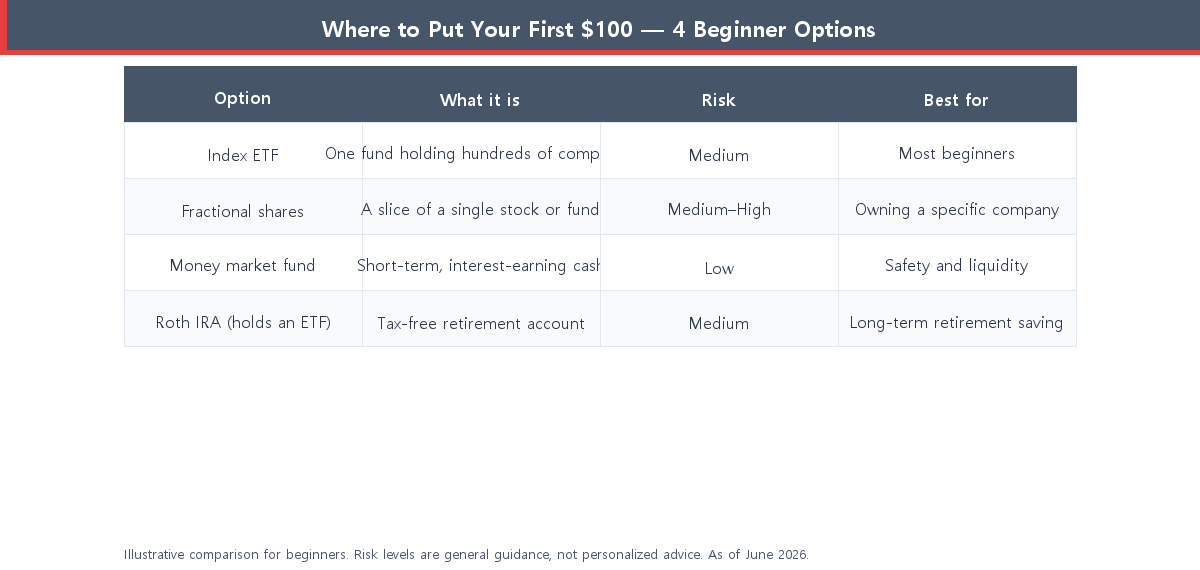
For most beginners, a broad index ETF is the simplest first move: a single purchase spreads your $100 across hundreds of companies, so no single stock can sink you. If you are saving specifically for retirement, holding that same ETF inside a Roth IRA adds tax-free growth on top.
Why Fractional Shares Changed the Game
A decade ago, $100 could not buy even one share of many popular funds or stocks. Fractional shares fixed that. Instead of buying whole shares, you invest a dollar amount and receive a proportional slice. If a total-market ETF trades near $300, your $100 simply buys one-third of a share — and you still earn the same percentage return as someone who bought ten shares.
This is why “I don’t have enough for a full share” is no longer a valid reason to wait. Every dollar gets put to work, which matters most when you are starting small. Once you own your first fund, it is worth learning how to split future contributions across asset types — our beginner’s guide to asset allocation covers exactly that.
The Real Power of $100 Is Time, Not Size
The most important lever in investing is not how much you start with — it is how long your money stays invested. Compounding means your returns begin earning their own returns, and that effect grows dramatically over decades. The chart below shows how investing $100 every month, at a 7% average annual return, can grow over time.
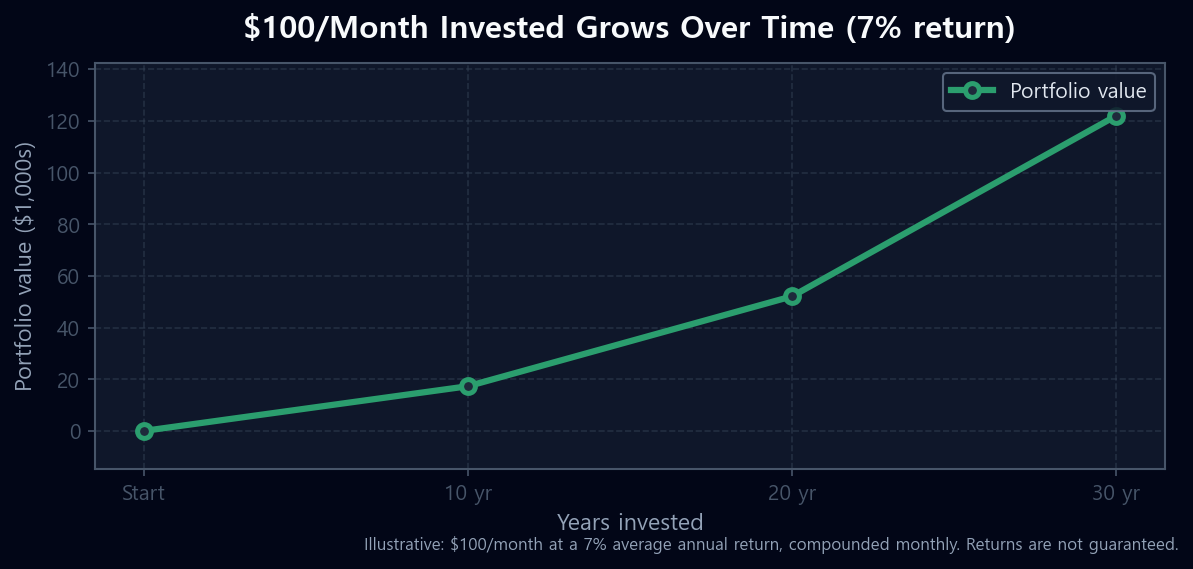
The numbers are striking: $100 a month for 30 years contributes $36,000 of your own cash, yet the balance reaches roughly $122,000 — the rest is growth (illustrative, 7% annual return, not guaranteed). Starting just five years later cuts the final balance by tens of thousands of dollars. The video below breaks down the practical first steps for getting started.
A Simple 5-Step Plan to Invest Your First $100
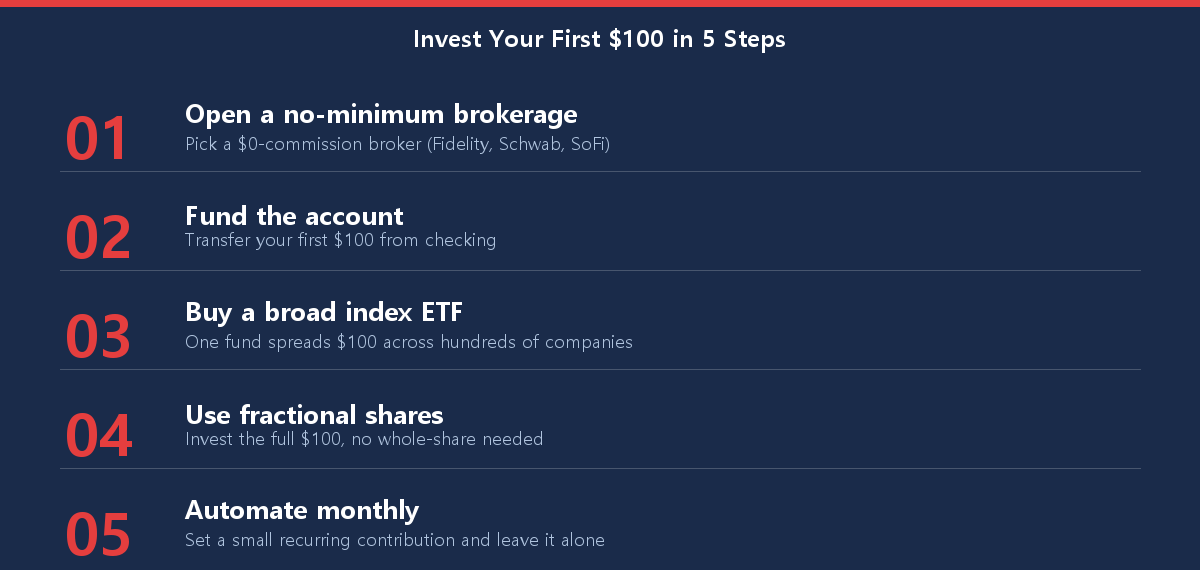
You do not need a complicated system. The checklist below turns “I should start investing” into a sequence you can finish this week.
Avoid These Three Beginner Mistakes
- Chasing hot tips. A single trending stock is the opposite of diversification. Broad index funds remove that single-company risk.
- Waiting for the “perfect” time. Time in the market consistently beats timing the market for long-term investors.
- Stopping at $100. The opening deposit is the spark; automated monthly contributions are the engine.
Conclusion: Start Small, Start Now
Learning how to start investing with only $100 comes down to three ideas: the barrier to entry has essentially disappeared, fractional shares let every dollar work, and time matters far more than the size of your first deposit. Open a no-minimum account, buy a low-cost broad index fund, and set up a small automatic contribution you barely notice. The investors who end up ahead are rarely the ones who started with the most — they are the ones who started early and kept going.
Found this guide useful? Bookmark it, make your first $100 contribution, and check back as we add more practical, beginner-friendly investing breakdowns.
This article is for informational purposes only and is not investment advice. Do your own research.
1 thought on “How to Start Investing With Only $100 (2026 Guide)”