
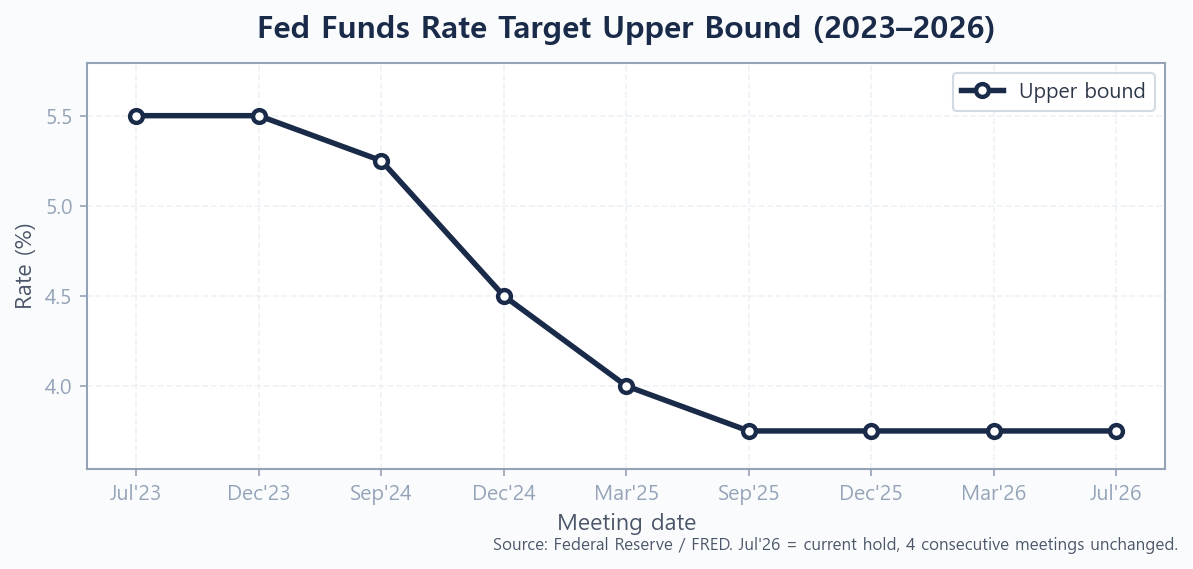
The Federal Reserve meets July 28–29, 2026, and all eyes are on what Chair Kevin Warsh says — not what the committee votes. With the fed funds rate parked at 3.50%–3.75% for four consecutive meetings, the July 29 decision itself is almost a foregone conclusion. What isn’t settled is the tone of the hold: hawkish enough to put a September hike firmly on the table, or dovish enough to give markets breathing room? That distinction is where your portfolio positioning comes in.
What to Expect at the July 29 FOMC Meeting
Rates on Hold: The Near-Certain Base Case
A Reuters survey of 104 economists produced unanimous agreement: the FOMC will hold rates in the 3.50%–3.75% range on July 29. Futures markets are similarly lopsided, pricing roughly 75% odds of a hold and just 25% odds of a 25-basis-point hike (Source: CME FedWatch, as of July 27, 2026). The Fed has held rates steady across four straight meetings — a pattern that itself communicates patience.
The base case is a 10–2 vote. Governors Hammack and Logan are the likely dissenters, pushing for an immediate hike. Their two votes won’t change the outcome, but they will confirm that the committee is not unanimous — a signal markets will read as the Fed leaning hawkish beneath the surface.
The Hawkish Hold — What It Is and Why It Matters
A “hawkish hold” is when the Fed leaves rates unchanged but keeps the door open to a hike at the next meeting. The policy statement will signal this through carefully chosen phrases. Watch for language that says inflation is making “progress” but has not yet reached the committee’s target — that phrasing keeps September optionality alive without committing to it.
For context on how the rate debate evolved over the past several months, see our breakdown of Will the Fed Hike Rates in 2026? Higher for Longer — which traced the June dot plot shift toward higher-for-longer.
Why the Press Conference Carries More Weight Than the Vote
July is not a Summary of Economic Projections (SEP) meeting. That means no dot plot, no updated growth or inflation forecasts, and no new median rate projection. All of the repricing happens through the statement wording and Warsh’s 2:30 PM ET press conference. Reporters will press on two questions: Is September a live meeting for a hike? And what data would change the calculus? Warsh’s answers — not the 10–2 vote — determine how the bond market and equity futures respond into the close.
What Markets Are Pricing — And What September Tells Us
How Futures Are Reading July 29
Futures markets have moved more than the headline July probability suggests. While a July hold is priced near 75%, traders have pushed September hike odds to roughly 75% as well (Source: CME FedWatch, as of late July 2026). That means the dominant market view is: hold now, hike in September. That interpretation is already embedded in current Treasury yields — the 10-year sits near 4.5% (Source: U.S. Treasury, July 2026), reflecting a market that believes the Fed stays tighter for longer even as it holds this month.
The September Signal: Reading the Real Rate Path
The July meeting is best understood as a prologue to September, not a chapter in its own right. If Warsh explicitly says September is a “live” meeting with no pre-commitment, bond yields at the 2-year end will nudge higher, and equity markets will face a brief sell-off before stabilizing. If he sounds more neutral — emphasizing that data dependency cuts both ways — risk assets get relief. Either way, the dot plot from June already told us the committee is split. July’s press conference is the update to that picture.
For a broader view of how Fed decisions ripple into equity prices, How Fed Rate Decisions Affect the Stock Market explains the four channels — discount rate, economic growth, credit conditions, and the dollar.
Asset Class Playbook for a Hawkish Hold
Bonds: Front-End Strength, Curve Steepening Continues
In a hawkish hold, the front end of the Treasury curve — maturities under two years — remains anchored near the fed funds rate. Short-term T-bills and 1–2 year notes continue to offer yields attractive enough to compete with savings accounts, without the duration risk of longer bonds. The more dangerous zone is the 10-to-30 year end. As we covered in Treasury Yield Curve Steepening in 2026, the bear steepener trend is pushing long-end yields higher, driven by term premium and fiscal supply. Holding long duration into this meeting introduces asymmetric downside if the statement or press conference comes out hawkish. A trim in long-duration exposure is a low-regret trade. See also: 10-Year Treasury Yield Outlook 2026 for the fuller picture on where the 10-year may head by year-end.
Equities: Rotation Into Defensives
Growth and technology stocks face two headwinds in a hawkish hold: rates stay elevated (compressing high-multiple valuations) and the September hike risk adds uncertainty to discount rates. Defensive sectors — consumer staples, healthcare, and utilities — have tended to show relative strength in periods where the Fed signals higher-for-longer. They are not immune to a broad sell-off, but they carry less rate sensitivity and offer dividend income that competes more favorably with bonds when yields are stable rather than rising. Value-tilted strategies also tend to hold up better; the growth-over-value rotation that dominated 2020–2021 reverses in a tight-rate environment.
Cash and Money Markets: The Silent Winner
With rates on hold at 3.50%–3.75%, money market funds and short-term T-bills continue to offer yields above 4% annualized. In an environment where the Fed may still hike in September, keeping a cash buffer earns a competitive return while preserving optionality — you can deploy it if post-meeting volatility creates an attractive entry point. This is not a trade; it is a structural advantage of the current rate environment.
Two Scenarios and Your Portfolio’s Response
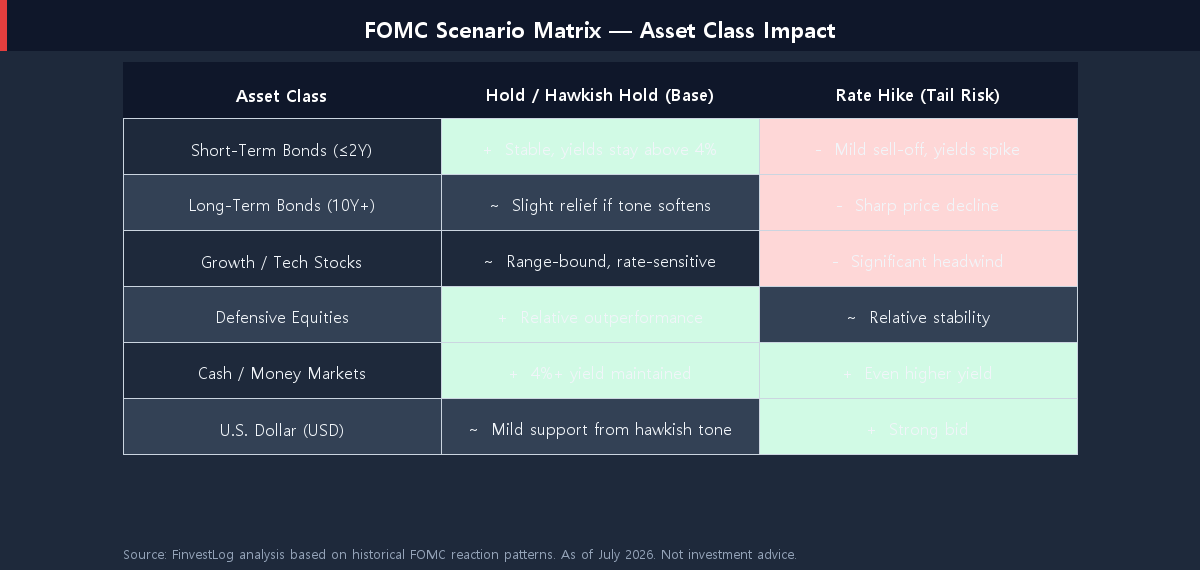
The table above maps the two most likely outcomes from July 29 onto each major asset class. The hold scenario (base case) rewards short-duration bond holders and defensive equity positioning. The tail-risk hike scenario — if Warsh surprised with a 25-basis-point move — would hit long-duration bonds hardest, weigh on growth equities, and give a strong bid to the dollar. Note that in both scenarios, cash-equivalent instruments (T-bills, money markets) remain attractive, which is why dry powder is one of the better positions to hold going into a high-uncertainty meeting.
Three Moves to Make Before July 29
Move 1 — Shorten Duration at the Margin
If you hold long-duration bond ETFs (TLT, EDV) or individual 10–30 year Treasuries, consider trimming exposure before July 29. Rotate proceeds into the 1–2 year part of the curve, where you collect a comparable yield without the price volatility that comes if the press conference reads hawkish. This is not a wholesale exit from fixed income — it is a duration adjustment. See our guide on How to Rebalance Your Portfolio When Interest Rates Are Rising for a step-by-step framework.
Move 2 — Tilt Toward Defensive and Income Equities
A modest reweight from high-growth, high-multiple positions toward dividend-paying defensives — consumer staples, healthcare, utilities — reduces rate sensitivity without exiting equities altogether. These sectors tend to be less volatile around Fed meetings and provide income that partially offsets the opportunity cost of not being in cash.
Move 3 — Keep Dry Powder; Don’t Chase Pre-Meeting
The most common mistake around FOMC meetings is making large bets on the outcome in the days before the decision. The market has already priced a hawkish hold. If that is exactly what happens, there may be little additional move. The real opportunity — if one materializes — will come in the hours after the 2:30 PM ET press conference, when markets digest the nuance of Warsh’s words. Having cash available to buy into that reaction is worth more than pre-positioning at elevated prices.
Looking Ahead — What July Tells Us About the Rest of 2026
The July 2026 FOMC meeting is a checkpoint, not a turning point. The two key variables to watch between now and September are: (1) core PCE inflation data — if it ticks below 2.5%, the case for a September hike weakens; and (2) the jobs report — if payroll growth slows to below 100,000 per month, the Fed will feel less pressure to tighten. Conversely, a hot inflation print or strong labor data will make September a near-certainty for a move. Use the July press conference to calibrate which direction the data dependency is leaning, then update your positioning accordingly.
Found this breakdown useful? Bookmark this page — FOMC meeting coverage updates as new data lands. For related analysis, Will the Fed Hike Rates in 2026? Higher for Longer lays out the full scenario framework, and How the Fed Moves Markets explains the mechanisms behind each market reaction.
This article is for informational purposes only and is not investment advice. Do your own research before making any investment decision.