
For years, dividend stocks played second fiddle to Big Tech. Growth stocks dominated returns, and dividend investing felt almost like a relic of another era. Then 2026 arrived — and flipped the script. As of late July 2026, the Schwab U.S. Dividend Equity ETF (SCHD) has delivered a total return of roughly +19.1% with dividends reinvested, compared with approximately +9.0% for the S&P 500 (Source: 24/7 Wall St., July 2026). Dividend stocks are finally beating the S&P 500 — and the reasons go deeper than a single quarter’s rotation.
This guide unpacks the macro forces behind the shift, the performance data that matters, and the four dividend ETFs best positioned to capitalize right now.

The Market Shift That Changed Everything in 2026
Rotation Out of Mega-Cap Tech
After several years in which Apple, Nvidia, Microsoft, and Meta drove the vast majority of S&P 500 gains, investors in 2026 began questioning whether those valuations were sustainable. The Vanguard S&P 500 ETF (VOO) trades at a forward price-to-earnings ratio of approximately 23x, while the Vanguard High Dividend Yield ETF (VYM) trades at just 16x — a seven-point P/E gap that has become impossible to ignore (Source: Vanguard, July 2026).
That valuation differential pushed institutional capital toward energy, industrials, financials, and consumer staples — the sectors where quality dividend payers cluster. For a deeper look at how rate policy shapes this rotation, see our earlier analysis of how rising Fed rates affect dividend stocks. The 2026 data is now confirming what many dividend investors had long argued: high-quality payers can lead the market when the macro winds finally shift their way.
The Rate Plateau Advantage
When the Federal Reserve was actively hiking rates in 2022–2023, dividend stocks suffered. Rising bond yields gave investors a risk-free alternative, and the discount rate applied to dividend income rose alongside them. But with rates now plateaued in the 4.25%–4.50% range — and cuts expected sometime in late 2026 or early 2027 — the calculus has changed.
In a plateau-rate environment, dividend stocks offer something bonds cannot: yield plus capital appreciation potential. Bonds are capped at their coupon; a quality dividend ETF can deliver income growth and price gains simultaneously. VYM holds roughly 9% in energy and 15% in industrials, two sectors that outperformed significantly in the first half of 2026 (Source: Vanguard, June 2026).
By the Numbers: How Big Is the Outperformance?
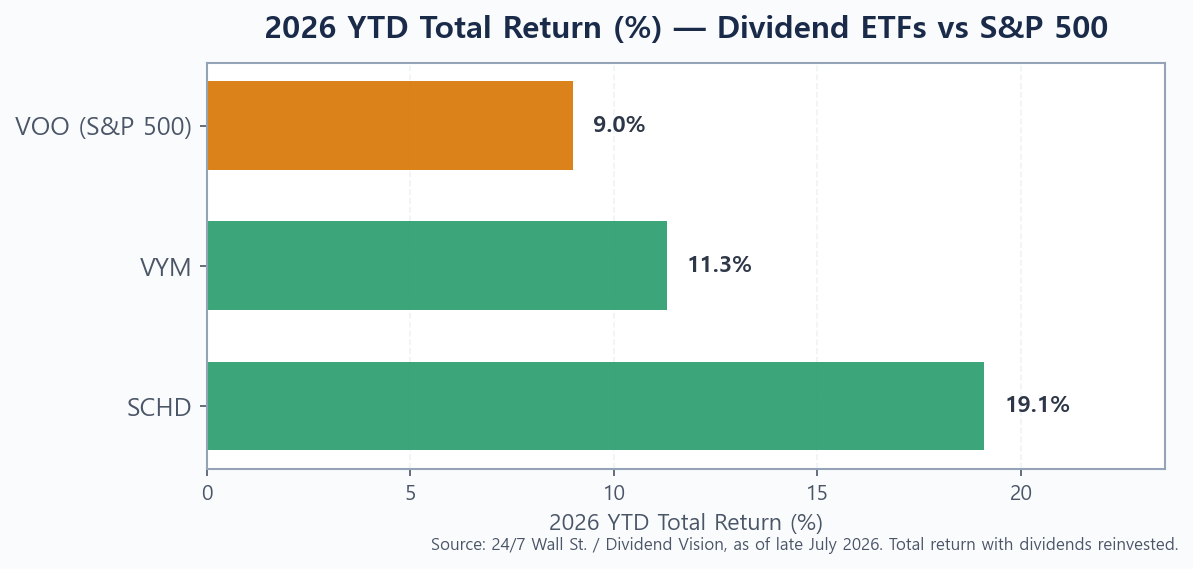
The numbers are stark. Through late July 2026 on a total-return basis (dividends reinvested):
- SCHD: +19.1% YTD (Source: 24/7 Wall St., July 2026)
- VYM: +11.3% YTD (Source: Dividend Vision, July 2026)
- S&P 500 (VOO): ~+9.0% YTD (multiple sources, July 2026)
SCHD’s outperformance is roughly double the S&P 500’s return. VYM’s edge is narrower but still meaningful at more than two percentage points ahead of the index. What makes this data particularly striking is that it comes during a year when AI and technology narratives remain front-page news. Even with Nvidia and the semiconductor sector generating headlines, dividend stocks are leading.
There’s a structural reason for the low starting bar. Both SCHD and VYM underperformed the S&P 500 over the previous five-year stretch — which means they entered 2026 with compressed valuations relative to the index. That setup, combined with the sector rotation, created the conditions for the outperformance we’re seeing now.
For a broader look at which high-yield options have performed best this cycle, see our roundup of the best high-yield dividend ETFs for 2026.
The Top Dividend ETFs to Own in 2026
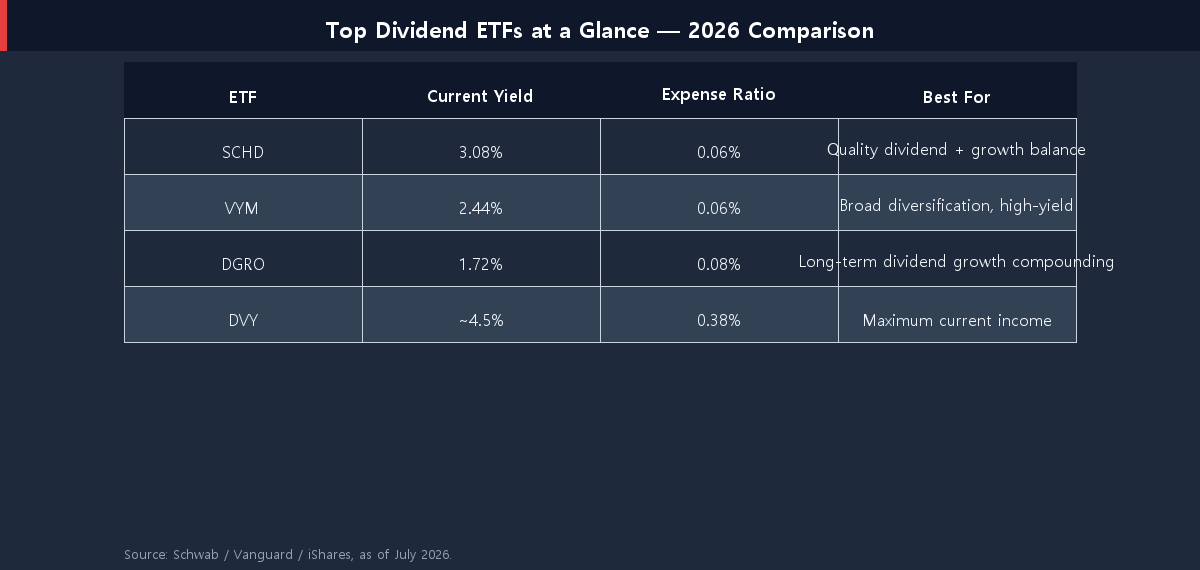
Below is a breakdown of four dividend ETFs that cover the full spectrum — from yield-plus-growth to maximum current income. The right choice depends on your income needs and time horizon.
SCHD — Quality and Growth in One Package
The Schwab U.S. Dividend Equity ETF is the clear standout in 2026. SCHD screens for dividend consistency, financial strength, and dividend growth — then charges a remarkably low 0.06% expense ratio. It currently yields 3.08% with a five-year dividend growth rate of 10.6% (Source: Schwab, July 2026). That combination of above-average current income and rapidly growing payouts is difficult to match.
SCHD’s 2026 outperformance is driven by its overweight to energy, financial services, and consumer staples — sectors that rotated back into favor as AI valuations stretched. For investors looking for a single dividend ETF to anchor a portfolio, SCHD is the most compelling all-around choice. Read our SCHD vs VIG deep dive for a head-to-head comparison with the other leading dividend growth fund.
VYM — Broad High-Yield Exposure
Vanguard’s High Dividend Yield ETF takes a simpler, broader approach: own a wide slice of stocks paying above-average dividends. With over 550 holdings and a 0.06% expense ratio, VYM is extremely diversified and ultra-low cost. Its current yield is 2.44% — slightly lower than SCHD but more than adequate for income-oriented investors (Source: Vanguard, July 2026).
VYM’s heavy sector tilts toward energy and industrials delivered a +11.3% YTD total return, and it trades at a forward P/E of just 16x — a substantial discount to the broader market. For investors who want maximum diversification within the dividend universe, VYM is a natural fit. For a side-by-side comparison with more yield-focused options, see our SPYD vs VYM vs SCHD comparison.
DGRO — Dividend Growth Over Current Yield
The iShares Core Dividend Growth ETF accepts a lower starting yield — currently 1.72% — in exchange for faster dividend compounding over time. DGRO’s five-year dividend growth rate is 9.2%, and its ten-year annualized total return is 13.16% — the strongest long-term record among the funds reviewed here (Source: iShares / PortfoliosLab, July 2026). The expense ratio is 0.08%, nearly as low as SCHD and VYM.
DGRO holds approximately 450 stocks and carries a higher tilt toward technology dividend payers — Apple, Microsoft — than the other ETFs on this list. That makes it a compelling choice for younger investors with a long runway who prioritize compounding dividend growth over maximizing immediate income. If you’re already reinvesting dividends automatically, the lower starting yield matters less than the growth trajectory.
DVY — Maximum Current Income
For investors who need income today, the iShares Select Dividend ETF targets the highest-yielding U.S. dividend stocks and currently delivers a yield of approximately 4.5% — nearly 1.5 percentage points more than SCHD (Source: iShares, July 2026). The trade-offs are a higher expense ratio of 0.38% and greater concentration risk, with heavy exposure to utilities and real estate investment trusts.
DVY makes the most sense as part of a broader portfolio — paired with a lower-yield, growth-oriented fund like DGRO — for retirees or near-retirees who need steady cash flow. As a standalone holding, the higher fee and sector concentration are meaningful drawbacks for most long-term investors.
Risks That Could Reverse the Trend
The dividend stock outperformance story is data-backed, but no market trend lasts indefinitely. Here are the scenarios that could shift momentum back toward growth stocks:
- AI earnings re-acceleration: If Nvidia, Microsoft, or Alphabet deliver another blowout earnings cycle, capital could rotate back into mega-cap tech, leaving dividend ETFs behind.
- Earlier-than-expected Fed rate cuts: Aggressive cuts could re-energize growth stocks by compressing the discount rate applied to future earnings — narrowing the valuation advantage dividend stocks currently hold.
- Energy sector reversal: SCHD and VYM both carry significant energy exposure. A sharp oil price decline could hurt these ETFs disproportionately versus the broader index.
- Dividend cuts in key holdings: If high-yield payers within DVY or VYM reduce their dividends due to earnings pressure, the income thesis weakens quickly and price declines often follow.
These risks underscore why dividend ETFs work best as part of a diversified portfolio rather than as all-in bets. If you’re thinking about extending your dividend exposure internationally, our guide to the best international dividend ETFs for 2026 covers high-quality funds beyond the U.S. market.
Final Verdict: Should You Add Dividend ETFs Now?
The 2026 outperformance of dividend stocks is not an anomaly. It is the product of a real valuation reset, a rate environment that no longer punishes income-oriented equities, and a market finally rewarding quality and consistency over hype. Dividend stocks beating the S&P 500 this year reflects a structural shift — not just a short-term trade.
SCHD is the standout and the most balanced choice for most investors. VYM provides breadth, DGRO provides long-term compounding power, and DVY provides maximum current income. The right combination depends on where you are in your investing journey.
If you already own dividend ETFs, 2026 is validation that the strategy works — and that patience matters. If you don’t own any yet, starting by setting up a dividend reinvestment plan (DRIP) can help you compound returns automatically without the temptation to time the market.
Found this breakdown useful? Bookmark it for the next time market narratives shift again — I cover practical investing analysis like this regularly at FinvestLog.
This article is for informational purposes only and is not investment advice. Do your own research before making any investment decisions.