
If you are building a portfolio around rising dividends, two funds almost always make the shortlist: the Schwab U.S. Dividend Equity ETF (SCHD) and the Vanguard Dividend Appreciation ETF (VIG). They share the “dividend” label, both demand a long track record of payouts from their holdings, and both charge next to nothing. Yet they are built on very different ideas about what a good dividend stock looks like. This SCHD vs VIG comparison breaks down how each fund picks its holdings, how their yields and fees stack up for 2026, and how to decide which dividend growth ETF fits your goals.
SCHD vs VIG: Two Different Takes on “Dividends”
The fastest way to misjudge these funds is to treat them as interchangeable. They both screen for companies with a real dividend history, but they pull in opposite directions on yield. One reaches for income today; the other reaches for the most reliable dividend growers and accepts a lower starting yield to get them.
SCHD — Higher Yield, Quality Screen
SCHD tracks the Dow Jones U.S. Dividend 100 Index. It starts with companies that have paid dividends for at least 10 straight years, then ranks them on a blend of dividend yield, cash-flow-to-debt, return on equity, and dividend growth. The result is a concentrated portfolio of roughly 100 quality, cash-generating businesses, tilted toward financials, energy, healthcare, and consumer staples. Because the screen rewards yield, SCHD pays meaningfully more income today — a trailing yield near 3.3% as of mid-2026.
VIG — Pure Dividend Growth, Lower Yield
VIG tracks the S&P U.S. Dividend Growers Index, which requires at least 10 consecutive years of dividend increases — and then deliberately excludes the highest-yielding 25% of eligible stocks. That single exclusion rule changes everything. By design, VIG avoids stocks that pay a lot now but may be stretched, and instead holds around 330 high-quality compounders such as Microsoft, Apple, Broadcom, and Visa. The trade-off is a much lower starting yield, near 1.7%, in exchange for a portfolio that looks and behaves a lot like a broad quality-growth fund.
Head-to-Head: Yield, Fees, and Holdings
Put the two funds side by side and the philosophy gap turns into hard numbers. SCHD offers roughly double the income; VIG holds three times as many stocks and edges SCHD on fees. The table below summarizes the figures that matter most when choosing between them.
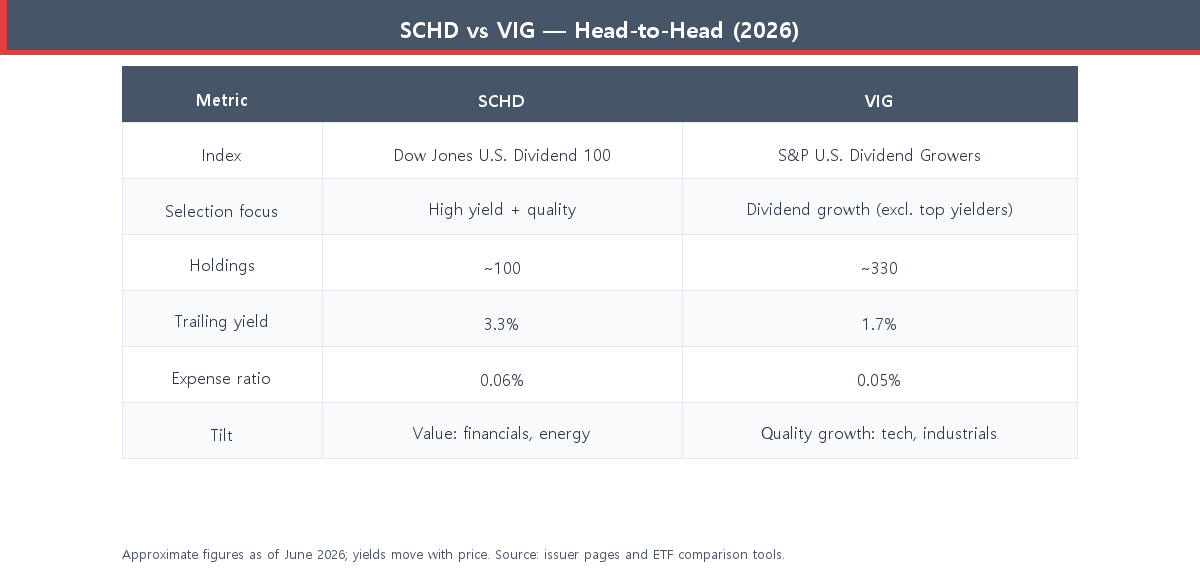
Neither fund is expensive — both rank among the cheapest dividend ETFs available, and the fee gap between them is small enough that it should not be the deciding factor. If you want a deeper look at how even tiny fees compound over decades, see our guide to what an ETF expense ratio really costs you.
Income Today: Comparing the Yields
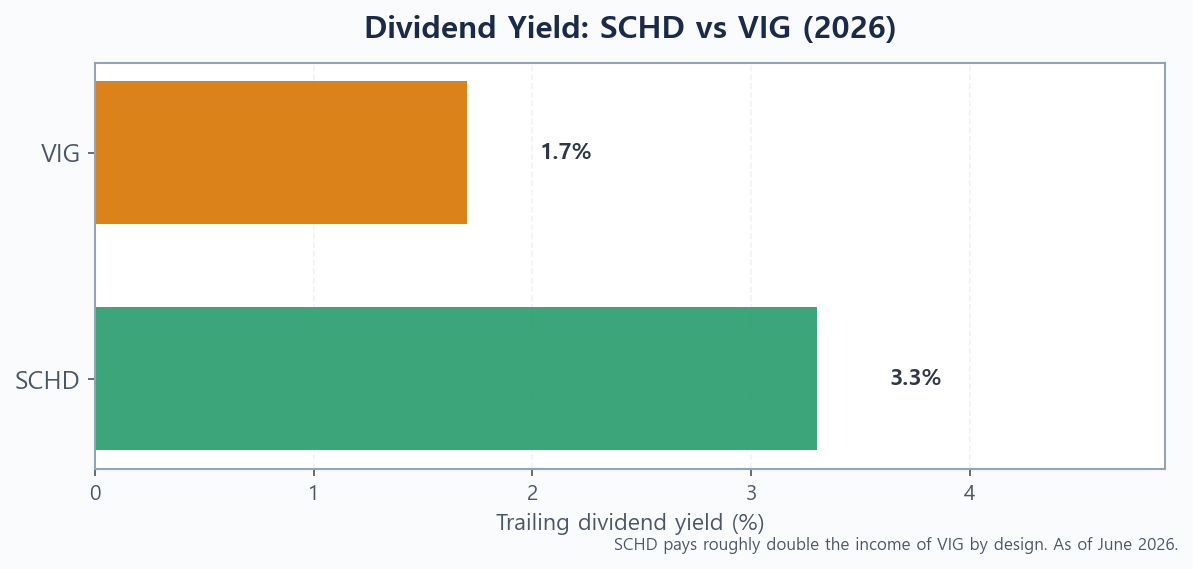
Yield is the single clearest difference between these funds, and for an income-focused investor it can be decisive. SCHD’s trailing yield of roughly 3.3% is close to double VIG’s 1.7%. On a $50,000 position, that is about $1,650 a year from SCHD versus roughly $850 from VIG — a real gap if you are spending the income now.
But a higher yield is not automatically the better deal. VIG’s lower payout reflects its growth tilt: it leans on companies reinvesting heavily and raising dividends from a smaller base, which can compound faster over time. The video below walks through how SCHD and VIG (alongside VYM) differ in practice and who each one suits.
Performance and Risk: Growth vs. Drawdowns
Over the trailing twelve months into mid-2026, SCHD’s value tilt paid off, with a total return ahead of VIG’s. Stretch the window to 10 years, however, and VIG’s quality-growth holdings have compounded slightly faster — roughly 13% a year versus about 12.5% for SCHD. The order flips depending on the period, which is the honest answer to “which performs better”: it depends on whether value or growth is in favor.
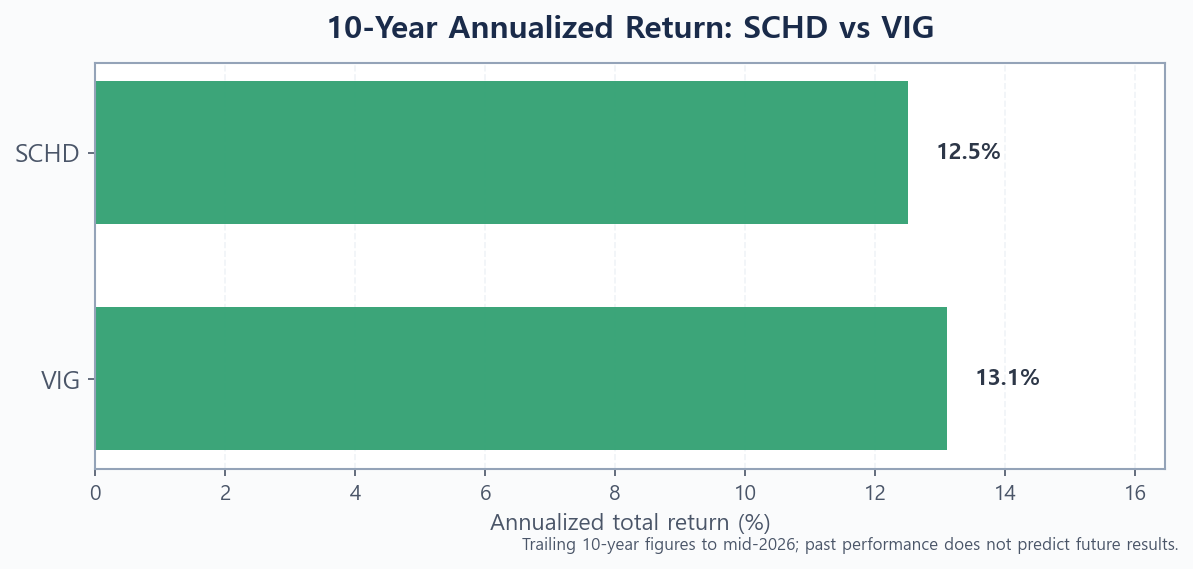
Risk profiles differ too. SCHD’s quality, cash-flow screen has historically cushioned it in selloffs, while VIG’s broader, more growth-leaning portfolio can swing harder when high-flying names correct. Both, though, are diversified, blue-chip funds — neither is a speculative bet, and either can anchor a long-term portfolio. To see where a dividend ETF sits next to bonds and broad index funds, read our beginner’s guide to asset allocation.
Which Should You Buy for 2026?
There is no universal winner here — only a better fit for your situation. Match the fund to the job you need it to do.
Choose SCHD If…
You want more income now, lean toward value, or are closer to (or in) retirement and plan to spend the dividends. SCHD’s ~3.3% yield and quality-value tilt make it the natural pick when current cash flow and downside resilience matter most. It is also a common choice for investors who want one core dividend holding to do most of the work.
Choose VIG If…
You are still in the accumulation phase, do not need the income yet, and want the smoother dividend-growth profile of high-quality compounders. VIG’s exclusion of the highest yielders means you sidestep some yield traps, and its lower payout is more tax-efficient in a taxable account because you are taxed on less income each year.
Why Not Both?
Because their holdings overlap only modestly — SCHD’s financials and energy versus VIG’s tech and industrials — pairing them is a legitimate strategy. Holding both gives you SCHD’s income and VIG’s growth in one diversified dividend sleeve. If you are just getting started and want to test the waters before committing, our guide on how to start investing with only $100 shows how to begin with a single share. For a wider menu of income funds, compare the best high-yield dividend ETFs for 2026.
Final Thoughts
In the SCHD vs VIG matchup, the “better” dividend growth ETF comes down to what you want from your dividends in 2026. SCHD delivers higher income and a value-quality tilt; VIG delivers a lower yield but a portfolio of elite dividend growers that has compounded a touch faster over the past decade. Both are cheap, diversified, and built for the long haul — and for many investors, owning both is the simplest way to avoid choosing. Whatever you pick, base the decision on your time horizon and income needs, not last year’s return.
This article is for informational purposes only and is not investment advice. Yields and returns are approximate as of June 2026 and will change with markets. Do your own research before investing.