
If you want a steady stream of dividends from a single fund, three names dominate every shortlist: the SPDR Portfolio S&P 500 High Dividend ETF (SPYD), the Vanguard High Dividend Yield ETF (VYM), and the Schwab U.S. Dividend Equity ETF (SCHD). All three carry the “high dividend” label and all three are dirt cheap to own. But they are built on three very different ideas about how to chase income — and that gap shows up clearly in their yields, their holdings, and their long-run returns. This SPYD vs VYM vs SCHD comparison breaks down how each high-dividend ETF works and which one fits your goals in 2026.
SPYD vs VYM vs SCHD: Three Very Different Strategies
The biggest mistake income investors make is treating these funds as interchangeable yield machines. They are not. Each one answers the question “what makes a good dividend stock?” in its own way, and that single design choice drives everything else.
SPYD — Maximum Yield, Equal Weight
SPYD takes the simplest, bluntest approach. It tracks the S&P 500 High Dividend Index, which just grabs the roughly 80 highest-yielding stocks in the S&P 500 and weights them almost equally. There is no quality filter and no growth screen — only yield. That is why SPYD pays the most income of the three, with a trailing yield near 4.3% as of mid-2026. The trade-off is that chasing pure yield pulls the fund heavily into real estate, utilities, and consumer staples, and can scoop up stretched payers whose dividends are at risk.
VYM — Broad, Balanced, Cheap
VYM tracks the FTSE High Dividend Yield Index, which covers every U.S. stock paying an above-average dividend and weights them by market value. The result is a huge, diversified basket of more than 550 companies spanning financials, technology, and health care. Because it is so broad and cap-weighted, VYM behaves a lot like a slightly value-tilted total market fund. Its starting yield is the lowest of the three, around 2.8%, but that buys you stronger diversification and a smoother ride.
SCHD — Yield Plus a Quality Screen
SCHD sits in the middle and is arguably the most thoughtfully built. It tracks the Dow Jones U.S. Dividend 100 Index, which first requires 10 straight years of dividends, then ranks survivors on cash-flow-to-debt, return on equity, dividend yield, and dividend growth. The outcome is a focused portfolio of roughly 100 quality, cash-generating businesses yielding about 3.3%. SCHD’s quality screen is the same idea behind our SCHD vs VIG dividend growth comparison — it tries to avoid yield traps rather than reach for the highest payout.
Head-to-Head: Yield, Fees, and Holdings
Put the three funds side by side and the philosophy gaps turn into hard numbers. SPYD wins on raw yield, VYM wins on diversification, and SCHD wins on the balance of income and quality. The table below summarizes the figures that matter most when choosing between them.
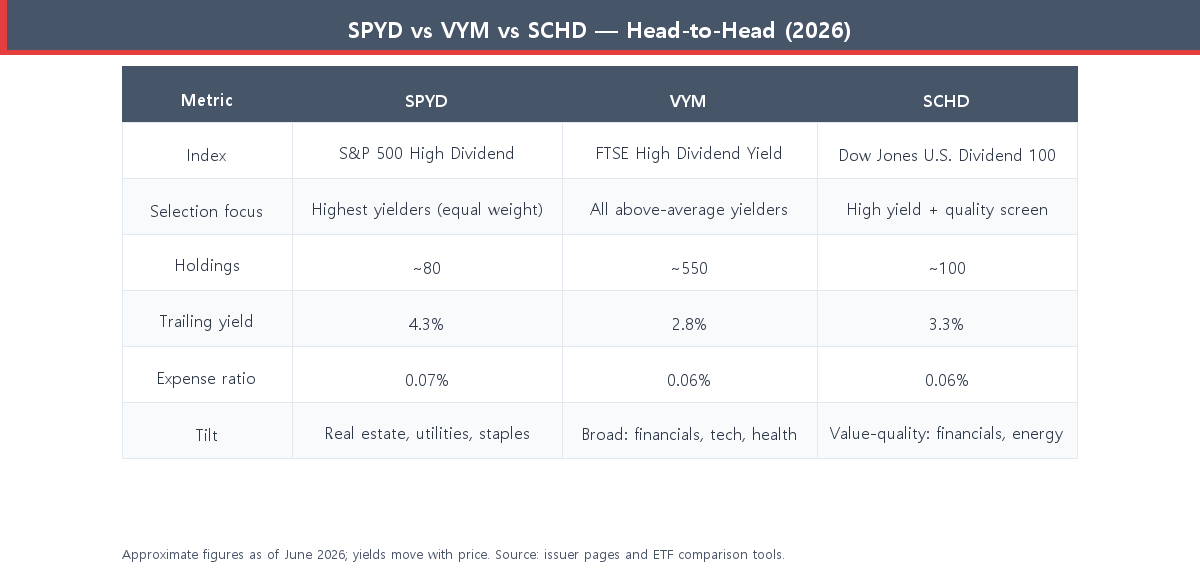
None of these is expensive — all three rank among the cheapest dividend ETFs available, and the fee gap is tiny. SPYD’s 0.07% edges out VYM and SCHD’s 0.06%, a difference of about $1 a year on a $10,000 position. If you want to see why even small fees compound over decades, read our guide to what an ETF expense ratio really costs you.
Income Today: Comparing the Yields
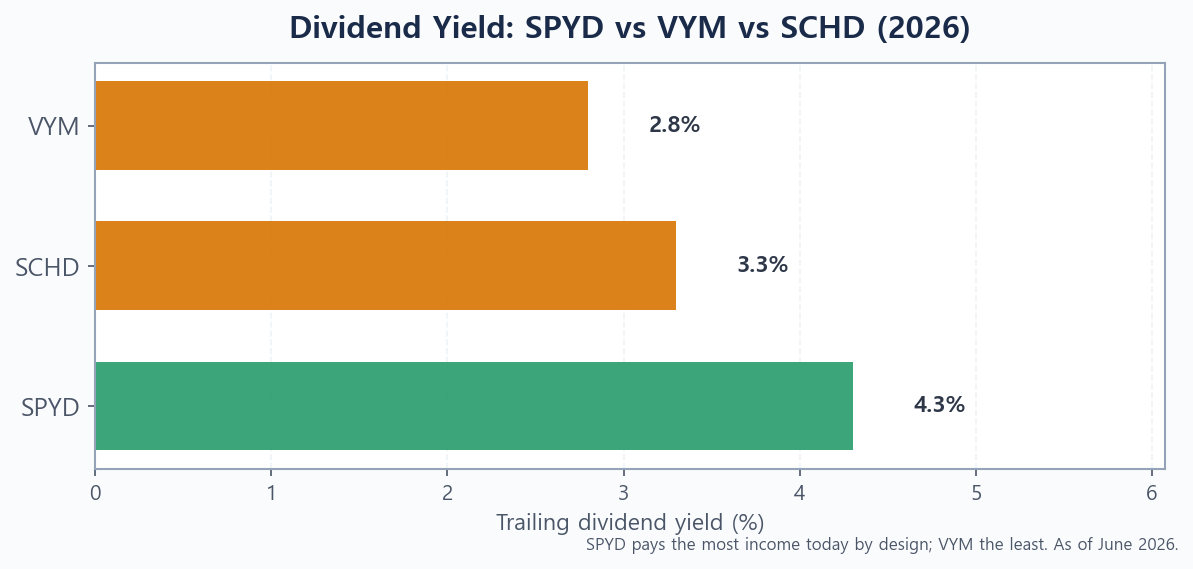
Yield is the clearest difference between these funds, and for an income-focused investor it can be decisive. SPYD’s trailing yield of roughly 4.3% towers over VYM’s 2.8%, with SCHD in between near 3.3%. On a $50,000 position, that is about $2,150 a year from SPYD versus roughly $1,650 from SCHD and $1,400 from VYM — a meaningful gap if you are spending the income now.
But a higher yield is not automatically the better deal. SPYD’s headline payout comes from concentrating in rate-sensitive, slower-growing sectors, so the income can be lumpier and the price more volatile. The video below walks through how SPYD, VYM, and SCHD differ in practice and who each one suits.
Total Return: Where SPYD Falls Behind
Income is only half the story — what matters over a decade is total return, which combines dividends with price growth. Here the order flips. Over the trailing 10 years to mid-2026, SCHD compounded at roughly 12.8% a year and VYM at about 10.8%, while SPYD trailed badly at around 9.1%. Reaching for the highest yield, it turns out, has historically cost SPYD investors in total wealth.
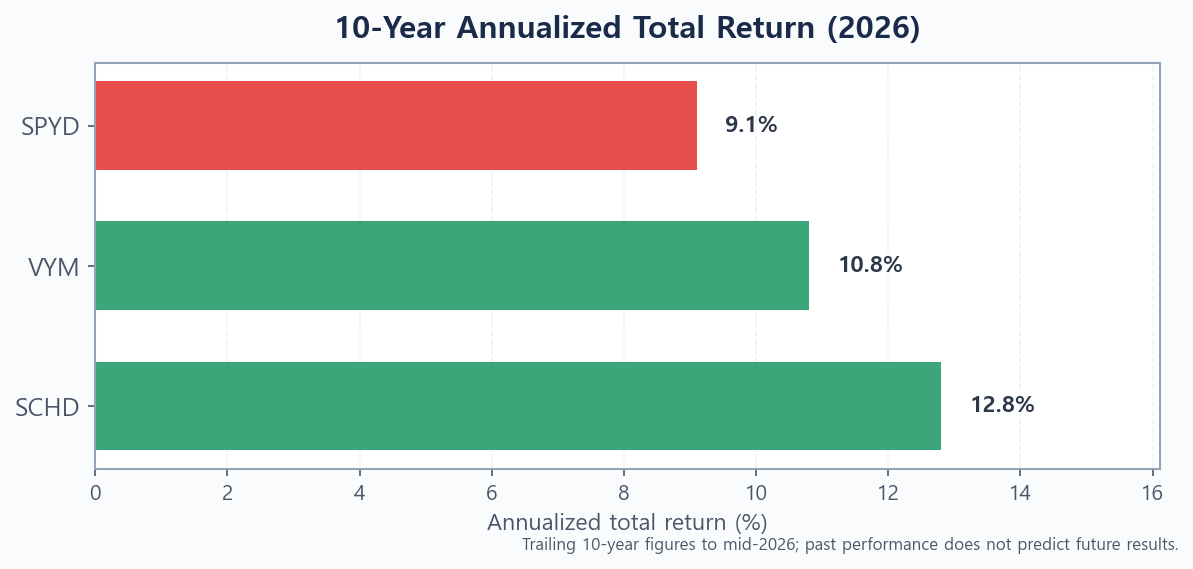
The reason is simple: SPYD’s pure-yield screen loads up on stocks with little dividend growth and weak price appreciation, while SCHD’s quality filter and VYM’s broad market exposure capture more of the market’s long-run gains. None of these is a speculative bet — all three are diversified, blue-chip funds — but if you are still accumulating, total return usually matters more than the headline yield. To see where a dividend ETF fits next to bonds and broad index funds, read our beginner’s guide to asset allocation.
Which High-Dividend ETF Wins in 2026?
There is no universal winner here — only a better fit for the job you need the fund to do. Match the ETF to your situation.
Choose SPYD If…
You want the maximum income today and plan to spend the dividends — typically because you are in or near retirement. SPYD’s ~4.3% yield is the highest of the three, and its equal-weight, value-heavy tilt can shine when beaten-down sectors recover. Just go in knowing you are trading long-run total return for current cash flow.
Choose VYM If…
You want the broadest, most diversified high-dividend exposure with the least single-stock risk. VYM’s 550-plus holdings make it the closest thing to a “set and forget” dividend core, pairing a respectable 2.8% yield with solid long-term returns. It is the conservative middle path between SPYD’s yield reach and SCHD’s concentration.
Choose SCHD If…
You want the best balance of income and growth — a yield near 3.3% plus a quality screen that has driven the strongest 10-year total return of the three. SCHD is the natural pick for accumulators who want one core dividend holding to do most of the work. For a wider menu of income funds beyond these three, compare the best high-yield dividend ETFs for 2026.
Final Thoughts
In the SPYD vs VYM vs SCHD matchup, the “best” high-dividend ETF depends entirely on what you want from your dividends in 2026. SPYD delivers the fattest yield but the weakest total return; VYM offers the broadest, steadiest exposure; and SCHD has historically blended strong income with the best long-run growth. All three are cheap, diversified, and built for the long haul — many investors even pair SCHD or VYM for growth with a slice of SPYD for extra income. If you are just getting started and want to test the waters first, our guide on how to start investing with only $100 shows how to begin with a single share. Whatever you choose, base the decision on your time horizon and income needs — not last year’s yield. Found this useful? Bookmark it so you can revisit when the market moves.
This article is for informational purposes only and is not investment advice. Yields and returns are approximate as of June 2026 and will change with markets. Do your own research before investing.