
When oil prices fall, financial headlines focus on what energy companies lose. The more useful question for most investors is the opposite: which sectors quietly gain when fuel costs drop, and which ETFs give you the cleanest exposure to that tailwind? In 2026, with Brent crude trading well below its 2023–2024 highs and OPEC+ supply additions flooding the market, this rotation is already underway. This guide breaks it down — sector by sector, ETF by ETF — with the data to back it up.
Why Oil Prices Are Falling in 2026
Two forces are driving the 2026 oil price decline: supply expansion and demand cooling. On the supply side, OPEC+ members have been gradually unwinding production cuts, adding over 1 million barrels per day (b/d) back to the market since late 2025 (Source: IEA Oil Market Report, July 2026). U.S. shale output has simultaneously hit fresh records, further capping any price recovery attempt.
On the demand side, economic growth in China — historically the world’s biggest marginal buyer of crude — has underperformed forecasts. EV adoption is also structurally reducing petroleum consumption: the IEA estimates that electric vehicles displaced roughly 1.5 million b/d of global oil demand in 2025. Together, these forces have pushed Brent crude from peaks above $90/barrel in early 2024 to a range near $65–$75 in mid-2026 (Source: EIA Short-Term Energy Outlook, September 2026).
This matters beyond just cheaper gasoline. Energy costs are a meaningful input for dozens of industries, and when those costs fall, operating margins expand — often before the stock market fully prices it in. The effect is also disinflationary: cheaper oil relieves one of the stickiest components of consumer price inflation, giving the Fed more room to ease monetary policy. A weakening dollar — a related macro trend detailed in How a Weak Dollar Affects Your Investment Portfolio — can further amplify returns on commodity-sensitive sector trades.
Four Sectors That Win When Oil Gets Cheaper
Lower oil prices don’t help every sector equally. The biggest beneficiaries are industries where fuel is a large share of total costs — and where lower costs translate directly into wider margins rather than being passed back entirely to customers through lower prices.
Airlines and Transportation
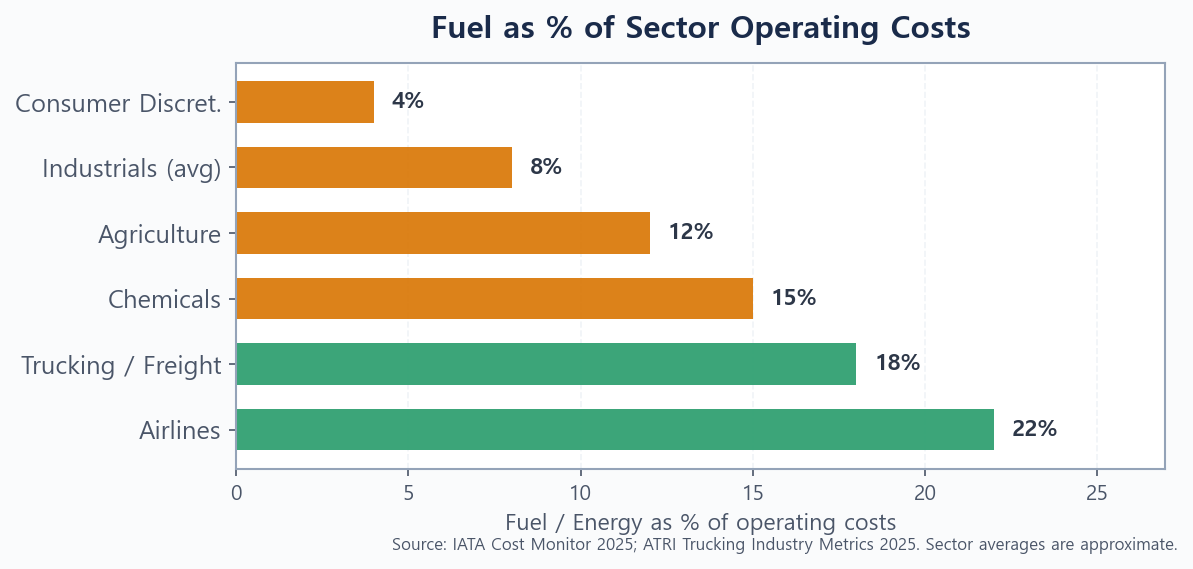
Jet fuel typically represents 20–25% of an airline’s total operating expenses — the single largest variable cost line (Source: IATA Cost Monitor, 2025). When Brent crude falls $10/barrel, major U.S. carriers collectively save roughly $1.5–2 billion annually. That margin relief flows almost directly to operating income, since airlines cannot easily cut other fixed costs like maintenance, labor contracts, and gate leases.
Freight carriers, rail operators, and trucking companies benefit similarly, though at slightly lower intensity. Fuel runs approximately 15–18% of trucking operating costs versus ~22% for airlines — still a meaningful input in a thin-margin industry.
Consumer Discretionary and Retail
Lower fuel prices act as a consumer stimulus. When Americans pay less at the pump — a typical household saves roughly $300–$500 per year for every $10/barrel decline in crude — discretionary spending tends to shift toward restaurants, travel, apparel, and electronics. Retailers also benefit from lower shipping and last-mile logistics costs throughout their supply chains.
This indirect benefit is real but slower-moving than the direct cost savings in airlines. Consumer confidence data typically lags the oil price move by 4–8 weeks before showing up in retail sales figures, so the trade takes patience.
Industrials and Manufacturing
Energy is a significant input for industrial companies — from chemicals and plastics manufacturing to steel production and construction equipment. Lower feedstock costs (natural gas and crude are frequently linked) can meaningfully compress cost-of-goods-sold for manufacturers. Capital goods companies also benefit from reduced transportation costs across their supply chains.
Many industrial companies operate on thin margins where a 5–10% reduction in energy input costs can swing overall profitability substantially — making the sector particularly sensitive to sustained oil price declines over multiple quarters.
Utilities: A More Complex Picture
Utilities have a nuanced relationship with oil prices. Natural gas-fired power plants benefit when energy input costs fall alongside crude. However, many utilities are also interest-rate sensitive: if declining oil tames inflation enough to prompt Fed rate cuts, dividend-paying utilities gain through a lower discount rate applied to future cash flows. The net effect depends on the specific sub-sector and the pace of any policy easing — not a one-size-fits-all call.
Best ETFs to Capture the Oil-Price Decline Trade
Rather than picking individual airline or retail stocks, most investors get cleaner diversified exposure through sector ETFs. Here are five worth understanding, each capturing the oil-price tailwind at a different angle.
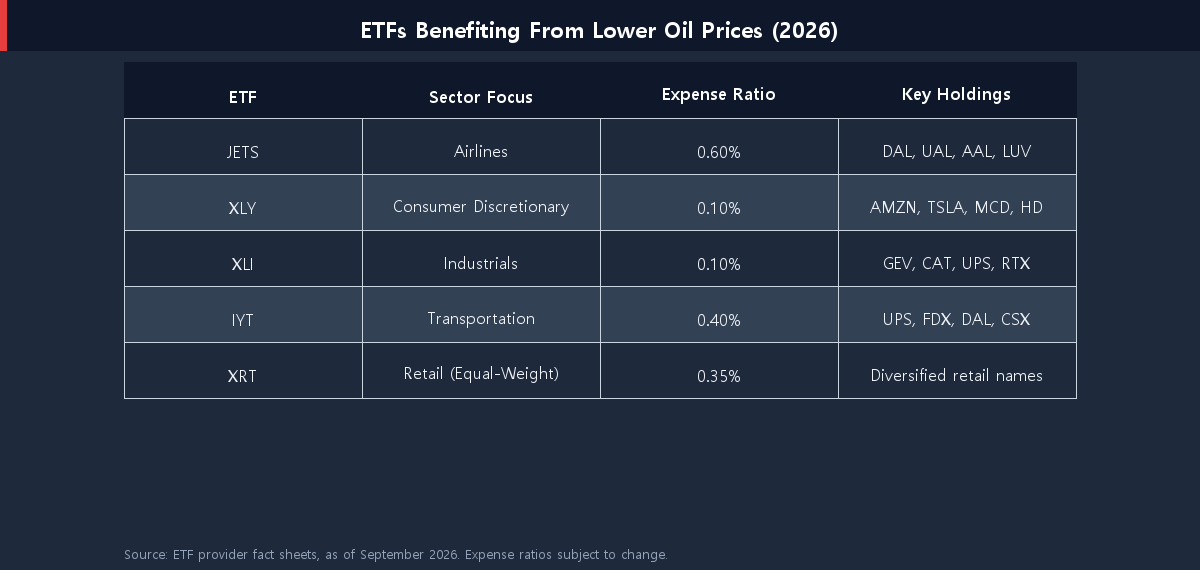
JETS (U.S. Global Jets ETF, ER 0.60%) offers the most direct exposure to airline fuel-cost leverage. Holdings include Delta, United, American, Southwest, and major international carriers. The tradeoff is concentration: if oil stays low but a macro slowdown reduces travel demand, JETS faces a demand-side headwind that partially offsets the cost benefit.
XLY (Consumer Discretionary Select Sector SPDR, ER 0.10%) is broader and far cheaper in fees. Amazon, Tesla, McDonald’s, and Home Depot dominate the top holdings. Amazon’s logistics operations benefit directly from lower fuel costs; the broader consumer spending stimulus shows up in restaurant, auto, and home-improvement sales. One caveat: a large portion of XLY’s 2026 returns will be driven by AI and consumer tech themes, making oil a partial rather than dominant driver.
XLI (Industrial Select Sector SPDR, ER 0.10%) captures manufacturers, aerospace and defense contractors, and logistics companies — broad industrial exposure at a rock-bottom cost. Key holdings include GE Aerospace, Caterpillar, UPS, and RTX. IYT (iShares U.S. Transportation ETF, ER 0.40%) is more targeted, tracking the Dow Jones U.S. Transportation Index with direct airline and freight rail weighting.
XRT (SPDR S&P Retail ETF, ER 0.35%) gives equal-weight exposure across the retail sector, reducing the mega-cap dominance you get in XLY. If the consumer spending stimulus from lower gas prices is your primary thesis, XRT captures it more purely.
If you’re looking for income alongside this sector rotation, our Best High-Yield Dividend ETFs for 2026 covers ETFs that blend income with equity upside — several of which also benefit from the cooling energy-inflation backdrop. The dividend stock outperformance story in 2026 is partly driven by the same macro rotation: lower energy costs improving margins for industrial and consumer dividend payers.
Sectors and ETFs to Approach Cautiously
The flip side of the oil-decline trade is obvious but worth stating clearly: energy sector ETFs face direct headwinds. XLE (Energy Select Sector SPDR), VDE (Vanguard Energy ETF), and XOP (SPDR S&P Oil & Gas Exploration & Production ETF) all see their earnings bases compressed when crude prices fall. Revenue for oil producers is literally the commodity price multiplied by volume — there is no hiding from a $20/barrel move down.
This doesn’t make energy ETFs permanently uninvestable. Integrated majors like ExxonMobil and Chevron have diversified refining, chemicals, and LNG businesses that partially offset upstream revenue loss. But if Brent stays in the $65–$75 range through year-end, consensus earnings estimates for XLE constituents will face downward revisions. Position sizing accordingly.
Master Limited Partnerships (MLPs) and midstream pipeline companies are less directly oil-price-sensitive — they earn fees on volume transported, not on commodity price. However, their distributions are sensitive to overall energy sector capital expenditure. If exploration-and-production companies cut drilling budgets in response to lower prices, that can eventually reduce pipeline throughput and pressure MLP distributions.
How to Position Your Portfolio Without Overconcentrating
The oil-decline trade is a macro theme, not a reason to rebuild your entire portfolio around one commodity cycle. A few principles worth applying:
- Size the trade as a tilt, not a concentration. Adding 5–10% to airline, industrial, or consumer ETFs on top of a diversified core is reasonable. Going all-in on JETS because oil is down 20% ignores the demand-side risk if the economy weakens.
- Watch the macro driver carefully. Oil often falls during recessions — and recessions hurt airlines and consumer discretionary companies too. The 2026 decline is primarily supply-driven (OPEC+ decisions, U.S. shale), which is the better scenario for beneficiary sectors. A demand-driven decline — signaling economic slowdown — reverses the trade.
- Rebalance systematically. If the trade works and JETS appreciates 25%, your allocation has grown beyond your original target. Our guide on how to rebalance your portfolio when interest rates are rising applies equally to any macro sector rotation — the mechanics are the same.
- Keep your base diversified. If you’re new to sector tilting, starting with a simple diversified core is the right foundation. Our Beginner’s Guide to Asset Allocation explains how to build one before adding any thematic overlays.
Supply-driven oil declines, when accompanied by stable consumer demand, have historically been the clearest scenario for airline, industrial, and consumer discretionary ETFs to outperform. That appears to be the environment in mid-2026. Knowing which positions give you that exposure cleanly — without unwanted sector concentration or demand-risk blind spots — is what separates a deliberate tilt from an impulsive bet.
Found this breakdown useful? Bookmark it and revisit when the next crude price move raises the same questions. Worth reading next: Why Dividend Stocks Are Finally Beating the S&P 500 in 2026.
This article is for informational purposes only and is not investment advice. Do your own research before making any investment decisions.