
The Federal Reserve’s “higher for longer” pivot has reshuffled almost every corner of the equity market in 2026. Growth stocks built on cheap money have repriced. Bond proxies have wobbled. And investors who thought defensive sector ETFs were a sure-fire hedge are now discovering that not all defensives are created equal. XLU, XLP, and XLV — the three biggest sector SPDR funds covering utilities, consumer staples, and healthcare — respond very differently when the cost of capital stays elevated. This guide breaks down exactly how each one behaves in a high-rate environment, compares their 2026 metrics side by side, and helps you decide which defensive ETF (or combination) fits your portfolio.

What “Higher for Longer” Actually Means for Equity Investors in 2026
The phrase “higher for longer” refers to the Fed holding its policy rate at elevated levels — currently in the 5.25–5.50% target range — for a sustained period rather than cutting as quickly as markets originally hoped. After the rate-hike cycle that began in 2022, most investors priced in aggressive cuts by 2024–2025. Those cuts never fully materialized, and the 2026 dot plot shifted the goalposts again.
Why the Fed Isn’t Cutting Soon — and What That Signals
Sticky core inflation (driven partly by shelter costs and sticky services), resilient labor markets, and fiscal spending have given the Fed cover to stay patient. For equity investors, the practical consequences are real: risk-free yields above 5% make dividend-paying stocks compete harder for capital, long-duration assets face continued valuation pressure, and rate-sensitive sectors — notably utilities — carry extra headwind. Understanding this backdrop is the starting point for any defensive sector allocation decision in 2026.
Want the full macro picture behind the rate path? My earlier breakdown covers Will the Fed Hike Rates in 2026? Higher for Longer in detail.
The Three Defensive Sector ETFs, Explained
XLU, XLP, and XLV all belong to State Street’s SPDR Sector lineup, each tracking a distinct sub-index of the S&P 500. All three carry the same rock-bottom 0.09% expense ratio and are among the most liquid sector ETFs on the market. The similarities largely stop there.
XLU — Utilities Select Sector SPDR Fund
XLU holds roughly 30 regulated electric, gas, water, and multi-utility companies — names like NextEra Energy, Southern Company, Duke Energy, and Dominion. Utilities earn predictable, regulated revenue regardless of the economic cycle, which is why they’re considered the purest defensive play. The catch: utilities run on debt. They borrow heavily to build and maintain infrastructure, so rising rates directly increase their financing costs and, simultaneously, compress the relative attractiveness of their dividends against risk-free yields. XLU typically yields around 3.2% (as of August 2026, Source: State Street), but when the 10-year Treasury offers 4.5%, that spread shrinks considerably.
XLP — Consumer Staples Select Sector SPDR Fund
XLP tracks roughly 37 companies that sell things people buy no matter what — Procter & Gamble, Costco, Coca-Cola, PepsiCo, Walmart, and similar names. Unlike utilities, staples companies fund operations primarily through earnings rather than debt issuance, making them far less sensitive to interest rate changes. XLP has posted stronger year-to-date performance in 2026 precisely because it carries lower interest rate risk while still providing a defensive tilt. Its yield (~2.8%, Source: State Street, as of August 2026) is lower than XLU’s, but its total return profile in a higher-for-longer environment has been more resilient.
XLV — Health Care Select Sector SPDR Fund
XLV is the largest of the three by AUM and holds about 62 companies across pharmaceuticals, health insurance, medical devices, and biotechnology — UnitedHealth Group, Eli Lilly, AbbVie, Johnson & Johnson, and Abbott Labs among them. Healthcare demand doesn’t track the interest rate cycle or GDP growth cycle; people need medications and medical procedures whether rates are 2% or 6%. That makes XLV genuinely non-cyclical, but it adds another dimension: regulatory risk and drug-pricing policy uncertainty. In 2026, XLV has underperformed the other two defensives largely due to policy-driven earnings uncertainty weighing on health insurance sub-sector names.
How Rising Rates Hurt (and Help) Each Defensive Sector
XLU: The Rate-Sensitive One
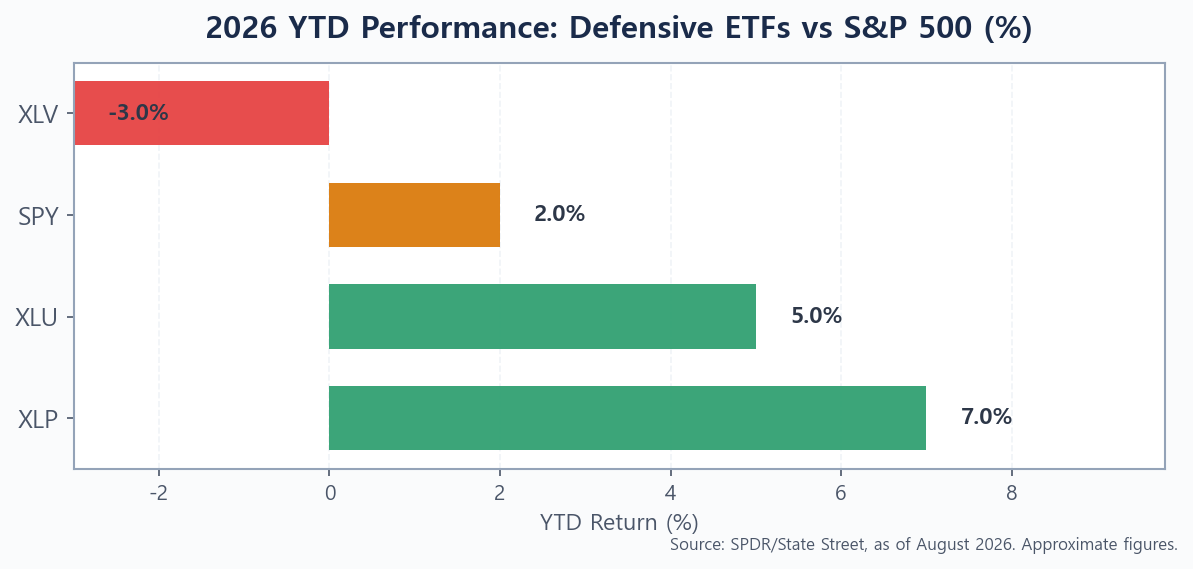
Utilities are sometimes called “bond proxies” because their price behavior tracks long-duration bonds more closely than most equities. When yields rise, XLU tends to fall — and vice versa. In a higher-for-longer scenario, this is the key structural headwind for XLU. Higher borrowing costs eat into utility profit margins, and the relative yield advantage shrinks. That said, XLU can still serve a role: if you believe rates will eventually stabilize or drop, utilities offer some of the highest potential mean-reversion upside among defensives. In 2026 YTD, XLU is up approximately +5% (Source: SPDR/State Street, as of August 2026).
XLP: The Steady Compounder
Consumer staples have delivered the most reliable risk-adjusted return among the three defensives this year. The sector’s lower debt dependency insulates it from rate headwinds, while its recession-resistant earnings make it a natural destination when investors rotate away from rate-sensitive growth stocks. XLP is up approximately +7% year-to-date in 2026 (Source: SPDR/State Street, as of August 2026), outperforming both XLU and XLV, and doing so with less volatility. (If you’re also weighing how rising rates affect your dividend income overall, How Rising Rates Affect Dividend Stocks walks through the broader picture.)
XLV: The Growth-Defensive Hybrid
Healthcare’s rate sensitivity sits between utilities and staples — lower balance-sheet leverage than utilities, but exposure to policy risk that the others don’t face. XLV has struggled modestly in 2026, down approximately -3% YTD (Source: SPDR/State Street, as of August 2026), mainly due to uncertainty around drug pricing regulations and Medicare reimbursement rates. However, its long-term case remains intact: demographic aging creates structural demand for healthcare products and services that no interest rate environment can switch off.
XLU vs XLP vs XLV — Head-to-Head Comparison (2026)
Here is how the three defensive sector ETFs stack up on the metrics that matter most in a higher-for-longer environment.
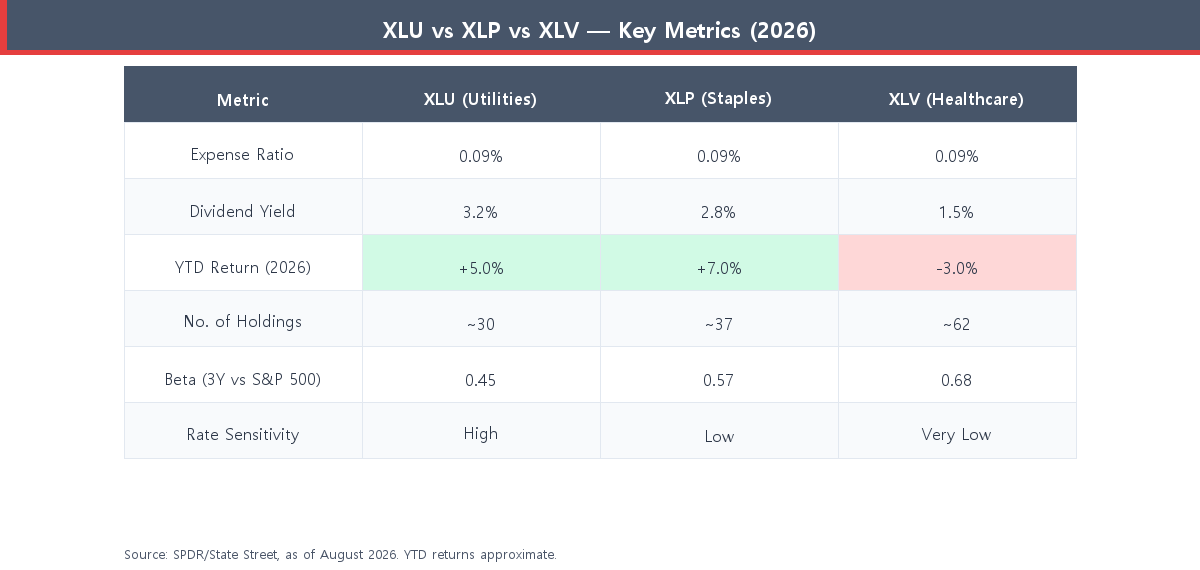
A few observations stand out from the data. First, all three charge an identical 0.09% expense ratio — cost is not a differentiator here. Second, XLU’s combination of the highest yield and highest rate sensitivity makes it the highest-risk defensive choice right now; its value proposition is most compelling if you’re calling a rate peak or plateau. Third, XLV’s low yield but low rate sensitivity makes it the closest thing to a “defensive growth” ETF — you’re paying up for healthcare’s structural demand story. Fourth, XLP sits squarely in the middle: decent yield, low rate sensitivity, and the steadiest 2026 performance of the group.
For investors who want to see how defensive ETFs fit alongside income-oriented alternatives, Best High-Yield Dividend ETFs for 2026 is worth reading next.
Which Defensive ETF Fits Your Portfolio Strategy?
If You’re Income-Focused
XLU offers the highest yield of the three (around 3.2%) but comes with meaningful rate sensitivity. If your primary goal is dividend income and you believe rates are close to a ceiling, XLU makes a compelling case. Just be aware that a prolonged higher-for-longer environment could continue to dampen the price return. Pairing XLU with shorter-duration bond exposure — such as a Treasury bill ETF — can help offset rate risk while keeping income flowing.
If You Want Stability with Low Rate Risk
XLP is the clearest winner here in 2026. Consumer staples companies have pricing power (they pass inflation to consumers), low interest rate exposure, and global diversification through their brand portfolios. For an investor who needs predictable, low-volatility equity exposure without the rate headwind of utilities, XLP is the most straightforward defensive choice in the current environment.
If You Want Defensive Exposure with Growth Upside
XLV is the choice for investors willing to accept near-term policy risk in exchange for the long-term secular demand story. Aging demographics across the US, Europe, and Japan create decades of structural tailwind for pharmaceuticals, medical devices, and health insurance. XLV also benefits from pharmaceutical innovation cycles — when major blockbuster drugs (GLP-1 weight-loss medications, Alzheimer’s therapies) gain traction, the sector can post growth returns despite a defensive label.
How to Combine XLU, XLP, and XLV for Maximum Stability
Rather than picking one, many defensive-minded investors use all three in a “defensive block” allocation — typically a 15–25% combined weight within a broader US equity portfolio, split across the three sectors in roughly equal thirds. This approach smooths out the idiosyncratic risks: XLV’s policy exposure, XLU’s rate sensitivity, and XLP’s consumer concentration.
In a higher-for-longer rate environment specifically, a tilt toward XLP (overweight) and XLV (neutral) with XLU underweight is a reasonable starting posture. As rate expectations shift — if the 10-year Treasury yield falls back toward 4% or below — the XLU underweight can be closed to capture utilities’ mean-reversion potential.
Rebalancing this defensive block correctly is as important as the initial allocation. For a step-by-step framework on how to rebalance amid rising rates, How to Rebalance Your Portfolio When Interest Rates Are Rising covers the mechanics in full.
Bottom Line: The Right Defensive Bet for Higher for Longer
In a higher-for-longer rate environment, not every defensive sector ETF defends equally. XLP has been the clearest winner in 2026 — low rate sensitivity, consumer pricing power, and steady compounding. XLV is the right call for investors with a longer time horizon who can absorb near-term policy noise in exchange for healthcare’s structural growth story. XLU carries the most rate risk but also the most upside optionality when (not if) rates eventually normalize downward.
The practical takeaway: if you are building a defensive tilt today and the Fed’s posture remains higher for longer through 2026, lean toward XLP first, add XLV for growth-defensive balance, and treat XLU as a rate-cycle trade rather than a core holding. Combining all three in proportion to your rate outlook gives you the most resilient defensive block available in the S&P 500 sector universe.
Worth reading next: Why Dividend Stocks Are Beating the S&P 500 in 2026 — the macro shift behind the outperformance overlaps directly with the defensive rotation story covered here.
Found this useful? Bookmark it so you can revisit when the market moves.
This article is for informational purposes only and is not investment advice. Do your own research before making any investment decisions.