
Every two years, the United States holds midterm elections — and every time, investors face the same question: what does a shift in congressional power mean for my portfolio? The 2026 midterm elections are no different. With control of both the House and Senate up for grabs in November, sector rotation is already seeping into market conversations. But before you make any drastic moves, the historical record offers a surprisingly consistent answer — and it may not be what you expect.
This guide breaks down the data on how the 2026 US midterm elections could affect the stock market, which sectors have historically won and lost after midterms, and how three distinct political scenarios map onto real sector trades.
The Historical Pattern: Why Stocks Almost Always Rally After Midterms
Before drilling into sectors, it helps to understand the macro picture. History is remarkably one-sided: the stock market almost always rises in the 12 months following a midterm election, regardless of which party wins.
The Numbers Behind the Post-Midterm Rally
Since 1938, the S&P 500 has posted positive price gains in the 12 months following midterm elections 95% of the time. Narrowing the window to 1990, the index has gained an average of 16.9% in every one of the nine post-midterm cycles (Source: Morgan Stanley, October 2026). That’s a remarkably consistent pattern across Republican and Democratic administrations alike.
The timing matters too. In the three months leading up to Election Day, the S&P 500 has averaged just a 2.5% gain — cautious, range-bound trading as investors wait. In the three months immediately after Election Day, that number jumps to 6.5%. The post-election relief rally is one of the most reliable seasonal patterns in US equities.
Why Uncertainty Before Election Day Suppresses Markets
Markets don’t dislike Democrats or Republicans — they dislike uncertainty. When the policy outlook is unclear (Will taxes rise? Will regulations tighten? Will a new Congress reverse executive orders?), institutional investors reduce risk exposure. This uncertainty discount compresses valuations and creates the muted pre-election returns we see historically.
Once results are known — whatever they are — uncertainty drops, and risk appetite returns. That’s the engine behind the post-midterm rally, and it’s a dynamic worth understanding as November 2026 approaches. For how macroeconomic policy feeds into equity prices more broadly, see How Fed Rate Decisions Affect Your Portfolio.
The Sectors That Have Historically Won After Midterms
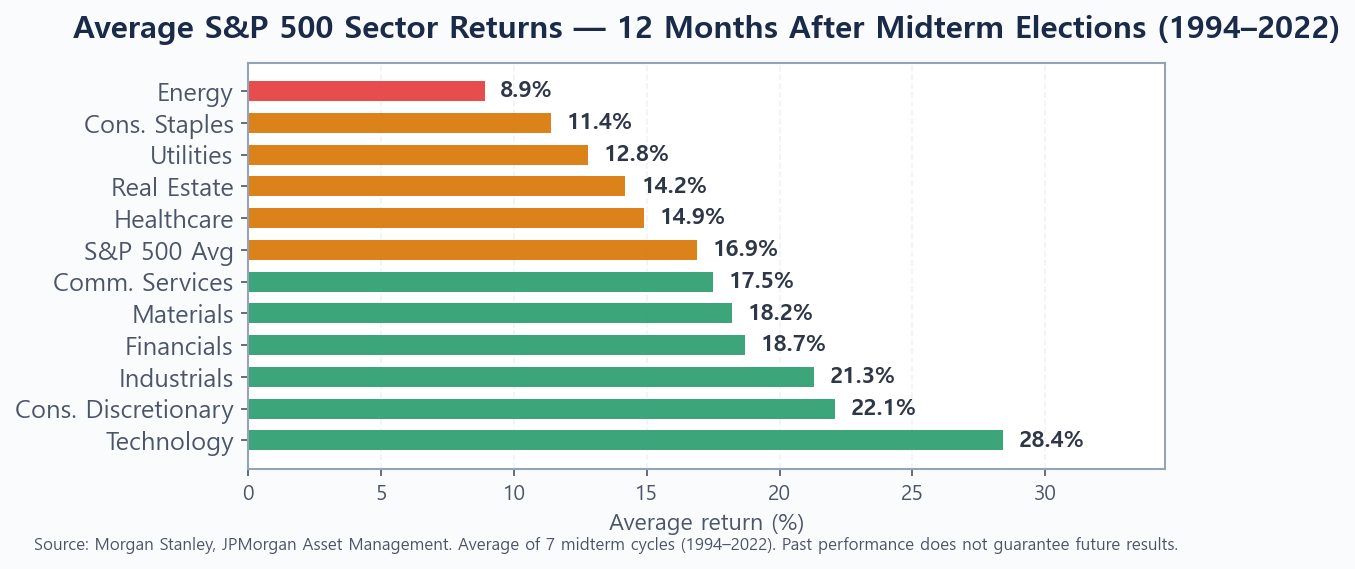
The broad market rally lifts most boats, but it doesn’t lift them equally. Across the past several midterm cycles, a clear pattern emerges: cyclical and growth-oriented sectors tend to outperform defensives in the 12 months post-election. Here’s what the data shows.
Technology and Communication Services
Technology has ranked among the top two best-performing S&P 500 sectors in the 12 months following each of the last four midterm elections. It’s not hard to see why: the post-election clarity that lifts all stocks hits growth sectors hardest, as their valuations are most sensitive to the discount rate embedded in uncertainty. Communication Services — which includes Alphabet, Meta, and Netflix — tends to follow a similar trajectory.
In 2026, this trend is amplified by the AI spending cycle. Both parties have signaled support for US AI competitiveness, meaning technology faces relatively limited political risk regardless of November’s outcome. The sector remains one of the cleaner plays heading into the midterms.
Industrials and Defense
Defense and industrial spending has historically enjoyed bipartisan support, making these sectors resilient across different midterm outcomes. National security budgets rarely shrink regardless of which party controls Congress, and infrastructure spending — already bolstered by prior legislation — tends to continue through project cycles that outlast any single election cycle.
Defense is particularly interesting in 2026 given elevated geopolitical tensions. With NATO commitments under continued discussion and defense budgets under review in multiple allied nations, US defense contractors could see sustained demand irrespective of domestic political shifts.
Consumer Discretionary and Financials
Consumer Discretionary has historically followed Technology as a post-midterm outperformer — recovering strongly as the uncertainty discount lifts and consumer confidence returns. Financials are more scenario-dependent (more on that below), but in a Republican-controlled Congress environment, they tend to outperform given deregulatory expectations. Even in a split Congress, the prospect of regulatory gridlock is often preferable to active new rulemaking.
Three Political Scenarios for November 2026 — and What Each Means for Sectors
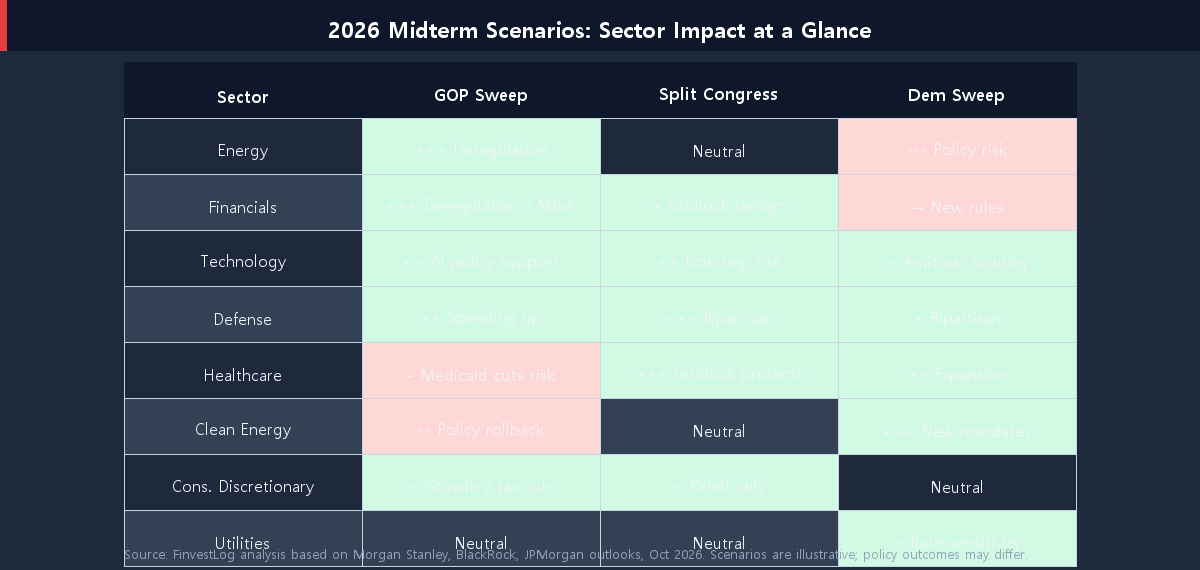
History tells us the broad market tends to rise regardless of outcome. But sector leadership does shift meaningfully depending on which party gains or retains control of Congress. Here are three realistic scenarios — and how institutional investors are currently positioning around each.
Scenario 1 — Republicans Retain Both Chambers
If Republicans hold both the House and Senate, the policy environment emphasizes deregulation, fossil fuel expansion, and business-friendly initiatives. Energy and Financials are the primary beneficiaries in this scenario — less regulatory friction means wider margins for banks and more drilling permits for oil and gas companies. M&A activity could also accelerate as antitrust scrutiny eases, benefiting deal-heavy sectors like Technology and Media.
The potential risk in this scenario lies in fiscal dynamics: continued deficits could keep Treasury yields elevated, which creates a headwind for long-duration growth assets. See Will the Fed Cut Rates in 2026? for how the interest rate environment interacts with this picture.
Scenario 2 — Split Congress (Democrats Take the House)
A split Congress — the most common historical outcome, and a plausible one in 2026 — typically produces gridlock. Gridlock means no major new legislation passes in either direction, which is historically benign for equities overall. Under this scenario, Healthcare, Defense, and civil infrastructure tend to hold up best: reduced risk of Medicaid cuts (no Republican trifecta), continued bipartisan military spending, and infrastructure projects already in motion.
The downside of gridlock is fiscal: recurring debt-ceiling confrontations and potential government shutdowns inject periodic volatility. Investors in energy, private equity, and digital assets may face more regulatory uncertainty than under a unified Congress. For portfolio-level adjustments around this kind of environment, see How to Rebalance Your Portfolio When Rates Are Rising.
Scenario 3 — Democrats Win Both Chambers
A Democratic sweep would be the most significant market surprise given current polling, but it’s a scenario worth modeling. Clean energy — particularly solar, wind, and grid infrastructure — would likely see a significant re-rating, as new climate legislation would gain a clearer legislative path. Social services and managed-care healthcare companies might also benefit from expanded coverage mandates.
The headwinds under this scenario fall on Big Tech (renewed antitrust scrutiny), Financials (more stringent regulation), and fossil fuel energy. The market’s initial reaction could be negative given the uncertainty repricing — but the historical pattern of post-midterm rallies would likely reassert itself within months.
The Sectors That Tend to Lag (and Why Healthcare Is the Wild Card in 2026)
Not every sector benefits equally from the post-midterm lift. Understanding the laggards is just as important as chasing the winners.
Defensives and Utilities
Consumer Staples and Utilities tend to underperform post-midterms relative to cyclicals — not because they fall, but because risk appetite rotates away from them once uncertainty resolves. Investors who over-rotated into defensives pre-election often rebalance toward cyclicals, compressing relative returns for these sectors in the 6–12 month window after Election Day.
Energy: The Sector That Defies Political Logic
Energy is perhaps the most counterintuitive sector in any election analysis. The data shows that energy was actually the worst-performing S&P 500 sector under the Obama administration and during Trump’s first term — despite the conventional assumption that a Republican White House is bullish for oil. Conversely, energy was among the best-performing sectors under the Biden administration.
The lesson: global oil supply-demand dynamics, OPEC+ decisions, and commodity price cycles matter far more than domestic political rhetoric. Investors who position on energy purely based on election outcomes have historically been disappointed. The sector deserves scenario analysis rather than a simple political trade.
Healthcare: Historical Outperformer, 2026 Underperformer?
Healthcare is the sector that creates the most interesting tension in 2026. Historically, healthcare has outperformed the S&P 500 by an average of approximately 17% in midterm election years between 1994 and 2024 (Source: JPMorgan Asset Management, October 2026). The sector has benefited from policy uncertainty — the “we don’t know what will change, so let’s not sell” logic that keeps pharmaceutical and managed-care names resilient.
In 2026, however, the sector is under real fundamental pressure. The XLV — the SPDR Health Care ETF — is down approximately 5% year-to-date, weighed down by drug-pricing uncertainty, managed-care earnings pressure, and ongoing Medicaid budget debates. Whether the midterm-year historical tailwind can overcome these headwinds is genuinely unclear. Healthcare might revert to its historical post-midterm outperformance, or 2026 may prove a structural exception.
How to Position Your Portfolio Around the 2026 Midterms
The historical evidence is encouraging: the stock market almost always rises after midterms, and the rally tends to be meaningful. But using that fact as a license to make aggressive sector bets is a different proposition entirely.
Don’t Overreact — But Do Audit Your Sector Weights
The single most common midterm investing mistake is making large tactical shifts based on polling or prediction markets — then getting the election result right but the sector call wrong. Energy’s performance under different administrations is the clearest example of how political logic can fail as an investment thesis.
Instead, use the pre-election period to audit your current sector weights. If you hold a broad index fund like VOO, you’re already well-positioned to capture the broad post-midterm rally without needing to make active bets. If you have concentrated positions in politically sensitive sectors — energy, healthcare, financials — it’s worth stress-testing those holdings against all three scenarios above. And if you’re worried about Technology concentration risk from the AI boom, a sector review may reveal you’re more exposed than you think.
Practical Steps for Long-Term Investors
- Rebalance to target weights now, before Election Day. The pre-election period of below-average returns is a reasonable window to tidy up any portfolio drift without chasing a rally.
- Avoid speculative sector ETFs based solely on election outcomes. Healthcare, energy, and financials are all scenario-dependent — not directional bets.
- Use volatility spikes as buying opportunities. Any pre-election selloff driven by polling surprises has historically been a better entry point than waiting for post-election confirmation.
- Keep a 12-month time horizon. The post-midterm effect is a 12-month phenomenon — not a one-week trade.
If your broader portfolio needs a structural review in the current rate environment, the step-by-step process in How to Rebalance Your Portfolio When Rates Are Rising is a useful framework to work through before November.
Conclusion
The 2026 US midterm elections are generating the usual mix of investor anxiety and tactical positioning. But the historical record offers a clear message: the stock market has rallied after midterms in 95% of cycles since 1938, with an average 16.9% gain in the following 12 months. The political outcome matters less for overall returns than most investors assume — it matters more for sector rotation.
Technology, Industrials, and Consumer Discretionary have been the consistent post-midterm winners. Defensives and Utilities tend to lag. Energy and Healthcare depend heavily on both political scenario and fundamental conditions — and in 2026, both sectors carry unusual uncertainty. The most durable approach is one that captures the broad rally through diversified exposure while stress-testing politically sensitive positions against all three realistic scenarios for November.
Found this useful? Bookmark it so you can revisit when the market moves in the weeks around Election Day.
This article is for informational purposes only and is not investment advice. Past market patterns do not guarantee future results. Do your own research and consult a qualified financial professional before making investment decisions.