
Every few weeks a new headline asks whether artificial intelligence stocks are a once-in-a-generation opportunity or a bubble waiting to pop. If you own a simple S&P 500 fund, you may assume you are safely diversified and have nothing to worry about. The uncomfortable truth is the opposite: a handful of AI-linked giants now drive the whole index, so learning how to protect your portfolio from an AI bubble in 2026 is really about managing concentration you already own. This guide shows you how to measure that exposure and five practical, low-drama ways to reduce the risk — without trying to time a crash.
First, Understand How Much AI You Already Own
Before you change anything, audit what you hold. The “Magnificent Seven” — the mega-cap technology names most tied to the AI trade — made up roughly 32.7% of the S&P 500 in mid-June 2026, with a combined market value near $22 trillion (Source: Motley Fool / InvestmentNews, 2026). In some recent sessions that weight has pushed as high as 35–40%. Within the group, Nvidia alone accounts for about 22% of the seven’s combined market cap (Source: Motley Fool, 2026).
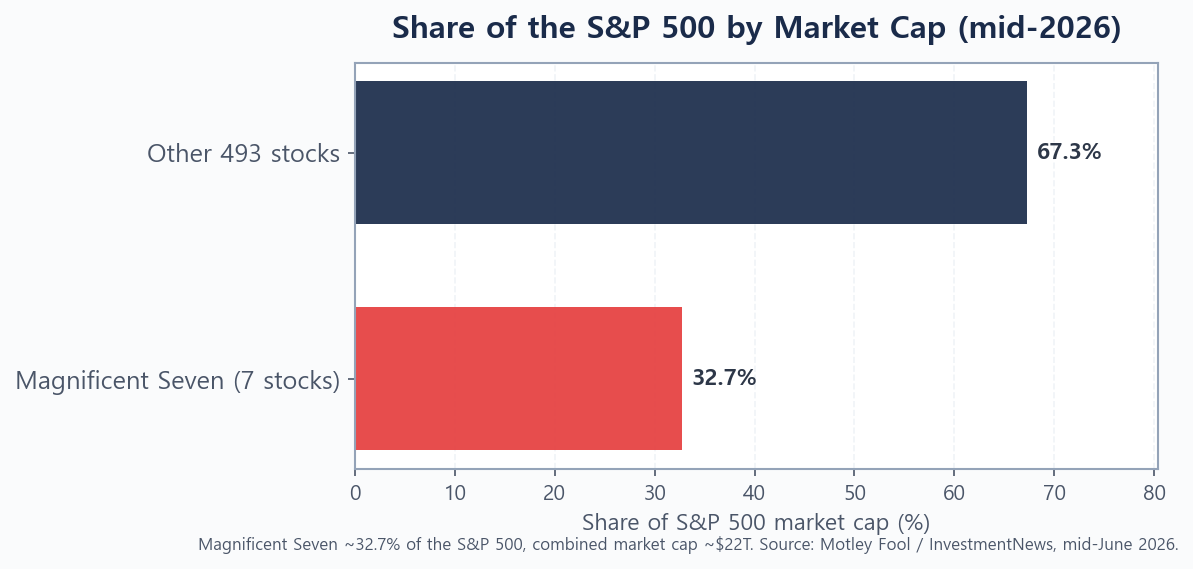
What this means in plain terms: if you have a “balanced” portfolio with 60% in US stocks, a large slice of that is concentrated in seven correlated, AI-exposed companies — even though you never chose them individually. You are not under-exposed to AI; you are over-exposed and may not realize it. That single insight reframes the whole question. The goal is not to bet against AI, but to make sure one theme cannot sink your plan. If you have never set deliberate target weights, our beginner’s guide to asset allocation is the right place to start.
Is It Actually a Bubble? What the Numbers Say
No one can prove a bubble until it bursts, and AI is clearly a real, profitable technology — not a story without earnings. But two warning signs are worth respecting. The first is concentration: when one-third of an index sits in a single theme, an ordinary disappointment in that theme moves your entire portfolio. The second is valuation: the leading AI names trade at rich multiples that assume years of flawless growth. If that growth merely slows, prices can fall sharply even without a true “crash.”
The honest conclusion is uncertainty, and uncertainty is exactly what diversification is built for. You do not need to predict whether 2026 brings a melt-up or a sell-off. You need a portfolio that survives either one. That is a far more achievable goal than calling the top.
Five Ways to Protect Your Portfolio From an AI Bubble
None of the moves below require selling all your stocks or sitting in cash. Each simply adds a counterweight that tends to hold up when crowded AI trades wobble.
1. Diversify into international stocks
Markets outside the US trade at a meaningful valuation discount and are far less concentrated in AI names. Over the recent comparison window, the Morningstar Global Markets ex-US Index rose about 32% in dollar terms while the US market gained 17% (Source: Morningstar, 2026). Adding unhedged international and emerging-market funds spreads your bet across different economies and currencies — a tilt that pairs naturally with how a weakening US dollar affects your portfolio.
2. Add small- and mid-cap stocks
The AI premium lives in mega-caps, so smaller companies are a genuine diversifier. They have lagged the giants and stand to benefit as the Federal Reserve continues cutting rates, which lowers borrowing costs for smaller firms. If you want the rate backdrop, see will the Fed cut rates in 2026.
3. Anchor with high-quality bonds
High-grade bonds are the classic ballast when equities fall. Vanguard’s research team estimates high-quality US fixed income now has the strongest risk-return profile for the next five to ten years, projecting roughly 4% annual returns over the next decade (Source: Vanguard via Morningstar, 2026). For where to start, compare the 10-year Treasury yield outlook for 2026 and short-term bonds vs. high-yield savings.
4. Hold a slice of real assets like gold
Gold has no earnings to disappoint and historically holds value when stocks and confidence wobble. The UBS chief investment office explicitly lists gold alongside international stocks and high-grade bonds as an AI-bubble hedge (Source: Yahoo Finance, 2026). A modest allocation is enough — our guide to how much gold to hold in your portfolio covers sensible sizing.
5. Separate AI “creators” from AI “adopters”
Not all AI exposure is the same. The “creators” — chipmakers and model builders — carry the steepest expectations. The “adopters” — banks, healthcare, industrials, and consumer firms that simply use AI to cut costs — may become the next leg of the cycle at far gentler valuations. Tilting toward adopters keeps you in the theme while stepping out of the most crowded corner of it.
How the Defensive Moves Compare
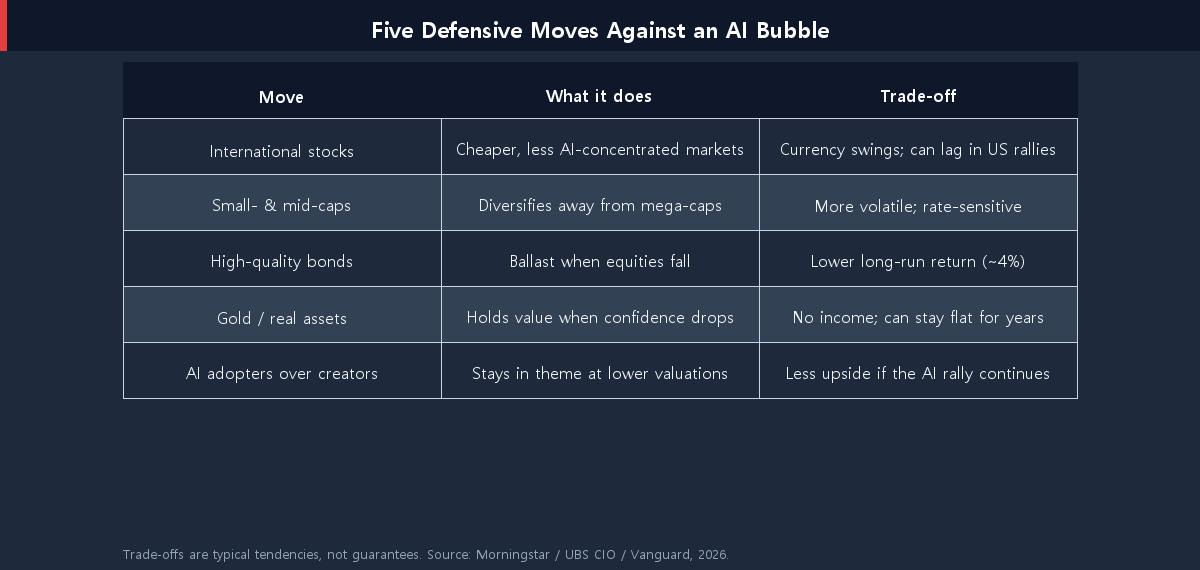
Each move trades a little potential upside for resilience. The table below lines them up so you can see what each one actually does and what you give up.
For a clear, level-headed walk through the bubble question itself, the short video below from analyst Ben Felix is worth your time — it explains why “the writing is never on the wall” before a market turn.
A Simple Pre-Bubble Checklist
You do not need to act on all five ideas at once. Work through these steps in order and stop when your portfolio feels balanced rather than concentrated.
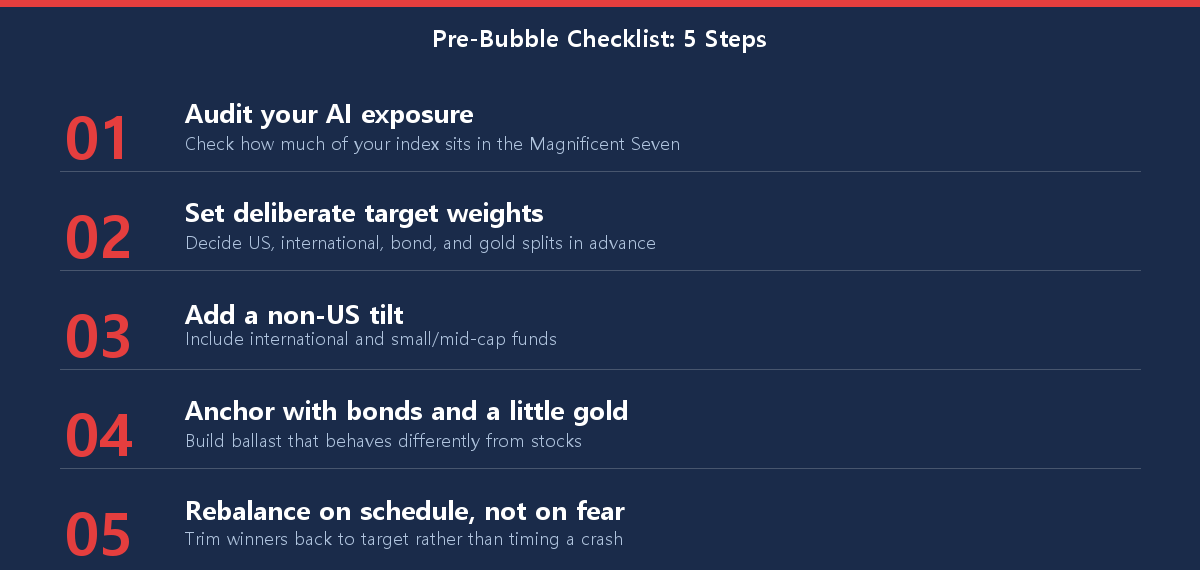
The throughline is discipline, not fear. Decide your target weights in advance, then rebalance toward them on a schedule — never in a panic on a red day.
Conclusion: Diversify, Don’t Flee
Protecting your portfolio from an AI bubble in 2026 is not about predicting a crash or dumping your winners. It is about noticing that a single theme quietly grew to a third of your US stocks — and adding counterweights that behave differently when that theme stumbles. International stocks, smaller companies, high-quality bonds, a little gold, and a tilt toward AI adopters together turn a fragile bet into a durable plan. Audit what you own, set deliberate weights, and let diversification carry the uncertainty so you don’t have to.
Found this useful? Bookmark it and revisit the next time the AI-bubble headlines flare up.
This article is for informational purposes only and is not investment advice. Do your own research before making any investment decision.