

Every quarter, millions of investors receive dividend payments — and then do nothing with them. The cash sits idle in a brokerage account, earning close to zero, while the market keeps moving. A dividend reinvestment plan (DRIP) fixes that problem automatically. Instead of receiving a cash payment, your dividends are immediately used to buy more shares of the same stock or ETF — often in fractional amounts, and typically at zero commission. Over a decade or two, that difference in behavior is the difference between a good portfolio and a great one.
This guide explains exactly what a DRIP is, how it works, and how to set one up on the major US brokers in 2026 — whether you’re just starting out or have been holding dividend stocks for years. If you’re brand new to investing, you may also want to read How to Start Investing With Only $100 before diving in.

How a DRIP Works: The Mechanics Behind Automatic Reinvestment
A DRIP is straightforward in concept: when a company or ETF pays a dividend, instead of depositing cash into your account, your brokerage automatically purchases additional shares of that same security using the dividend amount.
Here’s what happens under the hood:
- Dividend declared: A company or ETF announces a dividend per share (e.g., SCHD pays roughly $0.25/quarter per share).
- Dividend date hits: On the payment date, the brokerage calculates your dividend payout based on how many shares you hold.
- Automatic purchase: Instead of crediting cash, the brokerage buys additional shares — including fractional shares if your payout doesn’t cover a full share.
- Higher share count: Your position grows. The next dividend is calculated on the larger share count, creating a compounding loop.
Most brokerages execute DRIP purchases at the same time dividends are paid, often at the market opening price on the payment date. Unlike buying shares yourself, there’s no commission, no timing decision, and no temptation to spend the cash elsewhere.
Broker DRIP vs. Direct DRIP — Which Is Right for You?
There are two types of DRIP programs, and they work very differently.
Broker-Administered DRIP
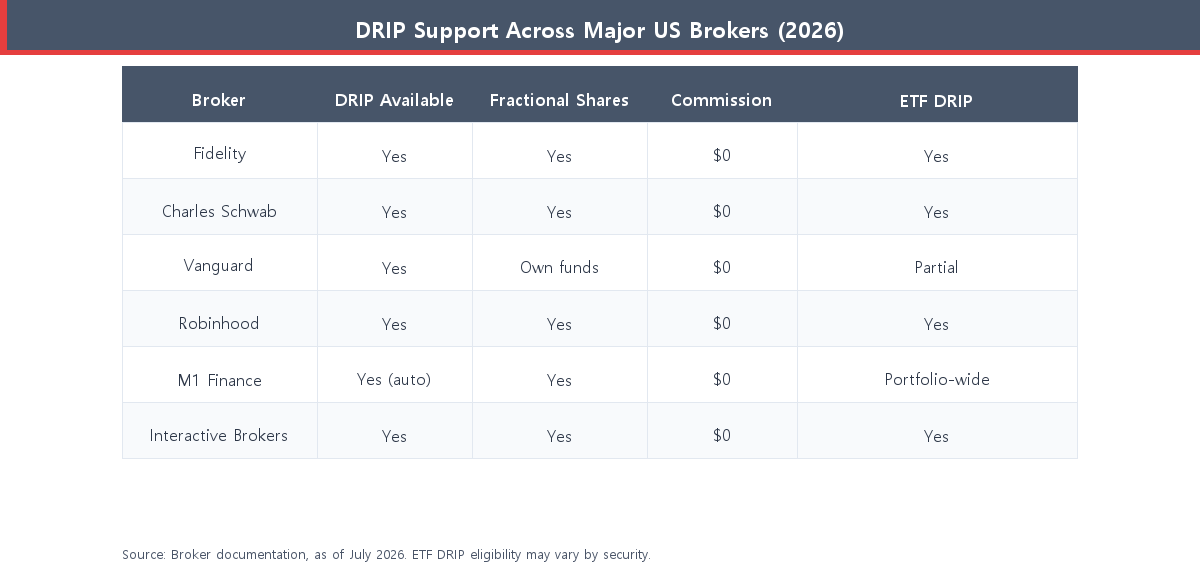
This is the version most investors use today. You enroll through your brokerage (Fidelity, Schwab, Vanguard, Robinhood, etc.), and the broker handles everything. Key advantages: supports fractional shares, works across your entire portfolio in one place, zero commission on reinvestment, and you can enable or disable it per security at any time. This is the approach we focus on in this guide.
Direct DRIP (Company-Sponsored)
Some companies — particularly large, established dividend payers like Coca-Cola, Johnson & Johnson, and Procter & Gamble — offer DRIPs directly through a transfer agent (usually Computershare). You buy shares directly from the company, often with a small initial minimum investment and sometimes at a slight discount to market price. The downside: each company requires a separate enrollment, and these programs don’t support ETFs. For most modern investors, the broker DRIP is far more convenient.
Worth reading if you’re still deciding which dividend assets to reinvest: Best High-Yield Dividend ETFs for 2026 covers the top options for yield and growth.
The Compounding Power of DRIP: Real Numbers Over 20 Years
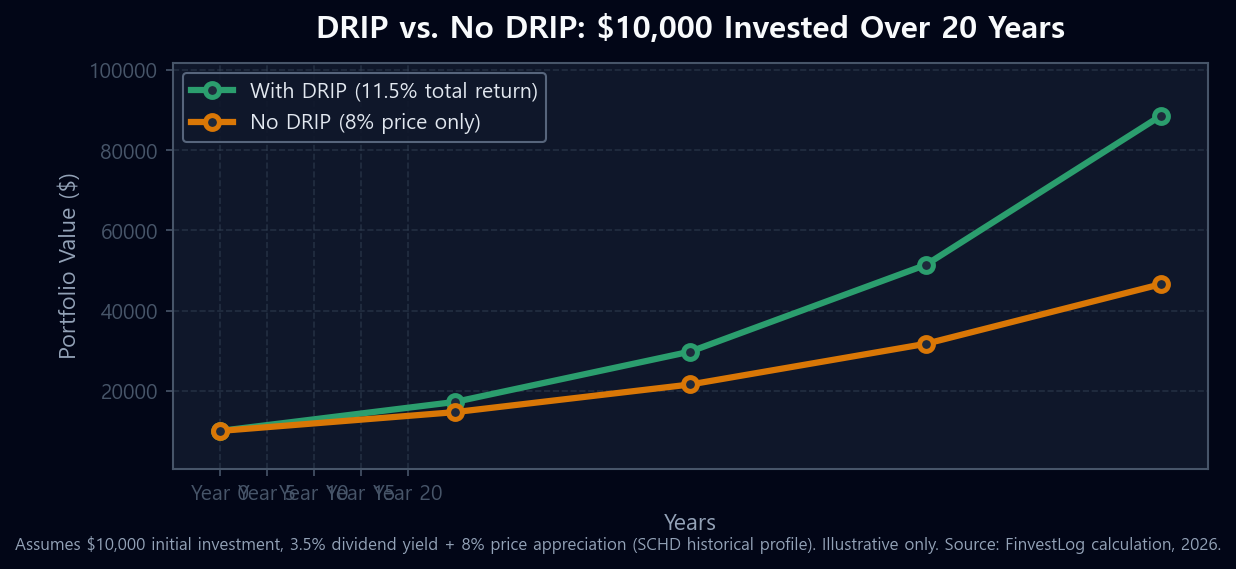
The math behind DRIP is not magic — it’s just compound interest applied consistently over time. Consider a $10,000 initial investment in a dividend ETF with approximately 3.5% annual yield and 8% average price appreciation (figures consistent with SCHD’s historical profile). Over 20 years:
- With DRIP: Dividends are reinvested, producing a total annual return of roughly 11.5%. The portfolio grows to approximately $88,600.
- Without DRIP: Dividends are taken as cash (and not reinvested elsewhere). Price appreciation alone at 8% brings the portfolio to approximately $46,600.
That’s a gap of more than $42,000 on the same $10,000 starting investment — from doing nothing except turning on an automatic checkbox. The difference widens every year as the share count grows and each subsequent dividend is calculated on a larger base.
This is essentially the same mechanism as dollar-cost averaging applied automatically — you buy at different prices each quarter without any effort. For a deeper look at that strategy, see Dollar-Cost Averaging vs. Lump-Sum Investing: Which Wins in 2026?
The following video explains the compounding mechanics of DRIP clearly — worth a watch before you set up your own enrollment.
How to Set Up DRIP on Major US Brokers (Step-by-Step)
Setting up DRIP takes less than five minutes on any major US brokerage. The general process is the same everywhere: log in, find your dividend reinvestment setting, and toggle it on. Here’s where to look on each platform.
Fidelity
- Log in at fidelity.com and go to Accounts & Trade → Dividend Reinvestment.
- You can enable DRIP for your entire account or for individual securities.
- Fidelity supports fractional share reinvestment on thousands of eligible stocks and ETFs — including SCHD, VYM, JEPI, and most S&P 500 components.
- Select “Reinvest” for each security you want enrolled, then confirm.
Fidelity is generally considered one of the most DRIP-friendly brokers because it allows per-security enrollment and covers a very wide range of eligible securities.
Charles Schwab
- Log in and navigate to Accounts → Dividend Reinvestment under your account settings.
- Schwab allows account-level enrollment (applies to all eligible securities) or per-security enrollment.
- Fractional shares are supported on eligible US equities and ETFs.
- Schwab also acquired TD Ameritrade, so former TD accounts now use Schwab’s DRIP system.
Vanguard
- Log in and go to My Accounts → Dividend and Capital Gains Options.
- For Vanguard’s own mutual funds and ETFs, reinvestment into fractional shares is fully supported.
- For non-Vanguard securities held at Vanguard, fractional DRIP may be limited — check the specific security’s eligibility in your account.
- If you hold primarily VOO, VTI, or VYM, Vanguard’s DRIP works seamlessly.
Robinhood & M1 Finance
Both platforms automate dividend reinvestment by default — but with different mechanics. Robinhood added a DRIP feature that allows you to enable automatic reinvestment per security. M1 Finance takes a portfolio-level approach: dividends are automatically swept back into your portfolio “pie” and reinvested across your target allocations rather than back into the original dividend payer specifically. This makes M1 useful for diversified reinvestment but less precise for DRIP purists who want dividends to reinvest only in the same security.
DRIP and Taxes: What Every Investor Must Know
The most common misconception about DRIP is that you’re not taxed on reinvested dividends because you don’t receive cash. That is incorrect.
The IRS treats reinvested dividends exactly the same as cash dividends for tax purposes. In a taxable brokerage account:
- Qualified dividends (held more than 60 days before ex-dividend date) are taxed at the lower long-term capital gains rate — 0%, 15%, or 20% depending on your income.
- Ordinary dividends are taxed at your regular income tax rate.
- Your broker will report the total dividend income on Form 1099-DIV at year-end, regardless of whether it was reinvested.
Cost basis tracking is critical with DRIP. Every reinvestment creates a new tax lot with its own purchase date and price. Over years of automatic reinvestment, you may have dozens of small lots. When you eventually sell, accurate cost basis records determine your capital gain or loss. Brokers track this automatically, but you should review your cost basis method (FIFO, specific identification, or average cost) and confirm your broker is reporting it correctly.
The good news: in a tax-advantaged account (Roth IRA, Traditional IRA, 401(k)), dividends are not taxed when received or reinvested. DRIP in these accounts is the most efficient — you get full compounding with zero annual tax drag. If you’re choosing which accounts to enroll in DRIP first, prioritize tax-advantaged accounts.
When DRIP Makes Sense — and When to Skip It
DRIP is not universally the right choice for every investor in every account. Here’s how to think about it.
DRIP makes sense when:
- You’re in the accumulation phase — years or decades away from needing income from your portfolio.
- The securities you hold are ones you’d willingly buy more of at current prices. DRIP makes no market timing decision — it buys regardless of valuation.
- You’re investing in a tax-advantaged account (IRA, 401(k)) where dividend tax drag doesn’t apply.
- You’re a hands-off investor who prefers full automation over managing cash flows manually.
Consider skipping DRIP when:
- You’re in retirement or near retirement and need dividend income for living expenses. DRIP routes that cash back into shares instead of your checking account.
- Your portfolio has become overweight in a single position. If you hold a lot of one stock and DRIP keeps increasing the concentration, rebalancing manually may be smarter.
- You want to redirect dividends strategically — for example, collecting dividends from large-cap dividend ETFs and redeploying them into underweighted small-cap or international positions for rebalancing purposes.
- You’re in a taxable account and in a high income bracket, and the quarterly tax hit on reinvested dividends is a meaningful drag you want to manage.
If you’re selecting dividend ETFs to DRIP, two comparison guides that can help: SCHD vs VIG: Best Dividend Growth ETF for 2026 and SPYD vs VYM vs SCHD: Best High-Dividend ETF for 2026.
The Bottom Line
A dividend reinvestment plan is one of the simplest and most powerful tools available to long-term investors. It costs nothing to set up, takes minutes to enable, and then works silently in the background — buying more shares with every dividend payment, quarter after quarter. The compounding effect over 10 to 20 years is substantial: on the same initial investment, the difference between DRIP and no DRIP can amount to tens of thousands of dollars.
The key steps are straightforward: choose your dividend-paying securities, enable DRIP through your brokerage’s account settings, verify fractional share eligibility, and understand that dividends remain taxable even when reinvested. For most investors in an accumulation phase, enrolling in DRIP is a decision you make once and benefit from for decades.
Found this guide useful? Bookmark it for reference when you add new dividend positions to your portfolio. This article is for informational purposes only and is not investment advice. Do your own research before making investment decisions.