
The AI boom has made “AI ETF” one of the most searched terms in investing — but not all AI-themed ETFs bet on the same thing. QQQ gives you a wide slice of the Nasdaq’s most powerful tech names. SOXX bets squarely on the semiconductor chips that AI cannot run without. BOTZ goes after robots, industrial automation, and surgical systems. And then there is the question every serious investor eventually asks: would I be better off just owning a handful of individual stocks?
This guide breaks down the best AI-themed ETFs for 2026 — comparing QQQ, SOXX, and BOTZ side by side on expense ratio, holdings, risk profile, and year-to-date performance — and explains exactly when owning individual stocks may beat all of them.
What “AI-Themed ETF” Actually Means — and Why It Matters
Walk into any financial media outlet today and you will find dozens of ETFs wearing the “AI” label. The label, however, tells you almost nothing about what the fund actually owns. An AI ETF can mean broad Nasdaq technology exposure, a narrow bet on the chip foundries and GPU designers, a global basket of industrial robots, or a pure-play software portfolio — and the right choice depends entirely on where you think AI revenue will be captured.
Before comparing funds, it helps to think in layers. The AI value chain has at least three distinct strata: (1) the infrastructure layer — semiconductors, servers, power — where SOXX lives; (2) the platform layer — cloud hyperscalers, foundational model companies — where QQQ is heavily weighted; and (3) the automation layer — physical robots, surgical systems, factory intelligence — where BOTZ focuses. Knowing which layer excites you most is half the decision.
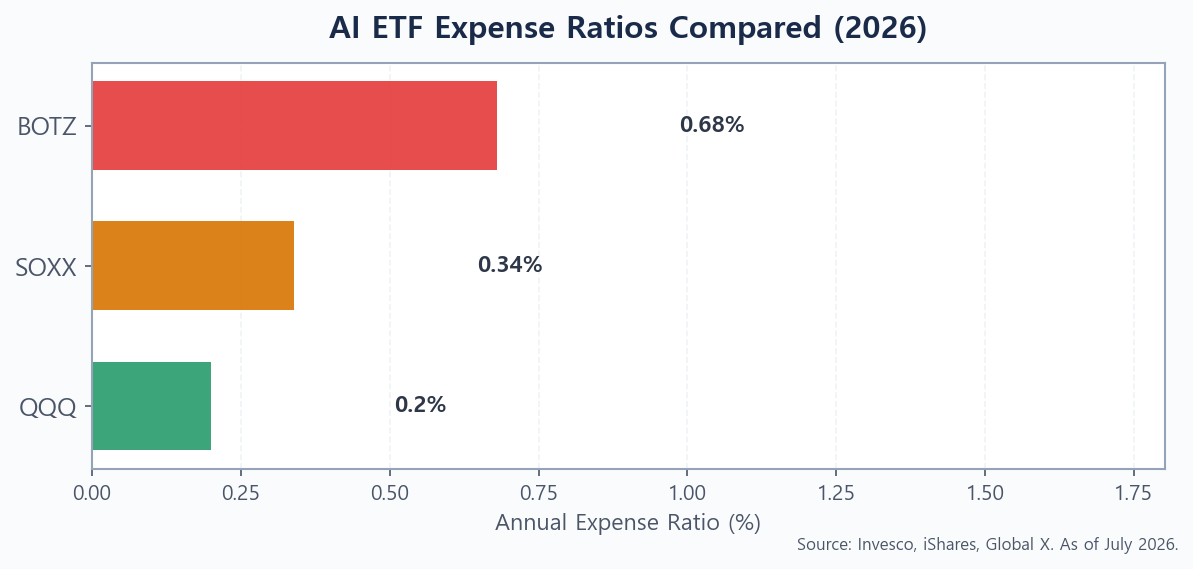
Cost is the other half. The gap between a 0.20% and a 0.68% annual expense ratio may look trivial, but on a $50,000 position held for 20 years, it compounds into a meaningful difference. (If you want the full math on how expense ratios quietly eat returns over time, this deep-dive explains the numbers.)
QQQ — The Broad AI Bet at 0.20% Cost
The Invesco QQQ Trust tracks the Nasdaq-100 Index, giving investors exposure to the 100 largest non-financial companies listed on the Nasdaq. With over $280 billion in assets under management and a 0.20% expense ratio, it is the cheapest and most liquid of the three funds discussed here.
What QQQ Owns
QQQ’s largest positions tend to cluster around Apple, Microsoft, NVIDIA, Alphabet, Meta, Amazon, and Tesla. That lineup explains why many investors already have substantial indirect AI exposure without realizing it — most diversified US equity portfolios already hold QQQ or a product that closely mirrors it. NVIDIA alone, the central chip designer powering AI training, typically sits near the top five positions.
QQQ’s Hidden Weakness for Pure AI Investors
Because QQQ tracks the full Nasdaq-100, roughly a third of the fund sits in companies whose revenues have limited direct AI exposure. Consumer electronics, e-commerce, biotech, and legacy software all share the index alongside AI infrastructure names. Studies from ETF.com show that pure-play AI ETFs (AIQ, IGPT) have delivered performance within a narrow range of QQQ over the past eight years, which is why some seasoned investors argue that paying a higher expense ratio for a narrower “AI” label is hard to justify when QQQ already captures the AI upside more cheaply.
QQQ is the default choice if you want broad AI exposure with minimal cost and maximum liquidity — but it is not a precise bet on any specific AI sub-theme.
SOXX — Semiconductor Infrastructure, the Backbone of AI (0.34%)
The iShares Semiconductor ETF (SOXX) tracks the NYSE Semiconductor Index and holds approximately 30 US-listed chip companies. With $21.7 billion in AUM and a 0.34% expense ratio, it provides focused access to the companies that design, manufacture, and supply the silicon on which every AI model depends.
What SOXX Owns
SOXX’s core holdings are NVIDIA, TSMC (US ADR), Broadcom, ASML, Qualcomm, and Intel. These are the names you consistently see named in AI infrastructure buildout conversations — datacenter GPUs, advanced foundry nodes, high-bandwidth memory, networking ASICs. Over the past decade, SOXX has delivered an annualized total return of 27.2% (Source: iShares, as of 2026), one of the strongest long-run records among sector ETFs.
Why Semiconductors Are the “Picks and Shovels” of the AI Gold Rush
The “picks-and-shovels” analogy — owning the tools sold to every miner rather than betting on any single mine — is a useful frame for SOXX. Whether OpenAI, Google, Meta, or a startup trains the next breakthrough model, they all buy chips. SOXX’s 2026 year-to-date performance significantly outpaced BOTZ as AI capital expenditure continued to flow into hardware. If you believe AI infrastructure spending will stay elevated for years, SOXX is arguably the most direct, cost-efficient way to own that thesis.
Worth noting: SOXX concentrates in US-listed companies, giving it a domestic tilt that limits geographic diversification but also avoids some of the currency and political risk embedded in global AI plays.
If you want to compare the top individual chips inside SOXX, our article on NVIDIA vs TSMC — which AI chip stock is the smarter long-term buy goes into detail on valuation and risk.
BOTZ — Robotics and Automation, a Different Kind of AI (0.68%)
The Global X Robotics & Artificial Intelligence ETF (BOTZ) focuses on the physical layer of AI — industrial robots, surgical systems, automated warehousing, and factory intelligence. Launched in 2016, it holds $3.56 billion in assets at a 0.68% expense ratio, making it the most expensive of the three funds.
What BOTZ Owns
BOTZ’s top holdings as of mid-2026 include NVIDIA (11.2%), ABB (10.6%), Keyence (9.57%), Fanuc (9.0%), and Intuitive Surgical (6.35%) (Source: Global X, as of June 2026). A key feature — and a risk — is that BOTZ is globally diversified: four of its top ten holdings are Japanese companies, ABB is Swiss, and non-US exposure likely exceeds 50% of the portfolio. This makes BOTZ a meaningfully different bet from QQQ and SOXX, both of which are dominated by US stocks.
The Case for BOTZ — and Its 2026 Lagging Performance
BOTZ is the right ETF if your AI thesis is that physical automation will reshape manufacturing, logistics, and healthcare over the next decade. The fund gives you that exposure in a single ticker rather than researching individual Japanese robotics companies. The downside: in H1 2026, physical automation underperformed the infrastructure and software layers of AI, dragging BOTZ’s returns well below both SOXX and QQQ. Investors who bought BOTZ expecting near-term AI-driven gains found themselves holding a more cyclical industrial portfolio instead.
One factor worth monitoring: BOTZ’s high expense ratio (0.68%) makes it a meaningful cost drag in periods of flat or modest returns. Before committing, consider whether the specific robotics exposure is part of your thesis, or whether you simply want AI exposure broadly — if the latter, QQQ or SOXX may serve you better at lower cost.
Given BOTZ’s concentration in AI-adjacent high-growth sectors, it’s also worth reading our analysis on how to protect your portfolio from an AI bubble if this ETF would become a significant position.
Head-to-Head: QQQ vs SOXX vs BOTZ — The Numbers Side by Side
The table below consolidates the key metrics across all three funds as of mid-2026, giving you a quick reference for the decisions that matter most: cost, size, holdings count, and geographic concentration.
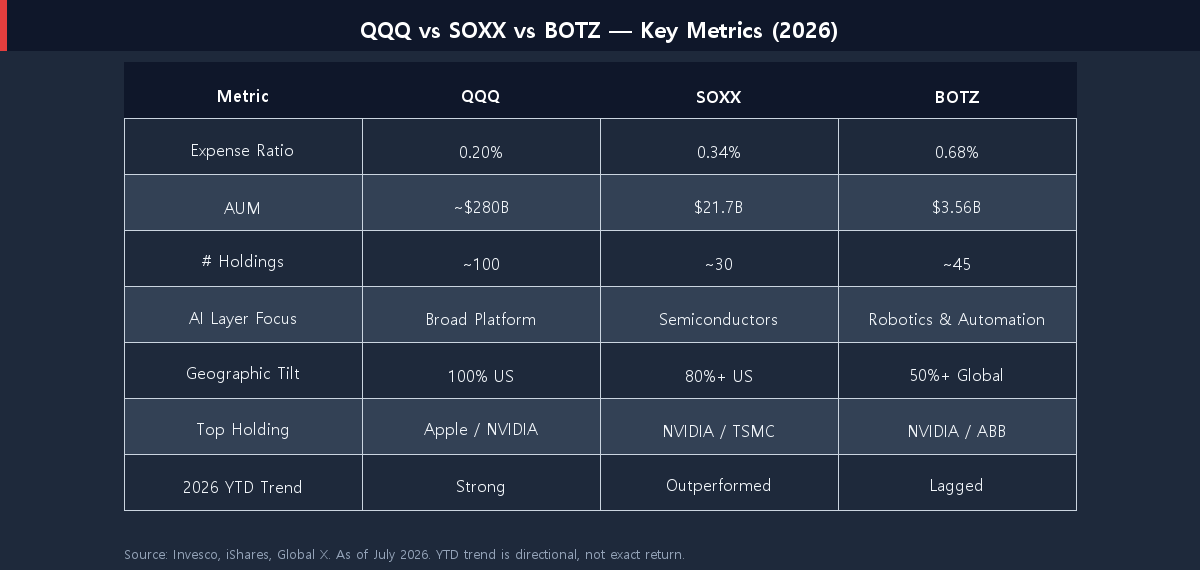
The bottom line from that comparison: QQQ wins on cost and liquidity; SOXX wins on targeted semiconductor exposure at a reasonable fee; BOTZ offers a unique robotics angle but charges the most and carries significant global risk. None of the three is universally “best” — the right pick depends on your thesis.
One pattern worth noting: broad AI ETFs with 60–70% Nasdaq-100 overlap give you little differentiation from QQQ while charging more. Before buying any AI-themed ETF, check its top ten holdings against what you already own. You may already have the exposure. (If you are thinking about your broader asset mix, equal-weight vs market-cap ETF strategies in 2026 is a useful companion read.)
ETF vs. Owning Individual Stocks: When Each Makes Sense
The Case for Individual Stocks (NVIDIA, TSMC, Broadcom)
During a strong AI investment cycle, a portfolio of three to five high-conviction semiconductor or AI platform names has historically outperformed a basket ETF — and you avoid all fee drag. If you are willing to track quarterly earnings, monitor export restriction risks, and hold through the volatility of single-company news, owning NVIDIA, TSMC, and Broadcom directly lets you size your conviction precisely.
The caveat: owning the ETF and layering individual stocks on top is common but often redundant. If SOXX already holds NVIDIA at 15% of the fund and you also own NVIDIA directly, adding SMH on top triples your effective NVIDIA exposure without adding diversification. Be intentional about overlap before building the “core + satellite” structure many advisors recommend.
Why Most Investors Should Still Choose an ETF
For the majority of investors, the ETF structure wins on convenience, tax simplicity, and discipline. ETFs automatically rebalance when one holding grows too dominant, they require no earnings research, and they prevent the common behavioral trap of holding one AI stock too long because you are emotionally attached to the company’s story. The semiconductor cycle is also more volatile than the broad market — individual chip stocks have experienced 50–70% drawdowns even during multi-year bull markets.
If you are building a core portfolio that you want to hold for years without active management, QQQ or SOXX as part of a simple 3-fund portfolio may be a more practical structure than a collection of individual AI picks.
Which AI ETF Strategy Is Right for You in 2026?
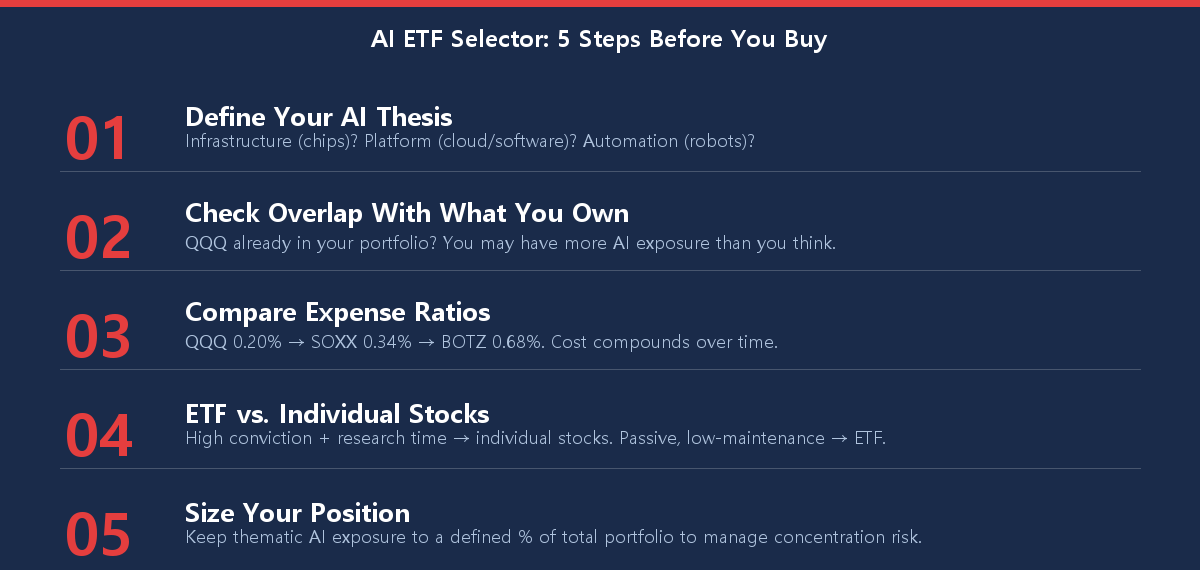
There is no universal answer — but the framework below should help you decide based on your thesis and situation.
Core + Satellite Approach
The approach that works for many AI-focused investors: use QQQ or SOXX as the core position (broad, low-cost, liquid) and allocate a smaller satellite position to either BOTZ (if the robotics thesis resonates) or 2–3 individual names like NVIDIA and TSMC. Keep the satellite to 10–20% of the total AI allocation so a bad quarter in any single name does not derail the portfolio.
Whichever approach you choose, review holdings overlap before buying. The most common and costly mistake in thematic investing is doubling up — paying two sets of fees to own the same five companies twice.
Found this comparison useful? Bookmark it so you can revisit when the market moves. I publish practical investing breakdowns on FinvestLog regularly — check back soon.
This article is for informational purposes only and is not investment advice. Do your own research before making any investment decisions.