
A reliable paycheck from your portfolio has obvious appeal, and covered call ETFs are built to deliver exactly that: a high distribution paid every single month. The three funds investors ask about most are JEPI, JEPQ, and QQQI — each pairing a stock portfolio with an options strategy to manufacture income, but at very different yields, costs, and risk levels. This guide to the best covered call ETFs for monthly income in 2026 compares all three, explains how the income is actually generated, and helps you decide which one fits your goals.

How Covered Call ETFs Turn Stocks Into Monthly Income
A covered call ETF holds a portfolio of stocks and then sells call options against that portfolio. A call option gives the buyer the right to purchase the underlying at a set price, and in exchange the fund collects an upfront premium. The fund repackages those premiums into a large monthly distribution. Because option premiums rise when markets are volatile, these funds can pay far more than a traditional dividend ETF.
The trade-off is the part many income chasers overlook. Selling calls caps how much the fund can gain when the market rallies hard — the upside above the strike price is handed to the option buyer. So in a strong bull market, a covered call ETF will usually lag a plain index fund on total return, even while it keeps paying a generous monthly check. These products are income tools, not growth engines.
The 3 Best Covered Call ETFs for Monthly Income in 2026
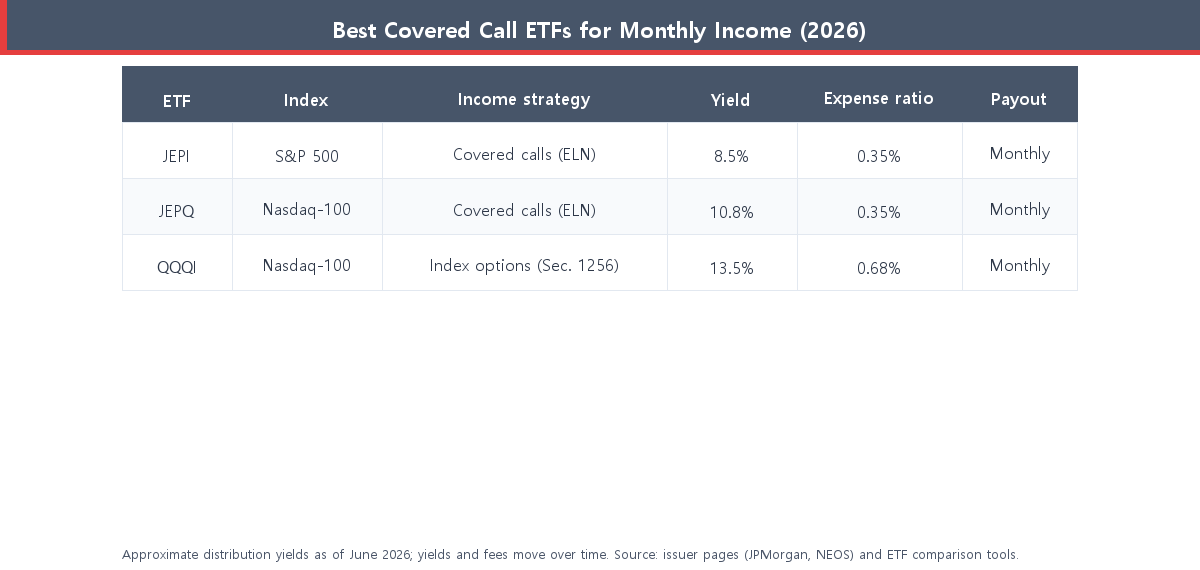
The table below compares the three most widely held monthly-paying covered call ETFs on what matters most: the index they track, how they generate income, their distribution yield, the fee, and how often they pay. All figures are approximate as of June 2026 and move with markets.
JEPI — The Conservative S&P 500 Income Anchor
The JPMorgan Equity Premium Income ETF (JEPI) is the largest and most conservative of the three. It holds a defensive, lower-volatility slice of the S&P 500 and generates option income through equity-linked notes. With a distribution yield around 8.5% and a 0.35% expense ratio, JEPI pays the smallest headline number here, but its S&P 500 base makes it the steadiest. It suits investors who want strong monthly income without taking on concentrated technology risk.
JEPQ — Higher Yield From the Nasdaq-100
JEPQ applies JPMorgan’s same approach to a Nasdaq-100-style portfolio. Because tech-heavy indexes are more volatile, the options sold against them command richer premiums, pushing JEPQ’s yield to roughly 10.8% — also paid monthly, at the same 0.35% fee. The higher income comes with more concentration in large technology names and bigger price swings. It is the middle ground: more yield than JEPI, less complexity than QQQI.
QQQI — The Highest Yield With Tax-Smart Distributions
The NEOS Nasdaq-100 High Income ETF (QQQI) tops the list on yield, distributing roughly 13.5% as of mid-2026. It pairs Nasdaq-100 stocks with index options that qualify for Section 1256 tax treatment — gains are split 60% long-term and 40% short-term regardless of holding period, which can improve after-tax income for investors in higher brackets. The catches: a steeper 0.68% expense ratio, and distributions that have included a large return-of-capital component, meaning part of your “income” can be your own principal handed back.
The video below breaks down how the Nasdaq covered call funds stack up heading into 2026 and where each one fits.
Yield vs. Cost: Comparing the Numbers
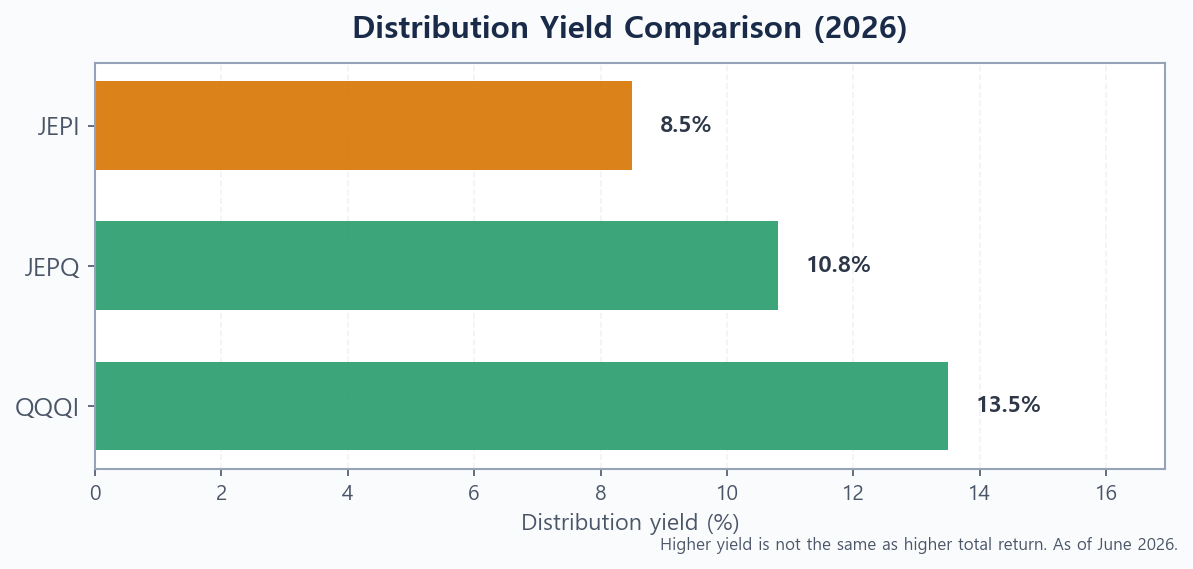
Yield is the headline reason investors buy these funds, so it is worth seeing the gap clearly. The chart below lines up the three distribution yields side by side. QQQI’s roughly 13.5% towers over JEPI’s 8.5%, but remember that a higher distribution rate is not the same as a higher total return — it tells you how much cash arrives, not how much wealth you keep after price changes.
What You Pay: Expense Ratios
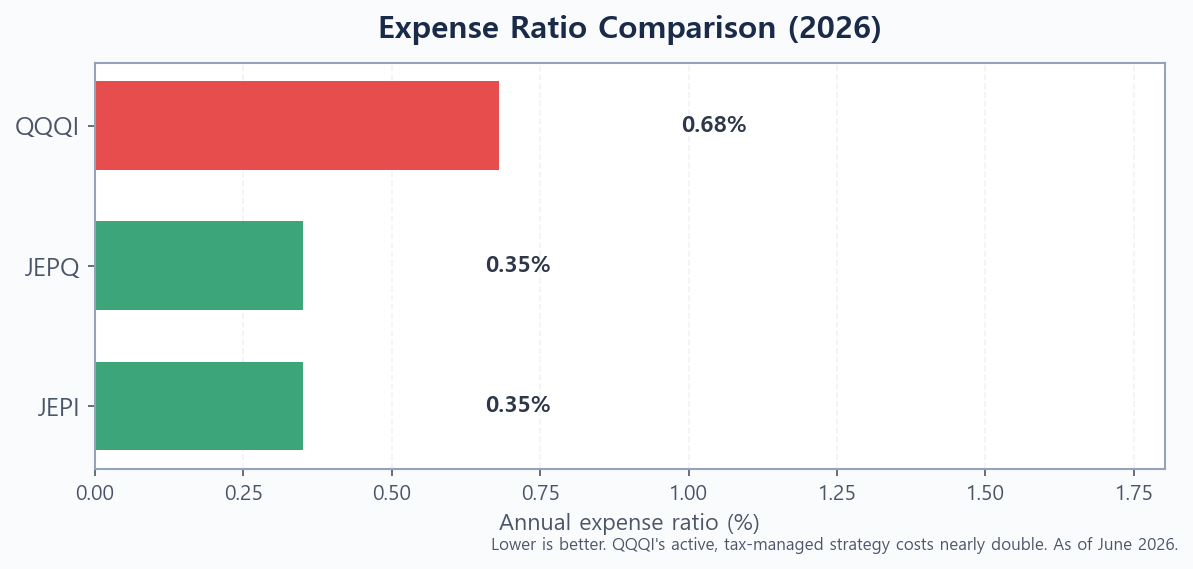
Fees quietly subtract from every distribution and every dollar of return. JEPI and JEPQ both charge 0.35%, while QQQI’s more active, tax-managed strategy costs nearly double at 0.68%. On a long-held position that gap compounds, so it is fair to ask whether QQQI’s extra yield and tax features justify the higher price. If fees are new to you, our explainer on how an ETF expense ratio eats your returns shows why even small percentages matter over time.
The Hidden Trade-Offs of Covered Call ETFs
Before chasing the biggest yield, weigh three structural costs that headline numbers hide. First is capped upside: in a roaring tech rally, JEPQ and QQQI can badly trail the plain Nasdaq-100 because the calls they sold give away the gains. Second is NAV erosion — when a fund pays out more than it sustainably earns, its share price can drift lower over time, eating into the principal that generates your income.
Third is taxes and return of capital. A large monthly distribution often mixes ordinary income, capital gains, and return of capital. Return of capital is not free money — it lowers your cost basis and can be your own money coming back. QQQI’s Section 1256 treatment helps in taxable accounts, but covered call income is generally taxed less favorably than the qualified dividends from a fund like those in our roundup of the best high-yield dividend ETFs for 2026. For many investors, these funds work best inside tax-advantaged accounts.
Which Covered Call ETF Is Right for You?
There is no single winner — the right choice depends on what you are optimizing for. If you want the steadiest monthly income and prefer broad S&P 500 exposure, JEPI is the conservative anchor. If you want a meaningfully higher yield and can stomach tech concentration, JEPQ is the balanced middle. If maximum cash flow and tax efficiency in a taxable account are the priority — and you accept a higher fee plus return-of-capital nuance — QQQI leads on yield.
- Want stability over size of check: JEPI (S&P 500, ~8.5%).
- Want more yield, accept tech risk: JEPQ (Nasdaq-100, ~10.8%).
- Want the highest tax-smart income: QQQI (Nasdaq-100, ~13.5%).
Many income investors hold more than one, or pair a covered call fund with a dividend-growth ETF for rising payouts over time — see our SCHD vs. VIG dividend-growth comparison. Wherever these funds land, decide how much of your portfolio belongs in high-yield income versus growth; our beginner’s guide to asset allocation walks through that balance.
Final Thoughts
The best covered call ETF for monthly income in 2026 is the one whose trade-offs you understand and accept. JEPI offers steady S&P 500 income, JEPQ raises the yield with Nasdaq exposure, and QQQI pushes income highest with a tax-aware, higher-cost structure. Read the distribution composition, mind the fees, and remember that a 13% yield with a sliding share price can leave you behind an 8% fund that holds its value. Match the fund to your income needs, risk tolerance, and account type before you buy.
This article is for informational purposes only and is not investment advice. Yields, fees, and fund characteristics are approximate as of June 2026 and change over time; verify current figures on each issuer’s page before investing.