
The 30-year US Treasury bond crossed 5% yield in 2026 — a level last seen nearly two decades ago. For long-duration investors, that figure carries a clear promise: lock in a 5%+ annual income stream, backed by the full faith and credit of the US government, for thirty years. The question is whether the promise is worth the risk. This guide breaks down the duration math, the bull and bear arguments, four concrete rate scenarios, and three practical ways to buy the 30-year Treasury today.

Why the 30-Year Yield Crossed 5% in 2026
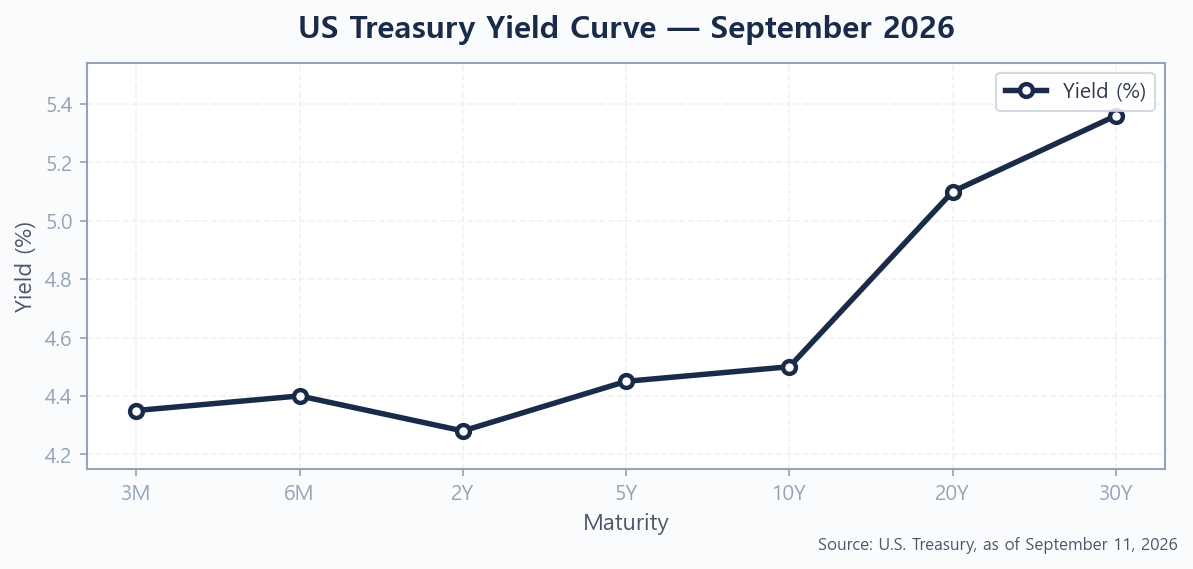
As of September 11, 2026, the 30-year Treasury yield stood at 5.36%, its highest reading since 2007 (Source: U.S. Treasury / FRED). While shorter maturities like the 2-year yield hovered near 4.28%, long-end yields have surged — a textbook bear steepener.
Three forces drove the move:
- Persistent fiscal deficit. US government interest payments surpassed $857 billion in the first nine months of fiscal year 2026, up 13% year-over-year (Source: U.S. Treasury). Markets are demanding a higher term premium — extra compensation for lending to Washington for 30 years.
- Sticky tariff inflation. The re-escalation of tariffs in 2025–2026 kept headline CPI elevated. Investors pricing in a 3%+ inflation floor over the long run pushed both real and nominal yields higher.
- Federal Reserve on hold. The 2026 FOMC dot plot shifted toward higher-for-longer, anchoring the short end but leaving the long end to price in inflation uncertainty independently. (For the full rate-path picture, see Will the Fed Hike Rates in 2026? Higher for Longer.)
The result is an unusually steep curve: the 2-year/30-year spread has widened to over 100 basis points — a level last seen in the early 2010s. The full yield curve as of September 2026 is shown below.
For a deeper look at what the steepening means structurally, see Treasury Yield Curve Steepening in 2026: What It Means for Long-Term Bond Investors.
What 5% Means for Long-Duration Investors
Duration Math: How Much Can You Gain — or Lose?
A 30-year Treasury issued at par with a ~5% coupon carries a modified duration of approximately 16 years. That single number defines your interest-rate sensitivity in both directions:
- Yields fall 100 bps (to ~4.36%): price appreciates roughly +16%
- Yields fall 200 bps (to ~3.36%): price appreciates roughly +32%
- Yields rise 100 bps (to ~6.36%): price falls roughly −16%
Add the 5% coupon income on top of any price change, and a Fed-pivot scenario playing out over 12–18 months could deliver total returns north of 20%. Conversely, a 100 bps yield rise would wipe out roughly three years of coupon in price losses alone. Duration is a two-edged sword — the key is entering with a clear thesis about the rate path.
Lock-In Advantage vs. Reinvestment Risk
The strongest case for buying today is simple: short-term T-bills (currently ~4.35%, Source: U.S. Treasury, September 2026) must be rolled over every 3–12 months, exposing investors to rate cuts or a soft-landing scenario in which reinvestment rates drop sharply. A 30-year bond eliminates that reinvestment uncertainty for three decades. Retirees and near-retirees living off fixed-income cash flows have a compelling structural argument here. See also our 10-Year Treasury Yield Outlook 2026 for context on where the broader curve is headed.
The Bull Case: Three Reasons to Buy the Long Bond Now
- Historically elevated starting yield. At 5.36%, the 30-year offers its highest coupon since the mid-2000s. Mathematically, a high starting yield acts as a cushion — even if yields rise another 50 bps, the coupon income partially offsets the mark-to-market loss within 12–18 months.
- Significant price upside in a growth slowdown. If US growth disappoints in 2027 — through tariff drag, consumer spending fatigue, or a credit tightening — the Fed would eventually pivot. A 200 bps decline in the 30-year yield would generate a roughly 32% price gain on top of the coupon, a payoff few asset classes can match in a recession scenario.
- Portfolio hedge against equity drawdowns. Long Treasuries historically rally during equity selloffs. For investors with 60–70% equity allocations, a modest long-bond position adds genuine diversification. The 2022 episode — when both stocks and bonds fell simultaneously — was driven by inflation normalization from near-zero rates; that specific setup is much less likely at 5%+ yield levels.
The video below offers a practical take on the lock-in-now vs. wait-for-higher-yields decision that many investors are weighing in 2026.
The Bear Case: Three Reasons to Stay Short Duration
- Fiscal trajectory is structurally bearish for long bonds. With US federal debt service exceeding $1 trillion annually and no credible deficit-reduction plan on the near-term horizon, the supply of long-dated Treasuries is set to expand. More supply at the same demand means higher yields over time — and mark-to-market losses for current 30-year holders.
- The inflation floor may have shifted higher. The post-tariff CPI regime, combined with onshoring-driven labor cost pressures, may make 3%+ inflation structurally persistent rather than temporary. With the 30-year real yield at roughly 2.3% (nominal 5.36% minus 10-year breakeven ~3.0%), the inflation-adjusted return is not especially generous given that uncertainty. For inflation-protected alternatives, see TIPS vs. I Bonds: Best Inflation Protection for 2026.
- Term premium repricing may not be complete. After a decade of near-zero rates and Fed balance-sheet suppression of long yields, the market’s fair-value term premium remains unsettled. Rosenberg Research and Charles Schwab analysts have both noted that the full repricing could push the 30-year toward 5.5–6.0% before the bond market stabilizes — meaning current buyers could face further near-term losses.
Worth reading next: Corporate Bonds vs. Treasuries in 2026: Worth the Risk? — for investors weighing whether investment-grade corporate bonds’ extra ~1% yield compensates for the credit risk over a long horizon.
A Decision Framework: Four Rate Scenarios for 2026–2027
Rather than predicting a single outcome, the most useful exercise is mapping total returns across a range of plausible scenarios. The table below uses a modified duration of 16 years and a starting 30-year yield of 5.36% to estimate 12-month total returns (price change + coupon). Estimates are illustrative; actual returns will vary.
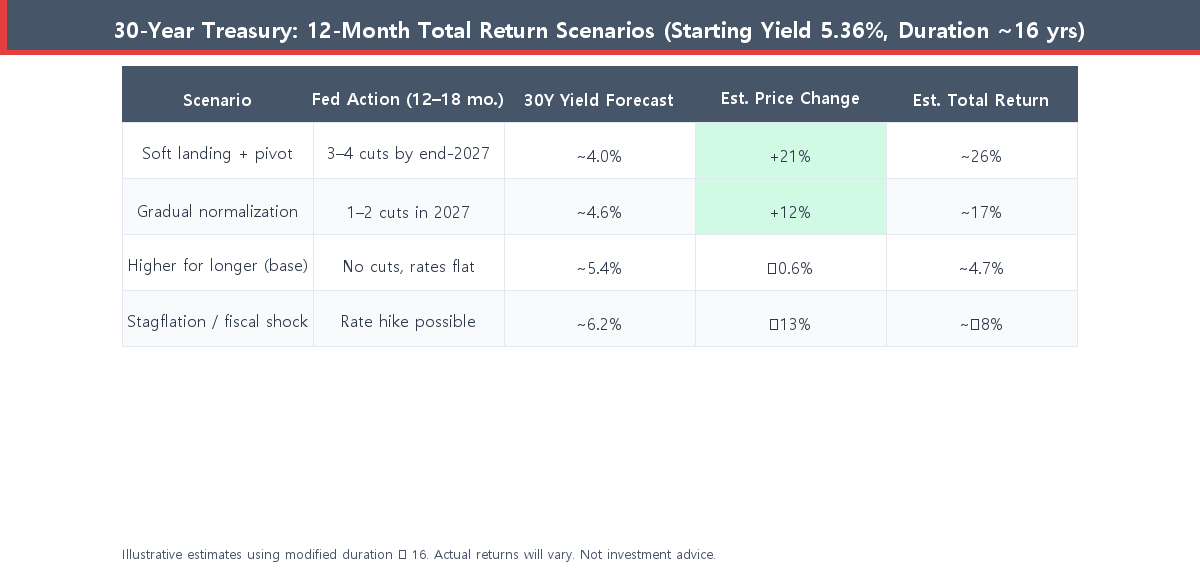
The key insight: the payoff is asymmetric in the bull direction. A Fed pivot — even a modest one — delivers outsized total returns relative to the coupon alone, while the “higher for longer” base case still provides a decent ~4.5–5% income return. The true risk is a fiscal shock that pushes yields to 6%+, which would generate a meaningful 12-month loss despite the coupon.
How to Buy 30-Year Treasuries (Three Methods)
Once you’ve formed a view, execution is straightforward. Three main routes exist:
- TreasuryDirect (US residents only). Buy new 30-year bonds directly from the US Treasury at monthly auctions — no commission, $100 minimum. Interest is exempt from state and local income tax. Non-US residents are generally ineligible for TreasuryDirect; for that path, see How to Buy US Treasury Bonds as a Foreigner (2026 Guide).
- Brokerage — secondary market. Interactive Brokers, Fidelity, and Charles Schwab all offer commission-free individual Treasury purchases in the secondary market. You purchase at the current market price, and the yield-to-maturity reflects today’s 5.36% pricing. This is the most flexible route: any dollar amount, any existing bond, no auction schedule required.
- Long-duration Treasury ETFs. For investors who want liquidity without managing individual bonds, ETFs like TLT (iShares 20+ Year Treasury, expense ratio 0.15%) and EDV (Vanguard Extended Duration, ~25-year avg. maturity, 0.06%) provide simple long-bond exposure. The tradeoff: ETFs never mature at par, so you carry perpetual mark-to-market volatility. For a side-by-side of individual bonds vs. ETFs for income goals, see Treasury Bond Ladder vs. Bond ETF: Retirement Income 2026.
Final Verdict: Is This a Generational Buying Opportunity?
The 30-year Treasury at 5%+ yield in 2026 is unambiguously attractive relative to any point in the last 15 years. Whether it is a generational opportunity depends on how the US resolves its fiscal trajectory and whether inflation returns sustainably toward 2%. The bull case is compelling: historically high starting yields, outsized price upside in a growth-scare or Fed-pivot scenario, and a genuine equity diversifier. The bear case is credible: structural deficits, a higher inflation floor, and a term-premium repricing that may not yet be finished.
The practical approach for most long-duration investors is to phase in gradually: deploy a meaningful but not fully committed tranche now (one-quarter to one-third of the intended allocation) and add incrementally on yield spikes toward 5.5–6% if they materialize. Avoid concentrating in a single week given the duration sensitivity. The 30-year bond rewards patience — both in entry timing and in holding period.
Found this useful? Bookmark it — this is the kind of post worth revisiting whenever the 30-year yield moves 50+ bps in either direction.
This article is for informational purposes only and is not investment advice. Do your own research before making any investment decisions.