
The S&P 500 has dominated US investor portfolios for the better part of a decade. But 2026 is reshaping that story. VEA — Vanguard’s developed-markets ETF — has returned 28.9% over the trailing 12 months. VXUS, its broader sibling including emerging markets, has returned 26.3%. Even the older, pricier EFA from iShares has clocked 25.1% (Source: ETF provider data, as of August 2026). International stocks are outperforming US equities for the first time in years, and many investors are asking whether they have waited too long to diversify.
This guide compares VEA, VXUS, and EFA side by side, explains how each one is built, and walks through how to decide how much international exposure actually fits your portfolio in 2026.
Why International Stocks Are Back in the Spotlight in 2026
Three structural forces have converged to make international stocks look more attractive than they have in years.
US dollar weakness. A softer dollar magnifies international returns for US-based investors. When a European or Japanese stock rises 10% in local currency and the dollar also weakens against that currency, the USD return can land well above 10%. This currency tailwind has been a significant contributor to international outperformance in 2026. (If you want to understand the mechanics in detail, see our post on how a weak dollar boosts international returns.)
US market concentration risk. The top ten holdings in the S&P 500 now represent roughly 35% of total index weight — the most concentrated the benchmark has been in modern history. An investor holding only a US-equity index fund is taking concentrated bets on a small cluster of mega-cap technology names, whether they realize it or not. International ETFs offer exposure to sectors and companies outside that cluster.
Valuation gap. International developed-market stocks trade at approximately 12–14× forward earnings, compared to 20–22× for the S&P 500 as of mid-2026 (Source: JPMorgan Asset Management Guide to the Markets, Q3 2026). That spread does not guarantee outperformance, but it does mean investors are paying significantly less per dollar of earnings in markets like Japan, the UK, and Germany.
The market-cap math. The US represents approximately 63% of total global stock market capitalization. The other 37% is outside US borders. An investor with a 100% US equity portfolio is dramatically overweight relative to global market weighting — often without having made an explicit choice to be so.
Understanding the Three ETFs: VEA, VXUS, and EFA
VEA — Vanguard FTSE Developed Markets ETF
VEA tracks the FTSE Developed All Cap ex-US Index, which covers large-, mid-, and small-cap stocks across 24 developed countries outside the United States. The fund holds approximately 3,920 securities, with top country weights tilted toward Japan (~21%), the United Kingdom (~14%), Canada (~9%), and France (~8%). The expense ratio is just 0.03% — among the lowest of any international ETF available.
Critically, VEA excludes emerging markets entirely. Investors who want developed-market exposure without the added volatility of China, India, or Brazil will find VEA’s narrower scope appealing. The trade-off is less total diversification across the global economy.
VXUS — Vanguard Total International Stock ETF
VXUS is a one-fund solution for everything outside the United States. It tracks the FTSE Global All Cap ex-US Index and holds roughly 8,600 securities spanning both developed and emerging markets. Approximately 26% of the fund is allocated to emerging economies. The expense ratio is 0.05% — only two basis points more than VEA despite offering significantly broader coverage.
VXUS is the international fund used in the classic 3-fund portfolio (US total market + international + bonds), and for good reason. If you want a single international ETF that covers the whole world, VXUS is the most cost-effective way to get it.
EFA — iShares MSCI EAFE ETF (and Why IEFA Is Better)
EFA is one of the oldest international ETFs on the market, tracking the MSCI EAFE Index (Europe, Australasia, and Far East). It holds roughly 900 large- and mid-cap stocks, excludes both Canada and emerging markets, and carries an expense ratio of 0.32% — more than ten times what VEA charges. For most new investors in 2026, EFA is difficult to justify on cost grounds alone.
The better alternative within the iShares lineup is IEFA (iShares Core MSCI EAFE ETF), which expands holdings to approximately 2,600 securities (adding small-cap exposure) and charges just 0.07%. If you have existing EFA shares in a taxable account and switching would trigger a large capital gains event, it may make sense to hold — but for new purchases, IEFA is generally the more efficient choice.
VEA vs VXUS vs EFA: Key Metrics Compared
Here is how the three funds stack up across the metrics that matter most for long-term investors.
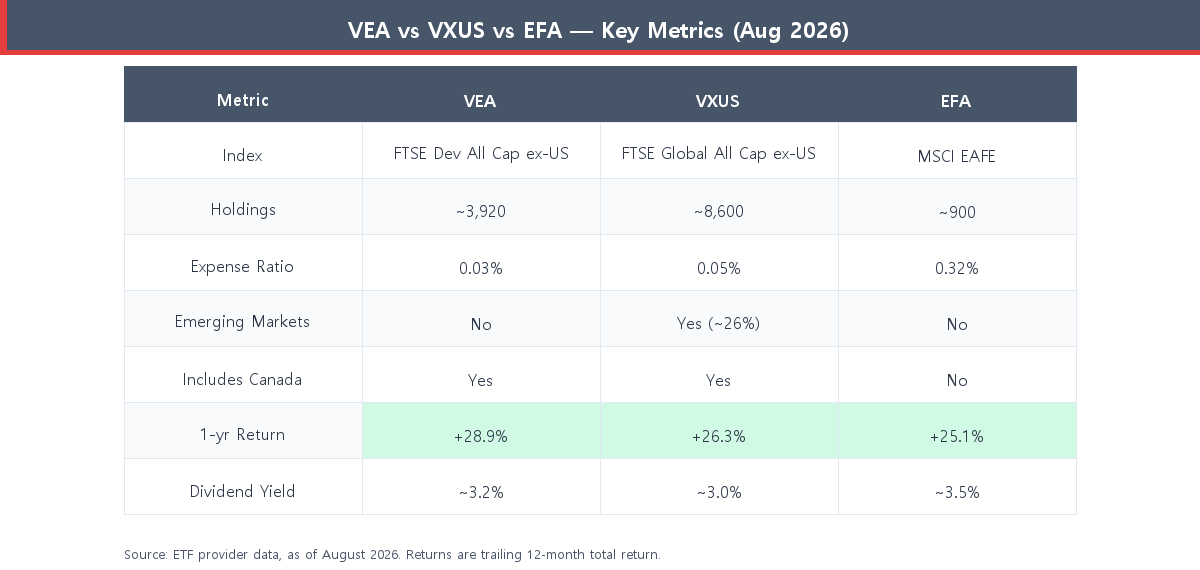
The standout takeaway from the table: EFA charges 0.32% for roughly 900 holdings while VEA charges 0.03% for nearly four times as many securities. Unless you have a specific mandate to track the MSCI EAFE index — for example, because a 401(k) only offers EFA — VEA or VXUS will serve most investors better on cost and diversification.
How International Stocks Have Performed in 2026
The 2026 performance reversal has been notable. After a decade in which the US market returned roughly double what international markets did, the past 12 months have flipped the script. VEA’s 28.9% trailing return leads VXUS (26.3%) and EFA (25.1%), all of which have outpaced major US benchmarks over the same period (Source: ETF provider data, as of August 2026).
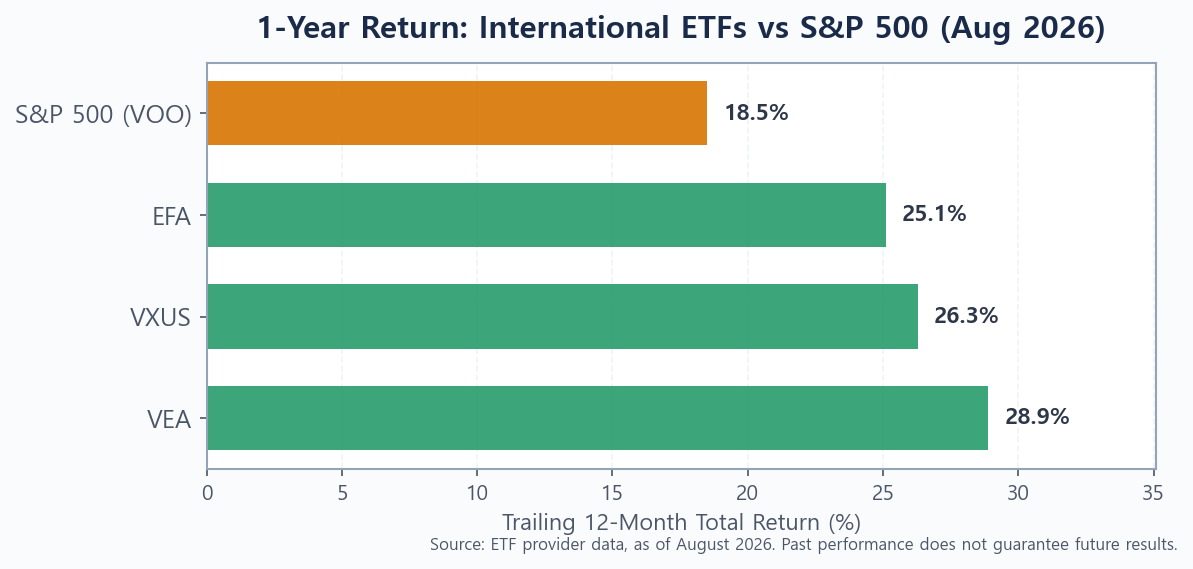
This outperformance does not mean international stocks will continue to beat the US. Markets cycle. But it does illustrate that the long-running narrative that “international stocks never work” was overstated — and that investors who held no international exposure over the past year left meaningful returns on the table.
How Much International Exposure Should You Actually Hold?
There is no universally correct answer, but several frameworks can guide your thinking.
- Global market-cap weight: If you want to hold the world as it is, put approximately 37–40% of your equity allocation in international funds. This is the purist approach, endorsed by index-fund proponents like Jack Bogle’s successors at Vanguard.
- Common practical range: Many financial planners suggest 20–30% of total equity as a starting range — enough to provide meaningful diversification without letting currency volatility dominate short-term returns.
- Evidence-based tilt: Researchers like Ben Felix at PWL Capital argue for even heavier international weighting — his model portfolio allocates roughly 55% to non-US stocks when combining developed and emerging markets.
- Target-date funds: Vanguard’s own target-date funds typically hold around 30% international equity, which can serve as a useful benchmark.
For a broader framework on how to think about the stocks-to-bonds split before you reach the geographic question, see our beginner’s guide to asset allocation.
The Case Against International Stocks (and the Counter-Arguments)
To make an informed decision, it is worth hearing the skeptical view honestly before deciding where you land.
Bear case 1 — Long-term underperformance. Over the 10 years ending in 2025, US stocks (as measured by the S&P 500) roughly doubled the annualized return of international developed-market stocks. A decade is a long time to wait for mean reversion that might not arrive. Counter: The same valuation gap that makes international stocks look attractive now was building throughout that underperformance period. Relative valuations do tend to revert over very long horizons, though the timing is unknowable.
Bear case 2 — Currency risk. Adding international stocks exposes you to currency fluctuations. A 10% gain in Japanese equities can evaporate quickly if the yen weakens against the dollar by the same amount. Counter: Currency risk also works in reverse — as 2026 demonstrates, dollar weakness amplifies international gains. Over long periods, currency effects tend to average out.
Bear case 3 — Geopolitical and regulatory risk. Emerging-market exposure (included in VXUS but not VEA or EFA) carries added uncertainty from government policy changes, delisting risks, and capital controls in markets like China. Counter: VEA sidesteps most of this by limiting exposure to developed economies. Even VXUS caps emerging-market weight at roughly 26%, limiting the damage any single country crisis can inflict.
The video above brings together ten experienced investors to debate international diversification from multiple perspectives — useful for pressure-testing your own reasoning before you commit.
How to Add International Stocks to Your Portfolio
If you have decided that some international exposure makes sense for you, here is a practical five-step approach.
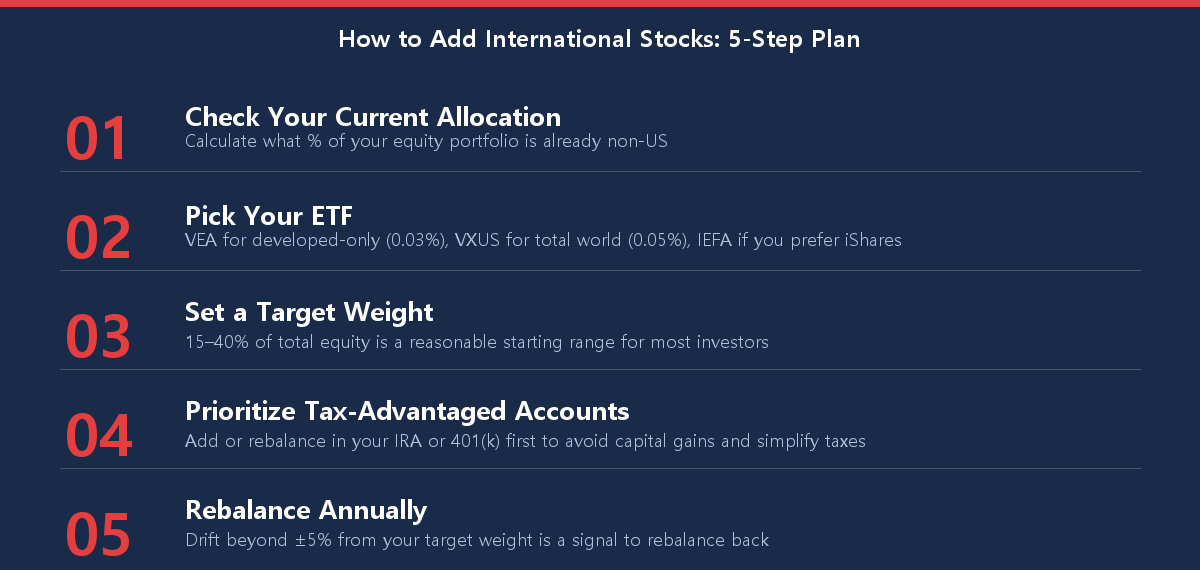
- Calculate your current allocation. Pull up your brokerage account and add up all non-US equity holdings. If that number is zero or under 10%, you have significant home-country bias.
- Choose your fund. VEA is the right choice if you want developed-market exposure only at minimum cost (0.03%). VXUS is the better choice if you want total international coverage including emerging markets in one fund (0.05%). EFA is hard to recommend for new purchases given its higher cost; consider IEFA if you prefer the iShares platform.
- Set a target weight. Pick a number in the 15–40% of total equity range and commit to maintaining it. Write it down. Vague intentions tend to get abandoned during periods of US outperformance.
- Prioritize tax-advantaged accounts first. Adding or rebalancing international funds inside an IRA or 401(k) avoids triggering capital gains events and simplifies the foreign tax credit picture. Taxable accounts can hold international ETFs too, but they involve additional year-end paperwork.
- Rebalance when your target drifts. A common rule of thumb is to rebalance when any position drifts more than 5 percentage points from target. Our portfolio rebalancing guide covers how to execute that efficiently in any rate environment.
Worth noting: if yield is a primary goal alongside diversification, international ETFs do carry higher dividend yields than the S&P 500 on average. See our dedicated post on international dividend ETFs for a deeper look at VYMI, SCHY, and other yield-focused options beyond VEA and VXUS.
Bottom Line
VEA, VXUS, and EFA all serve the same core purpose — getting you outside the US equity market — but they do it in meaningfully different ways. VEA is the low-cost developed-market pick. VXUS is the broadest one-fund international solution. EFA is a legacy product that most investors would replace with IEFA or simply VEA on cost grounds. The right choice depends on whether you want emerging-market exposure and which brokerage platform you use.
The more important question is whether to add international at all. Given current valuations, dollar dynamics, and the concentration risk inside US benchmarks, the evidence in 2026 tilts toward adding at least a meaningful international sleeve — though exactly how much is a personal decision tied to your risk tolerance, time horizon, and existing portfolio structure.
Found this useful? Bookmark it and revisit when markets shift. If a friend is wrestling with the same question, share this with them.
This article is for informational purposes only and is not investment advice. Do your own research before making any investment decision.