

The classic advice — “keep your emergency fund in a savings account” — made perfect sense when savings accounts paid almost nothing. But in 2026, with competitive yields available in both high-yield savings accounts and money market ETFs, the money market ETF vs. high-yield savings account debate is worth taking seriously. The difference between getting the decision right and wrong could be hundreds of dollars a year in lost interest, or a stress-filled morning when you need cash fast and your funds are stuck in settlement.
This guide breaks down the real tradeoffs: yield, taxes, safety, and liquidity. By the end, you will know exactly which account structure makes sense for your emergency fund — or whether a combination of both is the smarter play.

What Is a Money Market ETF? (SGOV, USFR, and BIL Explained)
A money market ETF is an exchange-traded fund that holds ultra-short-duration, high-quality government debt — typically U.S. Treasury bills maturing within three months. You buy and sell shares through a brokerage account just like any stock or ETF. The three most widely used options in 2026 are:
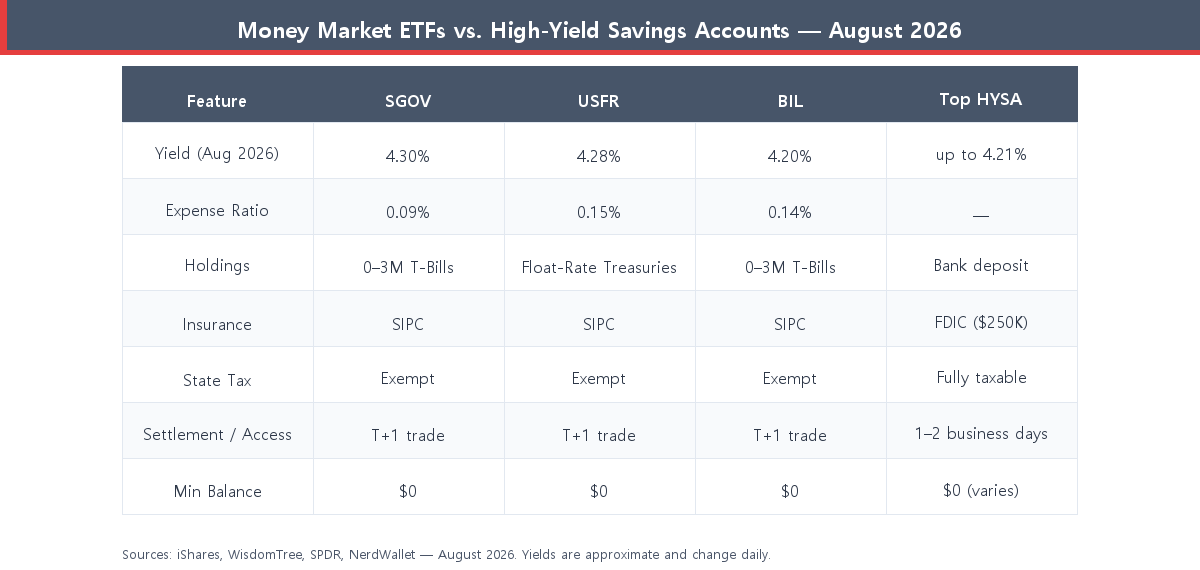
- SGOV (iShares 0-3 Month Treasury Bond ETF) — 4.30% yield, 0.09% expense ratio. Holds 0–3 month T-bills. The lowest-cost major option and the one most individual investors default to. (Source: iShares, August 2026)
- USFR (WisdomTree Floating Rate Treasury Fund) — 4.28% yield, 0.15% expense ratio. Holds floating-rate Treasury notes that reset weekly, reducing interest-rate sensitivity further.
- BIL (SPDR Bloomberg 1-3 Month T-Bill ETF) — 4.20% yield, 0.14% expense ratio. The oldest and most liquid T-bill ETF; often available commission-free at brokers where SGOV is not.
All three hold U.S. government obligations, pay monthly distributions, and are covered by SIPC (not FDIC — more on that below). Crucially, income from Treasury securities is exempt from state and local income taxes in every U.S. state — a detail that matters enormously once you run the after-tax math.
If you’re new to the mechanics of ETF fees, What Is an ETF Expense Ratio? explains how expense ratios quietly reduce your returns and why the difference between 0.09% and 0.15% compounds over time.
What Is a High-Yield Savings Account?
A high-yield savings account (HYSA) is a bank deposit account — typically offered by online-only banks — that pays a significantly higher annual percentage yield (APY) than the national average savings rate. It works exactly like a traditional savings account: you deposit money, earn interest, and can transfer funds to your checking account when needed. The key benefits are simplicity and FDIC insurance up to $250,000 per depositor per bank.
The top rates available in August 2026, according to NerdWallet and CNBC Select:
- Best available rate: up to 4.21% APY
- Marcus by Goldman Sachs: 3.50% APY, no minimum balance, no direct deposit requirement
- SoFi Checking and Savings: 4.50% APY with qualifying direct deposit; 1.20% APY without it
The conditional nature of some HYSA rates is worth noting. SoFi’s 4.50% APY is compelling, but only if you route your paycheck there — a commitment that may not suit everyone. Marcus’s 3.50% is lower but truly unconditional.
For a detailed look at how short-term bonds stack up against savings accounts specifically, see our earlier breakdown: Short-Term Bonds vs. High-Yield Savings Accounts (2026).
Yield Comparison: Money Market ETFs vs. HYSA in 2026
Current Rates at a Glance
On raw yield, money market ETFs and the top HYSAs are running nearly neck-and-neck in August 2026. But the headline numbers hide a meaningful difference once state taxes enter the picture.
The State-Tax Edge Nobody Talks About
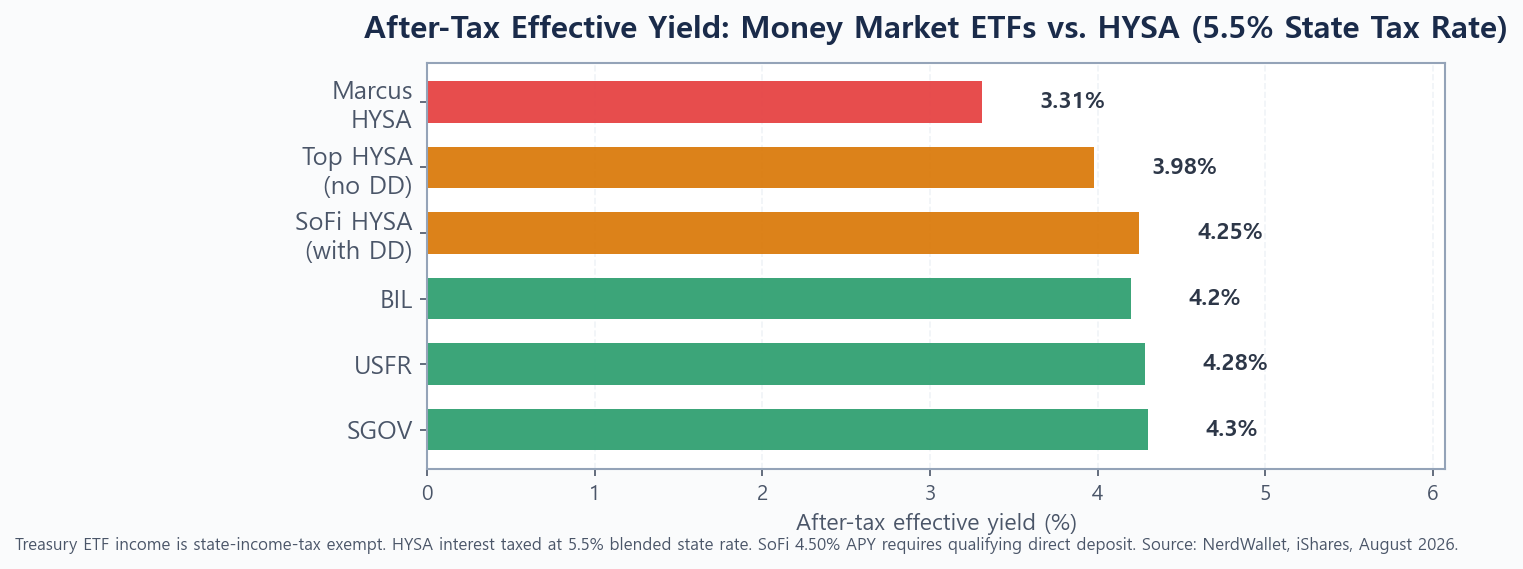
Here is the part most comparison articles skip. Income from U.S. Treasury obligations — including the distributions from SGOV, USFR, and BIL — is exempt from state and local income taxes by federal law. Interest earned on a HYSA is ordinary income, fully taxable at both federal and state levels.
Run the numbers for a resident of a moderate-tax state with a 5.5% state income tax rate:
- SGOV after state tax: 4.30% × (1 − 0%) = 4.30% effective yield
- Top HYSA after state tax: 4.21% × (1 − 0.055) = 3.98% effective yield
The gap is 0.32 percentage points. On a $30,000 emergency fund, that is roughly $96 per year in extra after-tax income — just from picking the right account type. In high-tax states like California (13.3% top rate) or New York (10.9%), the advantage is even more pronounced. (Source: Tax Foundation, 2026 state income tax rates.)
The video below compares T-bills, HYSA rates, and money market funds in detail, including the math for different tax situations:
Safety: FDIC vs. SIPC — Does the Insurance Difference Matter?
This is the most common objection to money market ETFs for emergency funds, and it deserves a direct answer.
HYSAs are FDIC-insured up to $250,000 per depositor per bank. If the bank fails, the FDIC makes you whole, typically within days. This is ironclad protection with zero counterparty risk.
Money market ETFs are held in a brokerage account covered by SIPC, which protects up to $500,000 in securities (including $250,000 in cash) if the brokerage fails — not if the underlying investments lose value. The underlying holdings of SGOV, USFR, and BIL are U.S. Treasury obligations, which carry the full faith and credit of the federal government. The ETF itself does not have a net asset value risk in the way a corporate bond fund does; T-bills maturing in under 90 days essentially cannot go to zero.
In practice, the risk difference between the two is theoretical for balances under $250,000. A brokerage custody failure (like the Lehman-era scenario SIPC was designed for) and an FDIC-insured bank failure are both extremely rare, and both have resolution mechanisms. For most savers, the FDIC label feels safer psychologically — and that feeling has real value if it means you will actually leave the money untouched during a market scare.
Liquidity and Access: Which Can You Tap in a Real Emergency?
This is where money market ETFs have a meaningful limitation that the yield numbers do not show.
When you sell shares of SGOV or BIL, the trade settles on T+1 (the next business day). The cash appears in your brokerage account the following day. Then, if you need to move that cash to your checking account to pay a bill, you initiate a bank transfer — which can take another one to two business days depending on your broker. In total, you might wait two to three business days from “I need money now” to “money is in my checking account.”
A high-yield savings account typically transfers to a linked checking account in one to two business days, and many banks offer same-day or instant transfers for a small fee. Some, like SoFi, can move money between your SoFi savings and checking accounts instantly.
For a true emergency — a car repair, a medical bill, a job loss — that one-business-day gap between an ETF and a HYSA can matter. It does not matter if your emergency fund is $50,000 and you need $3,000; you can keep a smaller liquid buffer in a checking or HYSA account. But if your entire emergency fund is in an ETF and you need it fast on a Friday afternoon, you may find yourself waiting until Tuesday.
The Smart Play: A Two-Tier Emergency Fund Strategy
Given the tradeoffs above, the optimal approach for most people is not either/or — it is a deliberate split:
- Tier 1 — Instant-access layer (1 month of expenses): Park this in a high-yield savings account. Marcus, Ally, or whichever no-minimum HYSA you already use. This is your “car broke down on Friday” money. FDIC insured, transferable quickly, boring — exactly right.
- Tier 2 — Core reserve (2–5 months of expenses): Move this to SGOV or USFR inside a brokerage account. You earn the state-tax-exempt yield advantage here, and you can tolerate a T+1 settlement window because you have Tier 1 to bridge any immediate gap.
This structure gives you the best of both: immediate liquidity for genuine emergencies, and a higher after-tax yield on the bulk of your reserve. Rebalancing is simple — once or twice a year, verify that Tier 1 still covers one month of your current expenses and adjust if your spending has changed.
Which One Should You Choose? (Decision Framework)
Use this quick filter to decide where your emergency fund belongs:
- Do you live in a state with no income tax (TX, FL, WA, etc.)? → The state-tax edge of T-bill ETFs disappears. A top HYSA may match or beat them on a net basis. Choose whichever is simpler.
- Do you already have a brokerage account? → If yes, adding SGOV costs nothing extra. If no, opening a HYSA is faster and simpler for a first-time saver.
- Is your emergency fund under 2 months of expenses? → Keep it all in a HYSA for now. The yield difference is small on a small balance; simplicity wins.
- Do you have at least 3–6 months saved? → Consider the two-tier structure: one month in a HYSA, the rest in SGOV or USFR.
- Does your HYSA require direct deposit for the best rate? → Factor in whether you can actually meet that requirement before counting on the advertised APY.
Want to go deeper on Treasury alternatives beyond T-bill ETFs? Continue with Where to Park Cash in 2026: Money Market Funds vs. Short-Term Treasuries, which covers money market mutual funds (like Fidelity’s SPAXX and Vanguard’s VMFXX) alongside T-bill ETFs.
Conclusion
The money market ETF vs. high-yield savings account decision comes down to three variables: your state tax rate, how quickly you might need the money, and how much is sitting in your emergency fund. For most people in high-tax states with a well-funded reserve, the two-tier approach — one month in a HYSA, the rest in SGOV — delivers the best combination of liquidity and after-tax yield without adding meaningful risk.
If you are still building the foundations of your financial plan, A Beginner’s Guide to Asset Allocation is a practical starting point for thinking about how your emergency fund fits alongside your long-term investments.
Found this useful? Bookmark it and revisit when rates shift — the right answer may change as the Fed adjusts policy over the coming months.
This article is for informational purposes only and is not investment advice. Yields cited are as of August 2026 and subject to change. Do your own research before making any financial decisions.