
Two companies sit at the very center of the AI hardware boom — yet they play completely different roles. NVIDIA designs the chips that power AI models. TSMC manufactures them. Both stocks have surged, both carry real risks, and investors keep asking the same question: which is the smarter long-term buy in 2026? The answer is more nuanced than a simple pick — and it starts with understanding what you actually own when you buy each one.

Two Very Different Roles in the AI Supply Chain
Before comparing price-to-earnings ratios, get clear on the business model. NVIDIA and TSMC occupy adjacent but non-overlapping positions in the semiconductor supply chain. Confusing them leads to confused investing.
NVIDIA — The Brain Designer (Fabless)
NVIDIA is a fabless semiconductor company. That means it designs chips — the H100, H200, B100, and the rest of the Blackwell lineup — but manufactures exactly zero of them itself. Every GPU NVIDIA sells is physically produced by a third-party foundry. That foundry is, overwhelmingly, TSMC.
NVIDIA’s value lives in its architecture and, crucially, its software. The CUDA parallel computing platform has over 3.5 million registered developers (Source: NVIDIA, 2024). Every AI research lab, cloud hyperscaler, and enterprise AI team has years of CUDA-optimized code. Switching to a competitor’s GPU means rewriting that code — a switching cost that is enormous in practice.
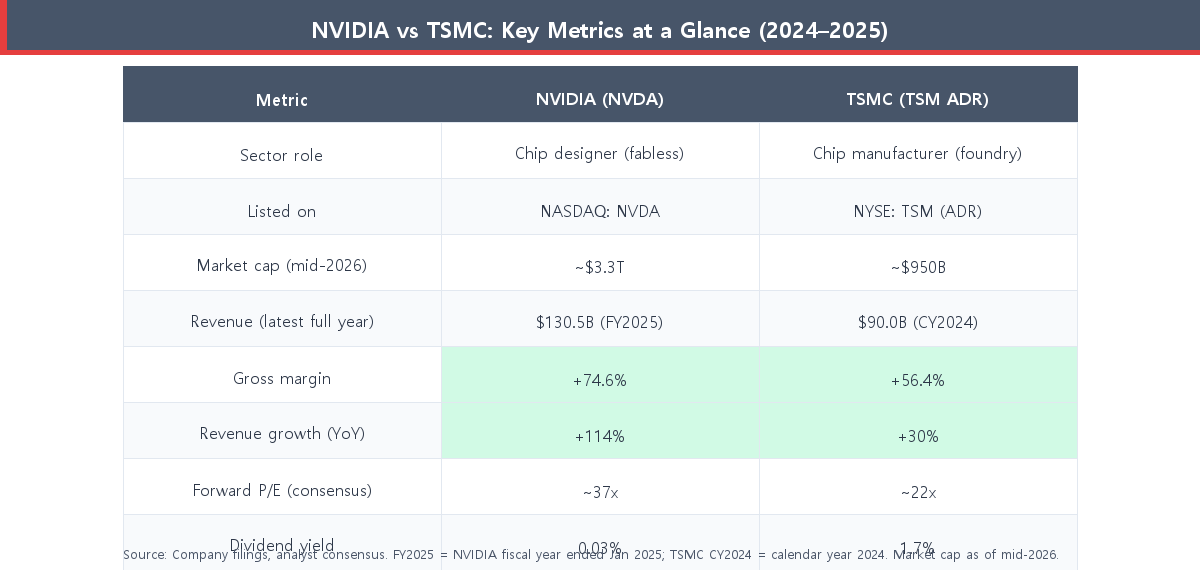
In fiscal year 2025 (ended January 2025), NVIDIA reported revenue of $130.5 billion, up 114% year-over-year (Source: NVIDIA Q4 FY2025 earnings). Its Data Center segment alone generated $115.2 billion — 88% of total revenue. Gross margin hit 74.6%. Net income reached $72.9 billion. These are historically rare numbers for any company, let alone a chipmaker.
TSMC — The Factory That Builds the AI Era
Taiwan Semiconductor Manufacturing Company (TSMC) is the world’s largest pure-play contract foundry, with roughly 60% global market share in advanced logic chips (Source: TrendForce, 2024). It does not design chips. It manufactures them — for Apple, NVIDIA, AMD, Qualcomm, and dozens of others.
TSMC’s competitive position rests on process-node leadership: the ability to etch transistors at 3 nanometers, 2 nanometers, and eventually 1.4 nanometers. Advanced nodes (3nm + 5nm + 7nm combined) represented 73% of TSMC’s revenue in 2024 (Source: TSMC 2024 Annual Report). No other foundry can mass-produce at these geometries at comparable yield and scale.
In calendar year 2024, TSMC posted revenue of approximately $90 billion, up 30% year-over-year. Gross margin was 56.4%. Net income reached roughly $35 billion. Strong results — but the growth trajectory looks very different from NVIDIA’s hyperbolic curve, as the data below shows.
Head-to-Head: Revenue, Margins, Valuation (2024–2026)
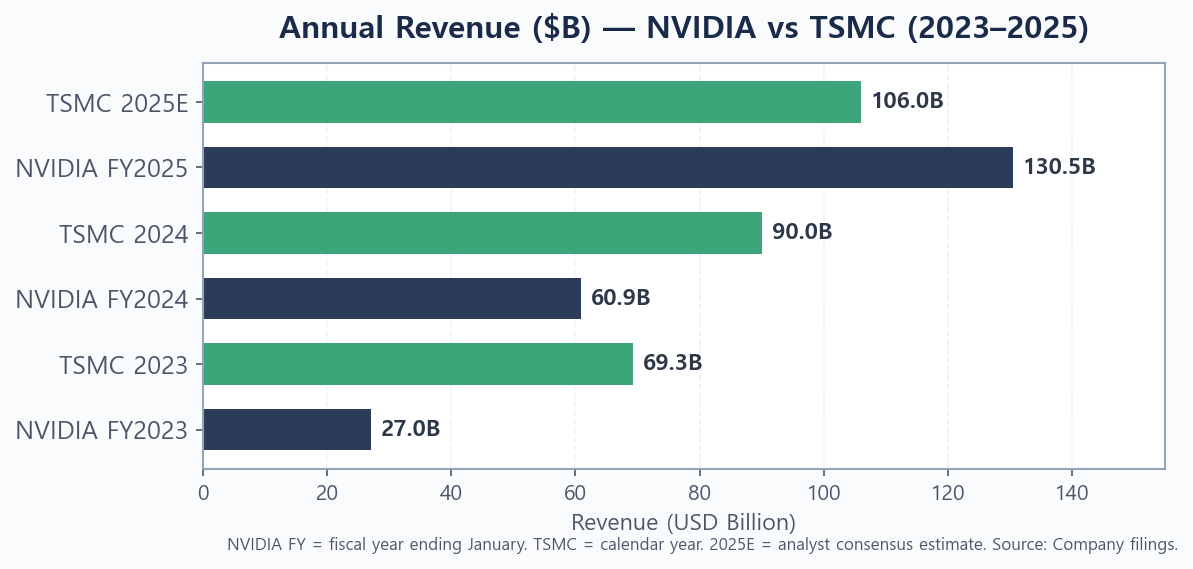
The revenue convergence chart above tells a remarkable story. In NVIDIA’s fiscal year 2023, its revenue was just $27 billion — well below TSMC’s $69.3 billion that same year. By FY2025, NVIDIA’s $130.5 billion exceeded TSMC’s full-year revenue by roughly 45%. A customer outgrew its manufacturer in revenue terms in just two years. That kind of trajectory is almost without precedent in industrial history.
The valuation gap is equally striking. NVIDIA trades at roughly 35–40× forward earnings; TSMC at roughly 22× forward earnings. The market is pricing NVIDIA as a growth-compounding platform and TSMC as a high-quality cyclical business. Both framings have merit — but they demand different holding mentalities.
One detail worth flagging: NVIDIA is TSMC’s single largest customer, accounting for an estimated ~25% of TSMC’s revenue (analyst consensus, 2024). That means owning NVIDIA already gives you indirect exposure to TSMC’s output — and owning TSMC gives you indirect exposure to NVIDIA’s demand. The two are financially intertwined in a way that most stock screeners won’t tell you.
The Moat Question: CUDA Lock-In vs. Nanometer Supremacy
Long-term investors ultimately bet on moats, not quarters. NVIDIA and TSMC have qualitatively different types of competitive advantage.
NVIDIA’s Software Fortress (CUDA Ecosystem)
NVIDIA’s hardware is excellent — but its real moat is software. CUDA has been the de facto language of GPU computing since 2006. The 3.5 million+ developer community has built an ecosystem of libraries (cuDNN, cuBLAS, TensorRT), frameworks (PyTorch CUDA extensions, JAX), and enterprise deployments that are deeply integrated into existing workflows.
Competitors like AMD’s ROCm platform and Intel’s oneAPI exist, but software compatibility and developer familiarity create a gravitational pull back to CUDA. A competitor can theoretically match NVIDIA’s chip performance; replicating the software ecosystem takes a decade of developer mindshare. That distinction makes NVIDIA’s moat qualitatively different from a pure hardware advantage.
TSMC’s Process-Node Lead (3nm, 2nm, and Beyond)
TSMC’s moat is its process-node leadership and the manufacturing know-how that enables it. Achieving high yields at 3nm or 2nm requires thousands of proprietary process steps, years of equipment calibration, and a skilled engineering workforce that took decades to build. Samsung has tried — and repeatedly stumbled — at comparable nodes.
TSMC is currently ramping its N2 (2nm) process and building out its CoWoS advanced packaging capacity, which is critical for AI chips that require massive memory bandwidth. Its Arizona facility came online with 4nm production in 2024; a 3nm Arizona fab is targeted for 2026. Geographic diversification reduces — but does not eliminate — the Taiwan concentration risk.
The key distinction: CUDA’s switching cost is behavioral and ecosystem-driven (very hard to replicate quickly). TSMC’s process-node lead is technical and capital-driven (very expensive to replicate, but not theoretically impossible given enough time and money). That gives CUDA a slight qualitative edge as a moat — but TSMC’s scale advantages in manufacturing remain formidable for the foreseeable future.
Risks That Are Unique to Each Stock
NVIDIA: Lofty Valuation and Rising Competition
NVIDIA’s biggest risk is its price. At 35–40× forward earnings, the stock is priced for sustained, exceptional growth. A slowdown in hyperscaler AI capex, a demand air pocket between chip generations, or a margin-compressing competitive response could reprice the stock significantly — even if the underlying business remains excellent.
Competition is real. AMD’s MI300X accelerators have gained traction with some hyperscalers seeking supply diversification. Google’s TPUs, Amazon’s Trainium, and Microsoft’s Maia chips are custom AI accelerators that chip away at NVIDIA’s captive market in the largest cloud environments. None of these is an immediate threat to NVIDIA’s dominance, but they set a ceiling on pricing power over a 5–10 year horizon.
China exposure adds another layer of uncertainty. NVIDIA cannot sell its highest-performance chips (H100, H800) to Chinese customers due to US export controls. It sells the restricted H20 chip instead, generating an estimated ~$15 billion per year in China revenue that could disappear if restrictions tighten further.
If you are concerned about concentrated AI-stock exposure in your broader portfolio, it is worth reading How to Protect Your Portfolio From an AI Bubble (2026) — it covers how to audit and hedge against Magnificent Seven concentration.
TSMC: The Taiwan Premium and Geopolitical Overhang
TSMC’s primary risk is geography. Approximately 70% of its advanced node capacity sits in Taiwan. A military conflict in the Taiwan Strait — or even a credible escalation — would be catastrophic not just for TSMC shareholders but for the global technology supply chain. This is a low-probability, high-consequence risk that the market prices in as a persistent discount to TSMC’s intrinsic value.
The Arizona diversification helps at the margin. But building a fab takes 5+ years and $20+ billion per site. Even with three Arizona fabs eventually operational, Taiwan will remain TSMC’s manufacturing center of gravity for years. Investors holding TSMC are, in part, making a bet that the Taiwan Strait stays stable — a geopolitical call, not just a financial one.
How China Export Restrictions Are Reshaping Both
US export controls affect both companies, but in different ways. NVIDIA loses access to its highest-margin products in its largest non-US market. The H20 workaround preserves some revenue, but each tightening of restrictions shrinks the addressable market in China. This headwind is unlikely to disappear regardless of which administration runs Washington.
TSMC faces a different version of the same pressure. It cannot produce chips at 3nm or below for Chinese customers — a US and TSMC policy requirement. Its China revenue (~10% of total) comes from older process nodes, which carry lower margins. The net effect is that TSMC’s growth is increasingly driven by non-China AI demand, which is actually a cleaner growth story, but it reduces diversification.
Longer-term, export controls accelerate China’s domestic chip ambitions (SMIC, Huawei HiSilicon). A competitive Chinese foundry or AI chip designer is a tail risk for both companies on a 10-year horizon — not a 2026 concern, but worth tracking.
Long-Term Verdict — Which Fits Your Portfolio?
The honest answer is that NVIDIA and TSMC suit different investor profiles — and different portfolio allocations.
NVIDIA is the higher-risk, higher-reward position. You are paying a premium for a company that has achieved near-monopoly status in AI compute at a pivotal moment in technology history, backed by a software moat that is genuinely hard to erode. The downside scenario involves valuation compression when growth decelerates — painful, but not existential for the business. Suitable for growth-oriented allocations where you can tolerate volatility.
TSMC is the quality compounder at a more reasonable multiple. You get a foundry business with irreplaceable technical capabilities, diversified customers (Apple, NVIDIA, AMD, Qualcomm), and a dividend yield (~1.7%) that NVIDIA barely registers. The downside scenario is geopolitical, binary, and largely out of management’s control. Suitable for investors who want AI exposure with better valuation discipline and are comfortable with the Taiwan risk.
If your concern is whether your portfolio is already too concentrated in AI mega-cap names, the Equal-Weight vs Market-Cap ETF debate in 2026 is worth reading — it examines whether the market-cap weighting of indices like VOO has created unhealthy AI concentration for passive investors.
The “Why Not Both?” Argument
There is a compelling case for holding both NVIDIA and TSMC rather than choosing one. They are not redundant — they occupy different rungs of the same supply chain. NVIDIA captures value in chip design, software, and go-to-market; TSMC captures value in manufacturing excellence and process R&D. A portfolio with both gets exposure to the AI hardware cycle without doubling down on a single company’s execution risk.
The counterargument is correlation: when AI sentiment turns negative, both stocks typically sell off together, regardless of their business model differences. They are both labeled “AI chips” in institutional models, and macro-driven selloffs don’t discriminate between designer and manufacturer. Diversification within the AI supply chain does not mean diversification from AI risk.
For investors who’d rather sidestep the individual stock selection problem entirely, How to Build a Simple 3-Fund Portfolio in 2026 makes the case for broad market exposure through index ETFs — capturing NVIDIA and TSMC as components of total market funds without the concentration of single-stock bets.
Both NVIDIA and TSMC are extraordinary businesses. The decision between them — or the decision to own both — comes down to your time horizon, risk tolerance, and how much single-stock volatility you are prepared to manage. The AI infrastructure build-out benefits both. The question is which risk profile you can live with over a full market cycle.
This article is for informational purposes only and is not investment advice. Do your own research.