
For most of the past decade, betting against mega-cap technology felt like financial suicide. The Magnificent 7 — Apple, Microsoft, Nvidia, Amazon, Alphabet, Meta, and Tesla — dominated every index, every headline, and most portfolios. But 2026 changed the script. As Q4 kicks off, small-cap and value stocks have staged their strongest run versus big tech in nearly three decades, and investors are asking a question that felt unthinkable in 2024: is the Q4 2026 stock rotation the real deal, or another head-fake?
This guide breaks down exactly what is driving the rotation, which ETFs stand to benefit most, and how to position your portfolio without chasing momentum at the wrong moment.

What Is the “Great Rotation” of 2026?
A stock market rotation happens when capital flows out of one sector or style and into another — not because the economy collapsed, but because relative valuations and earnings expectations shift. The 2026 version of this rotation has a specific flavor: money is leaving mega-cap tech and moving into small-cap and value-oriented companies that are finally closing the earnings gap.
By mid-year 2026, the Russell 2000 small-cap index had surged roughly 12% year-to-date, compared with just 1.5% for the S&P 500 in the same window (Source: FactSet, as of Q2 2026). That divergence widened further into Q3 and Q4, making this one of the most significant style rotations in modern market history.
The Valuation Gap That Sparked the Shift
Entering 2026, small-cap stocks traded at their largest valuation discount to large-cap stocks in roughly 30 years. The Russell 2000 was priced at approximately 12–14x forward earnings, while the S&P 500’s mega-cap tier sat closer to 28–32x. That gap — driven by years of AI hype and index concentration — created a coiled spring. When earnings growth began converging, the spring released.
Why Mega-Cap Tech Is Losing Its Edge
The Magnificent 7 did not collapse. But their dominance eroded as the market asked harder questions about return on AI investment. Tens of trillions of dollars in announced AI infrastructure spending raised an uncomfortable question: when does capex become earnings? Institutional investors began trimming outsized tech positions and rotating into undervalued corners of the market — exactly the dynamic that drives a broad style rotation. For more on navigating this risk, see our earlier piece on how to protect your portfolio from an AI bubble in 2026.
3 Catalysts Driving Small Caps and Value Higher in Q4 2026
Style rotations rarely have a single cause. The Q4 2026 rotation has three distinct, reinforcing drivers — all pointing in the same direction.
1. Earnings Growth Convergence
For the first time in 13 consecutive quarters, small-cap earnings are growing faster than large-cap earnings (Source: FactSet Earnings Insight, Q3 2026). Domestic-focused companies benefited from resilient consumer spending and infrastructure buildout, while Magnificent 7 earnings growth, though still positive, began to decelerate as the base effects of the AI capex boom faded. When the earnings narrative flips, capital allocation follows.
2. Fed Policy and Rate Sensitivity
Small companies carry more floating-rate debt than their large-cap counterparts, so they are far more sensitive to Federal Reserve policy. As the Fed signaled a potential easing path in the second half of 2026, small-cap balance sheets improved faster than large-cap ones on a relative basis. Lower borrowing costs disproportionately benefit smaller, more leveraged businesses — giving value-oriented companies in financials, industrials, and energy an extra tailwind.
3. Stretched Valuations on the Magnificent 7
At peak concentration, the Magnificent 7 accounted for over 32% of the S&P 500 by market cap. An equal-weight approach versus market-cap weighting had dramatically different implications — and 2026 was the year equal-weight started delivering. The concentration risk that passive investors had been warned about for years finally materialized in underperformance.
The video below gives an excellent breakdown of how this small-cap awakening plays out in practice, and what catalysts to watch as Q4 unfolds.
2026 Performance Scorecard: Small Caps vs Big Tech
The numbers tell a clear story. Through Q3 2026, small-cap and value ETFs have delivered returns that would have seemed impossible just two years ago — especially compared to the tech-heavy indexes that dominated 2023 and 2024.
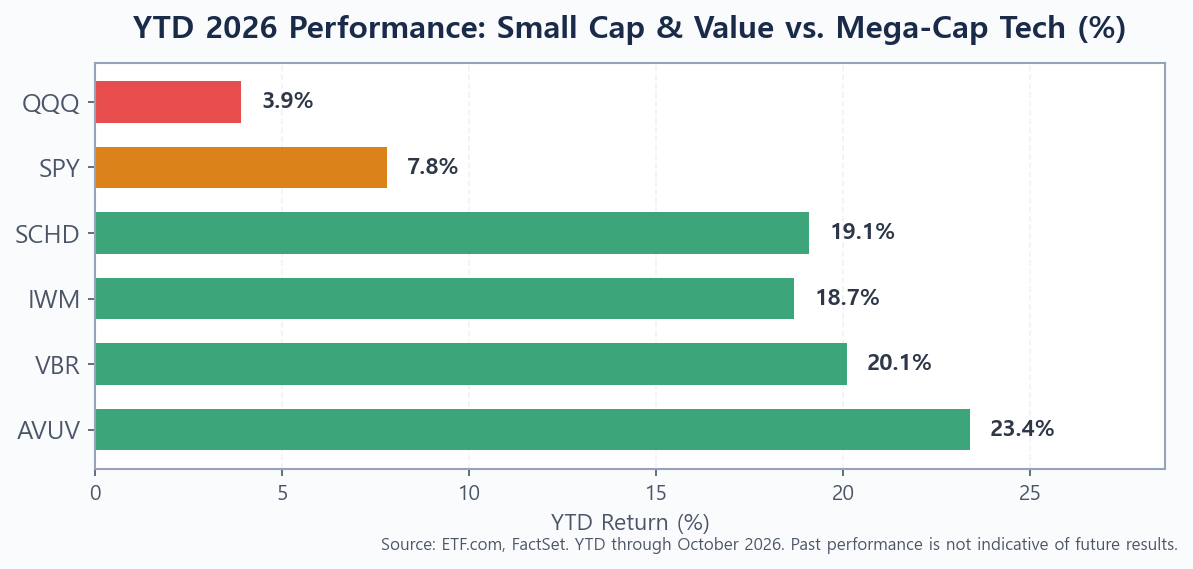
AVUV, the Avantis US Small-Cap Value ETF with deep factor exposure, leads the group. VBR and IWM follow closely. Meanwhile, QQQ — the Nasdaq-100 proxy that many investors treat as a default growth allocation — has returned a fraction of that. This is not a small gap. It is a generational-scale performance divergence, the kind that reshapes how advisors and individual investors think about portfolio construction for years to come.
Worth noting alongside this rotation: dividend stocks have also significantly outpaced the S&P 500 in 2026, reinforcing the broader theme that the market is rewarding value, cash flow, and fundamentals over speculative growth narratives.
Which ETFs to Own for the Q4 2026 Rotation
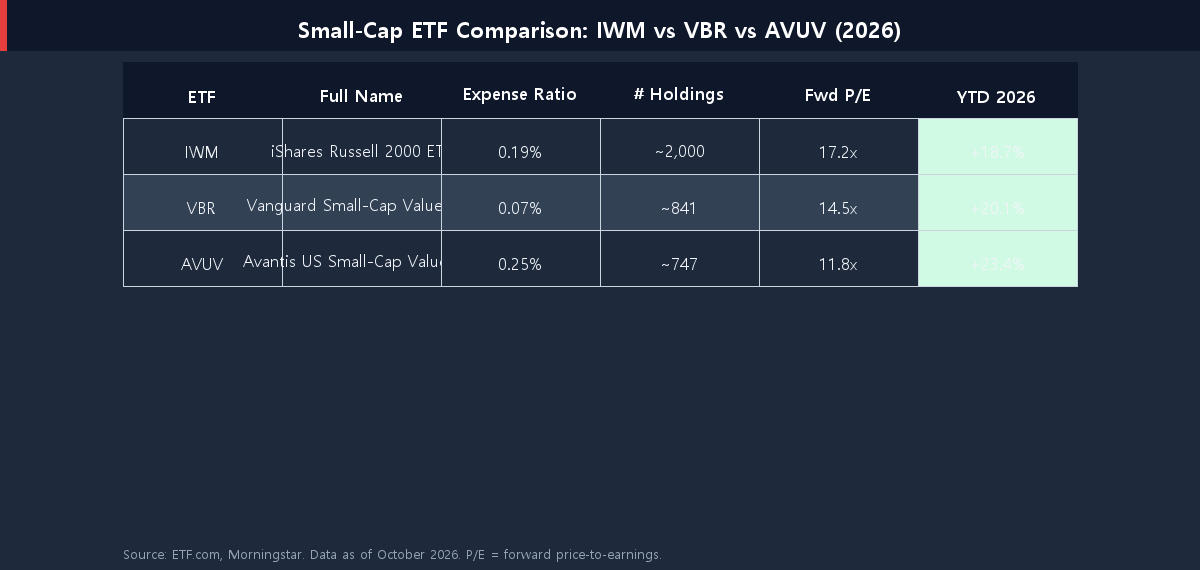
Not every small-cap ETF is the same. The distinction between broad small-cap exposure and small-cap value matters enormously — and the data in 2026 confirms it. Here is a comparison of the three most-discussed small-cap and value ETFs this year.
IWM — The Broad Small-Cap Play
The iShares Russell 2000 ETF (IWM) is the most liquid and widely traded small-cap instrument in the US market. It tracks all 2,000 companies in the Russell 2000 index, blending both value and growth names. The broad scope means it captures the rotation theme without a strong factor tilt — ideal for investors who want index-level small-cap exposure without overthinking factor premia. Expense ratio: 0.19%.
VBR — Small-Cap Value at Low Cost
Vanguard’s Small-Cap Value ETF (VBR) narrows the universe to approximately 840 stocks that screen for value characteristics — lower price-to-book, price-to-earnings, and forward earnings growth. Vanguard’s cost advantage is significant here: 0.07% is one of the cheapest expense ratios in the category. For long-term, cost-conscious investors who want the value tilt without paying up for it, VBR is a natural choice.
AVUV — Deep Value Factor Exposure
Avantis US Small-Cap Value ETF (AVUV) takes the most aggressive factor approach of the three. It screens for small size and deep value simultaneously, constructing a portfolio of roughly 750 stocks that score highly on both dimensions. The 0.25% expense ratio is higher than VBR, but the value loading is meaningfully deeper — which explains why AVUV has led the group in 2026 performance. For investors who subscribe to the Fama-French factor investing framework, AVUV is the purest implementation available in ETF form. The companion NVIDIA vs TSMC analysis is worth reading alongside this if you also want to understand the specific mega-cap AI names you would be underweighting in this rotation.
How to Implement the Rotation in Your Portfolio
Understanding why a rotation is happening and actually executing it in your own account are very different challenges. A few practical principles can help you avoid the most common mistakes.
Step-by-Step Rebalancing Checklist
- Audit your current concentration. Use your broker’s holdings breakdown to calculate what percentage of your equity allocation is currently in mega-cap tech or Nasdaq-heavy funds (QQQ, FXAIX, VOO all carry this risk to varying degrees).
- Define a target small-cap weight. Many allocation models suggest 10–20% of a total equity sleeve in small-cap, with a value tilt. The right number depends on your time horizon and risk tolerance — not on recent performance.
- Use new contributions first. Before selling anything, redirect fresh capital into VBR or AVUV. This avoids triggering capital gains and gradually moves you toward target.
- Consider tax-advantaged accounts for switches. Selling a large tech position in a taxable account generates a capital gains event. IRA or 401(k) rebalances are tax-free. Prioritize rotation inside tax-sheltered accounts first.
- Set a rebalance trigger, not a calendar. Decide in advance: if small-cap exceeds your target weight by 5 percentage points, trim. If it falls below by 5 points, add. Rule-based discipline beats emotion-based timing.
For a complete framework on executing this kind of portfolio shift — especially in a higher-rate environment — the step-by-step portfolio rebalancing guide covers each stage in detail. And if you are newer to portfolio construction and want a simpler starting point, building a 3-fund portfolio in 2026 lays out the foundational framework that this rotation strategy builds on top of.
What Could Derail This Rotation?
Every investment thesis has an exit scenario. The Q4 2026 stock rotation could stall or reverse if any of the following materializes:
- A recessionary shock. Small caps are more economically sensitive than large caps. A hard landing — unexpected unemployment spike, credit market stress — hits smaller companies harder. The Russell 2000’s higher debt load and domestic focus become a liability, not an asset, in a recession.
- Fed reversal. If inflation resurges and the Fed pivots back to rate hikes, the floating-rate debt benefit reverses. Small-cap balance sheets deteriorate faster in a re-tightening cycle.
- AI monetization breakthrough. If one or more of the Magnificent 7 demonstrates a decisive, measurable return on AI infrastructure investment — revenue, margin expansion, or market share capture — institutional flows could reverse back into mega-cap tech quickly.
- Liquidity risk in small caps. In a broad risk-off selloff, small-cap ETFs tend to experience sharper drawdowns than S&P 500 funds. The bid-ask spreads and underlying liquidity of Russell 2000 components are meaningfully worse than Apple or Microsoft. Size your position accordingly.
None of these risks makes the rotation thesis wrong. They just define the conditions under which it would be wrong — which is exactly the information you need to size your position sensibly.
Bottom Line
The Q4 2026 stock rotation from mega-cap tech into small caps and value stocks is supported by three converging forces: earnings growth convergence, Fed rate sensitivity, and a 30-year valuation gap that was simply too wide to sustain. ETFs like AVUV, VBR, and IWM have each outperformed the Nasdaq-100 by a wide margin in 2026, and the fundamental case for continuation into Q4 remains intact as long as the macro backdrop holds.
The key takeaway is not to chase the move, but to think systematically about whether your current portfolio reflects the concentration risk that built up over a decade of mega-cap dominance. A measured rebalance — executed in tax-advantaged accounts, funded with new contributions before triggering sales — lets you participate in the rotation without making an all-or-nothing bet on any single catalyst.
Found this useful? Bookmark it so you can revisit when the market moves. I publish practical investing breakdowns regularly — check back soon.
This article is for informational purposes only and is not investment advice. Past performance is not indicative of future results. Do your own research before making any investment decisions.