
The Federal Reserve raised its benchmark rate to 3.75%–4.00% in September 2026 — the first hike since 2023 — and futures markets are already pricing in a greater than 70% probability of another move in October. If you haven’t looked at your portfolio since the rate-cut era, your allocation has almost certainly drifted. Stocks have repriced, long bonds have taken a hit, and cash is now earning a meaningful yield for the first time in years. This step-by-step Q4 2026 portfolio rebalancing guide walks through exactly what to do with your stocks, bonds, gold, and cash after the September Fed rate hike — without panic-selling or overcomplicating things.

What the September 2026 Fed Rate Hike Means for Your Portfolio
The new rate environment: 3.75%–4.00% and “higher for longer”
The September 2026 decision marked a decisive pivot. After three years of rate cuts that pushed the Fed funds rate down toward 2%, persistent inflation — driven partly by tariffs and a tight labor market — forced the FOMC back into tightening mode. Our earlier analysis on whether the Fed would hike in 2026 outlined the conditions that would trigger this shift; those conditions are now reality. The key implication for investors: rates are unlikely to fall quickly. The “higher for longer” playbook is back in force, and your portfolio structure should reflect that.
Why Q4 is the ideal window to rebalance
Beyond the rate shock, Q4 offers a rarely discussed bonus: tax-loss harvesting season. Any positions that have declined this year — and in a rising-rate environment, long-duration bonds almost certainly have — can be sold to realize losses that offset capital gains elsewhere. Pair that mechanical advantage with the natural need to rebalance after a rate repricing, and Q4 becomes the most useful rebalancing window of the year. Acting before December 31 locks in that dual benefit.
Step 1 — Audit Your Allocation and Measure Drift
How to calculate your current weights
Before making any trades, take a snapshot. Add up the current market value of every holding and divide each position by your total portfolio value. What you get is your actual allocation — not the one you set up two years ago. Compare it against your target allocation. (If you don’t have a target yet, A Beginner’s Guide to Asset Allocation is a solid starting point for setting one.)
A typical moderate-risk target might look like: 50–60% stocks, 25–30% bonds, 5–10% gold, and 5–10% cash. After equity strength in H1 2026 and a bond selloff following the rate hike, many portfolios are now running 65–70% equities and under-weight in both bonds and cash.
The 5% drift band: when to act vs. when to wait
A practical rule: rebalance when any asset class drifts more than 5 percentage points from its target weight. If your target is 30% bonds and you’re now at 22%, that 8-point gap warrants action. Anything inside a 5% band can wait for your regular annual rebalance. This threshold avoids unnecessary trading costs while catching meaningful dislocations — exactly the kind that a rate shock creates.
Step 2 — Shorten Your Bond Duration
Why long-duration bonds fall hardest in a rising-rate cycle
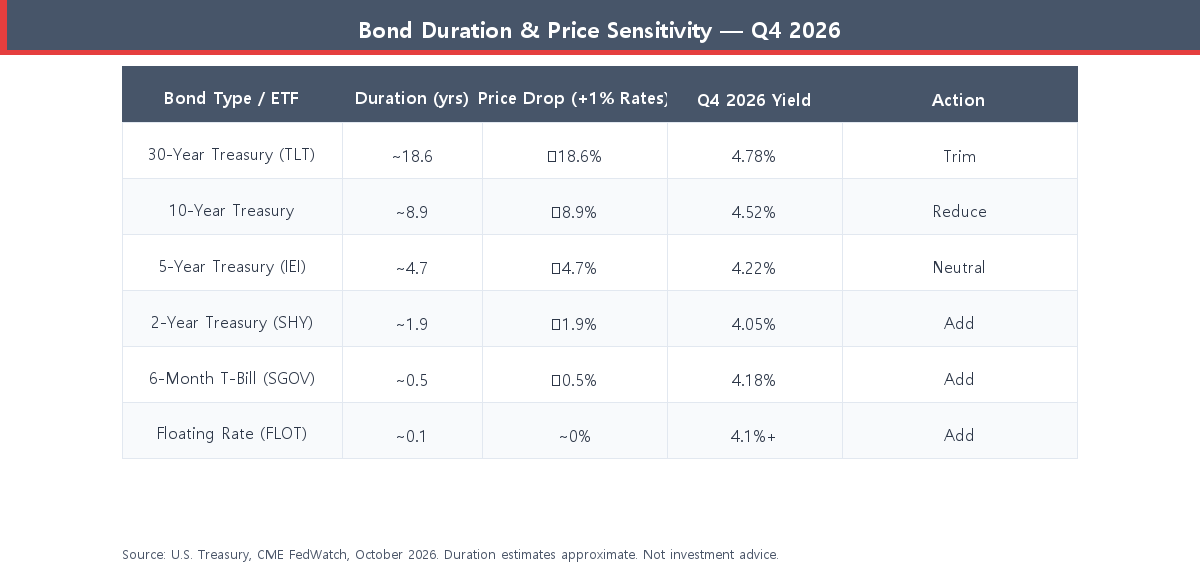
Duration measures how sensitive a bond’s price is to interest rate moves. A rough rule of thumb: multiply the duration by the rate change to estimate the price impact. A 30-year Treasury has a duration of roughly 18.6 years — meaning a 1% rise in rates causes approximately an 18.6% price drop. A 2-year Treasury, by contrast, has a duration near 1.9 years, so the same rate move costs you only about 1.9%. If you’re still holding TLT (the iShares 20+ Year Treasury ETF) or similar long-duration vehicles, you’re carrying that full price-sensitivity risk into a “higher for longer” environment. (For a deeper look at bond mechanics in a rising-rate cycle, see How to Rebalance When Interest Rates Are Rising.)
The Q4 2026 bond playbook: SHY, SGOV, floating-rate ETFs
The practical Q4 2026 bond strategy has three parts:
- Trim or exit long-duration ETFs (TLT, EDV) — these are the direct casualties of further hikes.
- Add short-term Treasuries — SHY (1–3 year), SGOV (0–3 month), or direct 6-month T-bills at ~4.18% yield (Source: U.S. Treasury, October 2026). Duration near zero means almost no price risk from additional hikes.
- Consider floating-rate bond ETFs (FLOT, FLRN) — their coupons reset with short-term rates, so rising rates actually increase your income rather than erode your principal.
If you want to keep some intermediate-duration exposure, stay in the 2–5 year range (IEI, VGIT) rather than extending to 10+ years.
Step 3 — Reposition Your Equity Allocation
Which sectors tend to outperform after Fed hikes
Rising rates aren’t uniformly bad for stocks — they just shift which sectors lead. Historically, financials (banks and insurance companies) benefit directly because their net interest margins widen when rates go up. Energy companies, heavily asset-backed with strong cash flows, also tend to hold up well. Technology and growth stocks face the most headwind, because their valuations depend on discounting future cash flows — and that discount rate just went up.
For Q4 2026, sectors worth adding or holding include financials (XLF), energy (XLE), and healthcare (XLV). If you’re rebalancing a broad-market equity ETF like VTI, no action may be needed — VTI already tilts toward large-cap quality, which is where you want to be.
Large caps over small caps — the historical case
Small-cap stocks (tracked by IWM, the Russell 2000 ETF) are historically more sensitive to rate increases for two reasons: they carry more floating-rate debt, and they’re more dependent on domestic bank lending. When the cost of credit rises, their margins compress faster than those of large-cap companies that issue long-dated corporate bonds at fixed rates. In the 12 months following the Fed’s last major hiking cycle, the Russell 2000 underperformed the S&P 500 by roughly 8 percentage points. For Q4 2026, large-cap quality funds like VTI, VIG (dividend growth), or VOO may be preferable to overweighting IWM.
Step 4 — Right-Size Your Gold Allocation
Gold’s role after the September hike
Gold occupies a unique position in a rising-rate environment: theoretically, higher real rates reduce gold’s appeal (gold pays no yield). In practice, gold also benefits from uncertainty, dollar hedging, and geopolitical demand — all of which are elevated in Q4 2026. The September hike restarted rate volatility, which historically supports gold as a volatility hedge even when nominal rates are rising.
How much gold is enough in Q4 2026
Most evidence-based frameworks suggest keeping gold at 5–10% of a diversified portfolio — enough to provide genuine diversification without letting its price swings dominate your returns. Our dedicated guide on how much gold to hold in 2026 runs through the data on gold’s correlation with stocks, bonds, and inflation, and gives a framework for sizing your slice. If you’re already in that 5–10% range, no change is likely needed. If you’ve let it drift above 15% after gold’s strong 2024–2025 run, Q4 is a reasonable moment to trim back toward target.
Step 5 — Maximize Your Cash Yield Before the Next Move
T-bills and money market funds at 4%+
One genuinely good thing about a higher-rate environment: cash finally earns something. Six-month T-bills are currently yielding approximately 4.18% (Source: U.S. Treasury, October 2026), and prime money market funds are running at similar levels. If you’re holding dry powder for future opportunities — or simply maintaining an emergency fund — this is the moment to make that cash work. Parking it in a 6-month T-bill ladder locks in the current rate while keeping liquidity roughly every 90–180 days.
Avoid leaving cash in low-yield savings accounts
Many traditional savings accounts are still paying 0.5–1.0% despite the Fed’s move. The gap between a savings account and a 6-month T-bill is now more than 3 percentage points. On a $50,000 cash position, that’s over $1,500 in forgone annual income. Where to Park Cash in 2026: Money Market Funds vs. Short-Term Treasuries compares the two options in detail, including the state-tax advantage that T-bills carry in most US states. Moving idle cash to either option is one of the simplest, lowest-risk improvements you can make in Q4 2026.
For a broader visual walkthrough of portfolio rebalancing mechanics, the video below offers a clear pre-2026 framework that applies directly to the current environment:
Putting It All Together: A Sample Q4 2026 Target Allocation
Below is a sample moderate-risk target allocation adjusted for the Q4 2026 rate environment. This is illustrative — not a personal recommendation — but it reflects the principles above:
| Asset Class | Target Weight | Suggested Vehicles | Key Adjustment |
|---|---|---|---|
| US Stocks (large cap) | 40% | VTI, VOO, VIG | Hold; trim IWM if over-weight |
| International Stocks | 15% | VXUS, EFA | Neutral; maintain target |
| Short-Term Bonds | 20% | SHY, SGOV, FLOT | Add; exit TLT/EDV |
| Intermediate Bonds | 8% | IEI, VGIT | Small position; avoid 10Y+ |
| Gold | 7% | GLD, IAU | Trim if above 12%; hold if 5–10% |
| Cash / T-Bills | 10% | 6M T-bills, VMFXX | Move from savings; deploy into bills |
For beginners who want to start simpler, the 3-fund portfolio guide for 2026 offers a low-maintenance baseline that holds up reasonably well in a rising-rate environment.
Frequently Asked Questions
Should I sell all my bonds after a rate hike?
No. The question is which bonds, not whether to hold bonds at all. Long-duration bonds carry the most price risk; short-duration bonds and floating-rate instruments are broadly neutral to positive in a rising-rate regime. A balanced bond sleeve still provides diversification relative to equities.
How often should I rebalance in Q4 2026?
Once is enough for most investors. Determine your drift, make the necessary trades before year-end (to capture any tax-loss harvesting benefit), and then set a calendar reminder for your regular annual rebalance. Over-trading during rate-volatile periods tends to increase costs without meaningfully improving outcomes.
What if the Fed doesn’t hike again in October?
The structural advice here — shorten duration, prefer quality equities, maximize cash yield — remains sound even if the October hike doesn’t materialize. Rate cuts are not expected soon; the highest probability scenario is rates holding in the 3.75%–4.25% range for at least two to three more quarters (Source: CME FedWatch, October 2026).
Does this apply to tax-advantaged accounts (401k, IRA)?
Yes — and it’s even simpler there, because you can rebalance without triggering a taxable event. The asset allocation logic is identical; just execute the same shifts inside your IRA or 401(k) without worrying about capital gains.
Conclusion
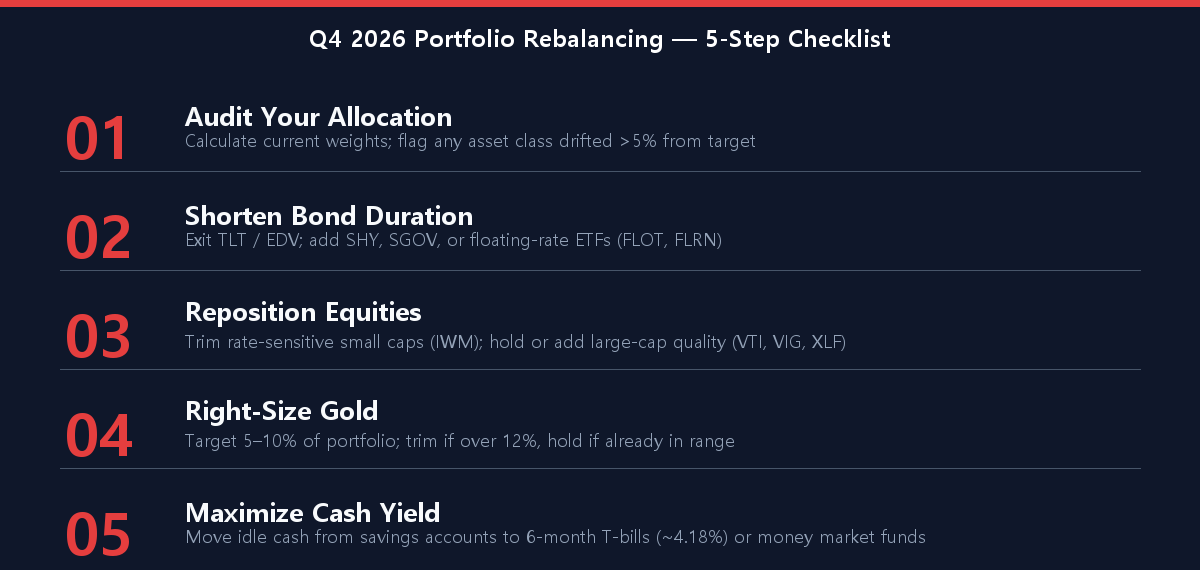
Q4 2026 portfolio rebalancing after the September Fed rate hike comes down to four core moves: shorten your bond duration away from long-term Treasuries, lean toward large-cap quality equities over rate-sensitive small caps, keep gold in the 5–10% range, and move idle cash from low-yield savings into T-bills or money market funds earning 4%+. Layer on the Q4 tax-loss harvesting opportunity and the seasonal discipline of a year-end review, and this becomes one of the most productive rebalancing windows in recent memory. The goal isn’t to predict the Fed’s next move — it’s to build a portfolio structure that holds up across a range of rate outcomes.
Found this useful? Bookmark it so you can revisit when the market moves.
This article is for informational purposes only and is not investment advice. Do your own research before making any investment decisions.