
With 10-year Treasury yields pushing past 5% and the long end of the curve holding above that level through September 2026, building a Treasury bond ladder has rarely offered a more compelling case. You can lock in today’s elevated yields across several maturity dates, smooth out reinvestment risk, and collect predictable coupon payments — all with the full faith and credit of the US government. This step-by-step guide shows you exactly how to build a Treasury bond ladder at 5% yields, from sizing each rung to choosing where to buy.

What Is a Treasury Bond Ladder — and Why 5% Changes Everything
How a bond ladder works
A bond ladder is a portfolio of individual bonds with staggered maturity dates — the “rungs” of the ladder. Instead of putting all your money into a single bond or a bond ETF, you spread purchases across multiple maturities: say, 2-year, 4-year, 6-year, 8-year, and 10-year Treasuries. When the first rung matures, you receive your principal back and reinvest it at whatever yields are available at that time. The ladder keeps rolling forward, rung by rung.
The key advantages are income certainty (every rung pays a fixed coupon until maturity), principal protection (you get 100 cents on the dollar at maturity, regardless of price fluctuations in the interim), and reinvestment flexibility (you’re never fully exposed to a single interest rate environment, because rungs mature at different times).
Why today’s 5% yields make laddering more compelling than ever
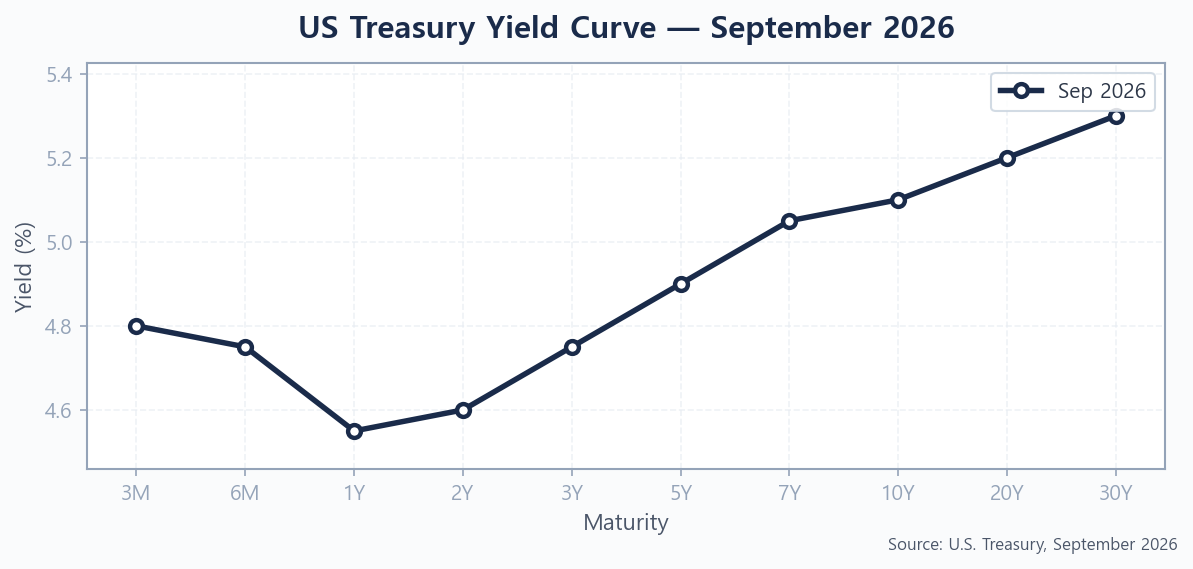
For most of the 2010s, Treasury yields were too low to make a ladder meaningfully different from cash. A 10-year note yielding 1.5% barely beat inflation. The calculus changed dramatically when the Fed began hiking in 2022 and yields re-rated higher. By September 2026, the 10-year Treasury yields around 5.10% and 30-year bonds are at 5.30% (Source: U.S. Treasury, September 2026). That means you can lock in a blended yield close to 5% across a multi-year ladder — real, after-inflation income that you can count on.
For context on where yields may go from here, see our 10-Year Treasury Yield Outlook 2026 and Treasury Yield Curve Steepening in 2026.
Step 1 — Define Your Goals: How Much Income Do You Need?
Before you buy a single Treasury, answer two questions: How much predictable annual income do you want from this ladder? and Over what time horizon do you need the money back? A retiree covering a $2,000/month income gap needs a much larger ladder than someone parking a six-month emergency fund.
A practical framework: list your fixed annual expenses, subtract guaranteed income sources (Social Security, pension, annuity), and treat the gap as your income target. Divide that target by the average yield you expect from your ladder to estimate the capital required. For example, targeting $2,400/year in coupon income from a ladder yielding ~4.9% requires roughly $49,000 in face value — which our sample ladder below illustrates precisely.
Step 2 — Choose Your Maturity Range and Rung Spacing
Maturity range: 1–10 years vs. 2–20 years
A shorter ladder (1–5 years) captures most of the short-end yield with minimal duration risk, but you’ll be reinvesting rungs more frequently. A longer ladder (2–10 or 2–20 years) locks in today’s rates for longer, which matters if you believe yields will fall. Given that 2026’s steepening yield curve is paying meaningful extra yield on the 7-to-10-year range, a 2–10 year ladder offers a good balance of income and rate protection. If your primary concern is short-term certainty, our piece on why short-duration bonds win in a 4% Treasury world covers the short-ladder logic in depth.
Rung spacing: annual vs. semi-annual
Annual rungs are simpler to manage — one purchase per year of maturity, reviewed once a year. Semi-annual rungs double the number of positions but smooth cash flow more finely, which suits investors who want quarterly-level income predictability. For most individual investors building a five- to ten-rung ladder, annual spacing is the practical starting point.
Step 3 — Pick Your Purchase Method: TreasuryDirect vs. Brokerage
TreasuryDirect.gov lets you buy new-issue Treasuries directly from the government, with no transaction fees and a minimum of $100. The downside is limited functionality: you can’t sell bonds before maturity through the platform, and the interface is dated. It’s best for buy-and-hold investors who know they’ll hold each rung to maturity.
A full-service brokerage (Fidelity, Charles Schwab, Vanguard) gives you access to both new issues at auction and the secondary market, plus dedicated bond ladder builder tools that calculate rung sizes, projected income, and maturity dates automatically. You can also sell any rung early if your situation changes. Transaction costs vary but are typically zero or near-zero for Treasuries at major brokers.
If you’re buying from outside the United States, the mechanics and platform choices differ — our guide on how to buy US Treasury bonds as a foreigner covers those specifics.
Step 4 — Build a Sample $50,000 Ladder at September 2026 Yields
The table below shows a five-rung Treasury bond ladder using $50,000, spread evenly across 2-year through 10-year maturities as of September 2026. The blended yield is 4.92% — just under 5% — and the total annual coupon income is $2,460 on $50,000 invested.
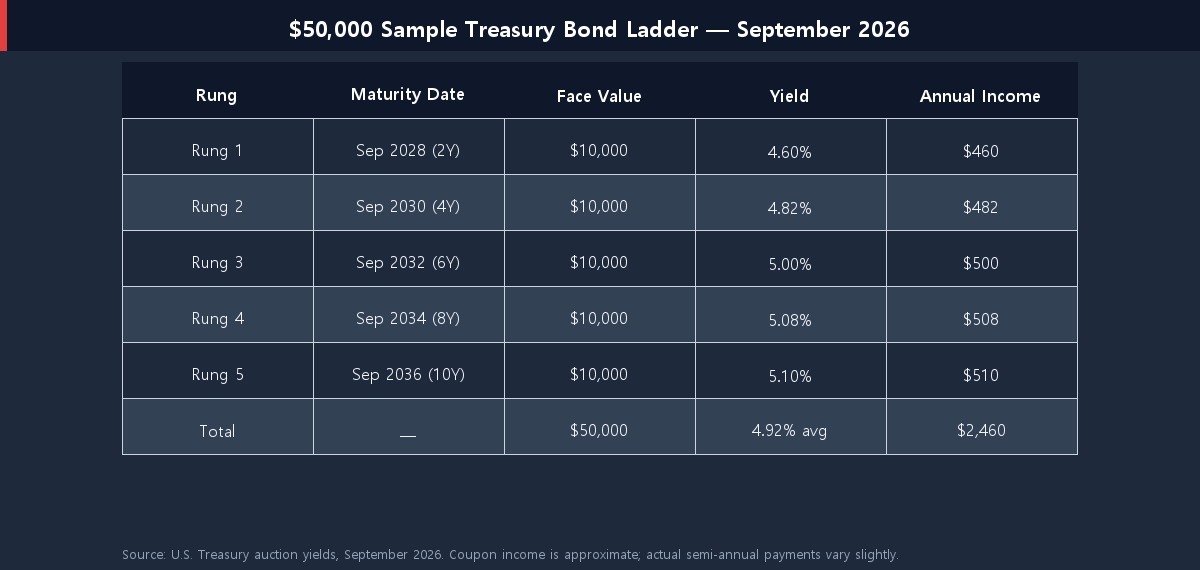
Each year starting in September 2028, one rung matures and you receive $10,000 back. You then decide whether to reinvest at the prevailing 10-year yield (extending the ladder) or keep the cash for spending. This is the reinvestment decision covered in Step 5.
If you’d like to compare this ladder approach against a bond ETF side-by-side — including income certainty, liquidity, and expense differences — see our full breakdown: Treasury Bond Ladder vs. Bond ETF for Retirement Income.
Step 5 — Reinvestment: What to Do When Each Rung Matures
When a rung matures, you face a fork in the road. The most common approach is to extend the ladder: take the $10,000 in principal and buy a new bond at the longest maturity in your original structure (in this case, a new 10-year note). This keeps your ladder at a constant length and rolls you into whatever the current 10-year yield is.
Alternatively, you can shorten the ladder as you approach retirement spending: let a rung mature and use the proceeds for living expenses rather than reinvesting. This is the “spending phase” of a bond ladder strategy — you’re essentially pre-funding specific future expenses with each rung.
A third option is to lock in opportunistically: if yields spike when a rung matures, extend further out (say, to a 15- or 20-year bond). If yields fall, stay shorter and wait for a better entry. This requires more active judgment but can meaningfully improve long-run income.
Treasury Bond Ladder vs. Bond ETF: Which Is Right for You?
A bond ladder wins on income certainty and principal protection — you know exactly what you’ll receive and when. It’s the better tool if you have specific future cash needs (retirement living expenses, a child’s tuition, a mortgage payoff date). The tradeoff is illiquidity: selling a bond before maturity exposes you to market-price risk, and building a true ladder requires meaningful upfront capital (realistically $25,000 or more for a five-rung structure).
A bond ETF (like iShares TLT, BND, or VCSH) offers instant diversification, daily liquidity, and accessibility with any dollar amount. But it provides no maturity date — the fund rolls bonds perpetually, so your principal is always exposed to interest rate moves. If rates rise further after you buy, the ETF’s NAV falls, and you may face a paper loss if you need to sell.
For a deeper comparison — including a $100,000 worked example — see Treasury Bond Ladder vs. Bond ETF for Retirement Income in 2026.
Risks and Limitations You Need to Know
- Reinvestment risk: If yields fall when a rung matures, you’ll reinvest at a lower rate. A longer initial ladder reduces this risk by locking today’s rates further out.
- Inflation risk: A nominal Treasury bond pays a fixed coupon. If inflation rises above your coupon yield, your real return turns negative. Consider pairing a ladder with TIPS or I Bonds as an inflation hedge — see our TIPS vs. I Bonds comparison.
- Liquidity risk: Selling before maturity means accepting the secondary-market price, which can be below par if rates have risen. Plan your ladder so no rung needs to be sold early.
- Concentration risk: A Treasury-only ladder has no credit diversification. That’s generally a feature, not a bug — Treasuries are the risk-free benchmark — but it means you’re fully exposed to US fiscal policy and rate movements.
Frequently Asked Questions
What is the minimum amount needed to build a Treasury bond ladder?
TreasuryDirect allows purchases from $100. For a five-rung ladder to generate meaningful income, most investors start with $25,000–$50,000. Smaller amounts may be better served by a short-term Treasury ETF or T-bill ladder until capital builds up.
Do Treasury bonds pay interest before maturity?
Notes and bonds (2-year and longer) pay semi-annual coupon payments. T-bills (1 year or shorter) are sold at a discount and mature at full face value — you collect your interest at maturity rather than as coupon payments.
Can I hold a Treasury bond ladder in a tax-advantaged account?
Yes. Holding Treasuries inside a traditional IRA or 401(k) defers tax on coupon income. Inside a Roth IRA, interest is potentially tax-free. State-tax-exempt status of Treasury interest is irrelevant inside a tax-advantaged account, but the federal deferral or exemption is a significant benefit for high earners.
What happens if the US government defaults?
A full sovereign default on Treasuries is treated as a tail risk, not a planning scenario. For investors seeking additional credit diversification beyond Treasuries, see our comparison of corporate bonds vs. Treasuries in 2026.
Bottom Line
Building a Treasury bond ladder at 5% yields in 2026 is one of the most straightforward ways to generate predictable, government-backed income for the next decade. The steps are clear: define your income target, choose a maturity range and rung spacing, pick a purchase platform, execute your purchases, and decide on a reinvestment rule for maturing rungs. With today’s yield curve paying 4.6%–5.3% across the 2-to-30-year range, the opportunity to lock in meaningful real income without credit risk is unusually strong.
Found this useful? Bookmark it so you can revisit when the market moves. I publish practical investing breakdowns regularly — check back soon.
This article is for informational purposes only and is not investment advice. Yields quoted are approximate as of September 2026 and will change. Do your own research before making any investment decisions.