
Most bond ETFs take a straightforward hit when interest rates rise: prices fall as yields move higher. Floating rate ETFs behave differently. Their coupon payments reset periodically — usually every 90 days — against a short-term benchmark rate, so when the Fed lifts rates, the income these funds pay goes up rather than down. After the Fed’s September 2026 rate hike — the first since 2023 — with the possibility of a second hike still on the table, floating rate ETFs are one of the few fixed-income tools that can actually benefit from additional tightening. This guide breaks down the three main options: FLOT, FLRN, and BKLN — what they own, how they differ, and how to use them as a rate hike hedge in 2026.
Why Floating Rate ETFs Are Back in Focus in 2026
How the Fed’s September 2026 Rate Hike Rewrote the Playbook
For much of 2025, the consensus view was that the Fed’s next move would be a cut. The June 2026 dot plot quietly flipped that script: nine FOMC officials penciled in a rate hike, and the Fed delivered in September — pushing the federal funds target range to 5.50–5.75%. Investors holding long-duration fixed-rate bond ETFs watched their NAVs slip. Investors holding floating rate ETFs watched their distributions tick up. That asymmetry is the entire appeal of the asset class.
The 10-year Treasury yield has stayed stubbornly near 4.5%, and the short end of the curve is yielding close to 5.5%. In this environment, floating rate notes — which carry effective durations under 0.10 years — generate near-money-market yields without locking investors into long-dated price exposure.
What “Floating Rate” Actually Means for Your Coupon
A floating rate note (FRN) pays a coupon tied to a benchmark — today, primarily the three-month SOFR (Secured Overnight Financing Rate, which replaced LIBOR after 2023). The typical structure is simple:
Coupon = 3-Month SOFR + Credit Spread
When SOFR rises after a Fed hike, the next coupon payment rises with it — usually within 30–90 days. This makes FRN-based ETFs effectively duration-neutral: prices stay flat while income adjusts upward. Compare that with a standard 10-year Treasury ETF, which loses roughly 8% of its value for every 1% rise in the benchmark rate. For those already convinced of the short-duration bond case, floating rate ETFs take that thesis one step further — to near-zero duration.
FLOT vs FLRN — Investment-Grade Floating Rate Notes Head-to-Head
FLOT and FLRN are the two most widely held investment-grade floating rate ETFs in the US market. They track nearly identical indexes with identical fee structures, which makes the comparison unusually granular. Both invest in investment-grade corporate and financial-sector FRNs — think Goldman Sachs, JPMorgan, Bank of America — not in government bonds.
FLOT (iShares Floating Rate Bond ETF)
- Issuer: BlackRock / iShares
- Index: Bloomberg US Floating Rate Note <5 Years Index
- Expense ratio: 0.15%
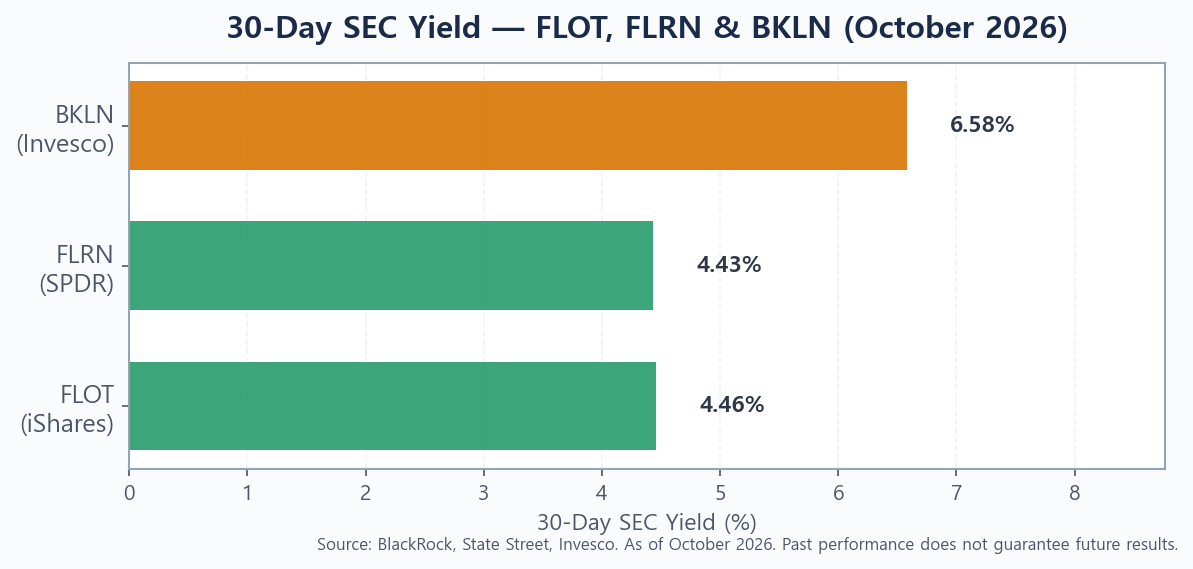
- 30-day SEC yield: ~4.46% (Source: BlackRock, as of October 2026)
- Effective duration: ~0.05 years
- AUM: ~$10.5 billion
- Credit quality: Investment grade (predominantly A and BBB rated)
FLOT is the largest and most liquid floating rate ETF in the US market. Its deep AUM base means tight bid-ask spreads even during volatile sessions. The fund holds primarily US-dollar-denominated FRNs issued by banks and financial institutions, with coupons that reset every quarter against 3-month SOFR. Its 1-year total return has been approximately 4.56% (Source: iShares, as of October 2026).
FLRN (SPDR Bloomberg Investment Grade Floating Rate ETF)
- Issuer: State Street Global Advisors / SPDR
- Index: Bloomberg US Dollar Floating Rate Note <5 Years Index
- Expense ratio: 0.15%
- 30-day SEC yield: ~4.43% (Source: State Street, as of October 2026)
- Effective duration: ~0.05 years
- Average maturity: ~1.93 years
- AUM: ~$3.1 billion
- Credit quality: Investment grade
FLRN tracks a Bloomberg index nearly identical to FLOT’s. The practical difference is AUM: FLRN is about one-third the size, which can mean marginally wider spreads in thin markets. The yield gap between the two is under 5 basis points on most trading days. Over the past 10 years, both funds have returned approximately 3.05–3.06% annually — a near-perfect tie (Source: ETFdb, as of October 2026).
FLOT vs FLRN: Which Investment-Grade FRN ETF Should You Choose?
For most investors, FLOT wins on liquidity grounds: greater AUM means tighter spreads and easier trading in size. FLRN is a perfectly reasonable substitute for those whose brokerage platforms favor SPDR funds or where FLOT carries a commission. Either way, the risk-return profile is essentially identical. If you prefer Treasuries over corporate FRNs entirely, why short-duration Treasuries make sense at 4% covers that closely related strategy without the corporate credit exposure.
BKLN — The Senior Loan Alternative with Higher Yield and Higher Risk
How Senior Loans Differ from Investment-Grade Floating Rate Notes
BKLN (Invesco Senior Loan ETF) uses the same floating-rate coupon mechanism but applies it to a fundamentally different corner of the market: leveraged bank loans. These are syndicated loans made to below-investment-grade companies — the same debt that finances leveraged buyouts and private equity transactions. They sit at the top of the capital structure in bankruptcy (hence “senior”), but the underlying borrowers are substantially riskier than the banks and financial companies in FLOT and FLRN.
Like FLOT and FLRN, BKLN’s coupons float against SOFR. The credit spread is far wider because the borrowers are riskier — which is why BKLN’s yield is significantly higher, around 6.58% (Source: Invesco, as of October 2026) versus ~4.4% for the investment-grade peers. For investors weighing the extra income, this is structurally similar to the question explored in corporate bonds vs. Treasuries in 2026 — is the additional spread worth the credit risk?
BKLN’s Credit Quality and Default Risk in 2026
The bulk of BKLN’s holdings are rated single-B or BB — well into speculative, below-investment-grade territory. Its expense ratio of 0.65% is more than four times that of FLOT or FLRN, reflecting the additional active management required to navigate leveraged loan markets. AUM stands at approximately $6.7 billion (Source: Invesco, as of October 2026).
In a Fed hiking cycle that tips the economy toward a credit event or recession, default rates on leveraged loans spike sharply. During the 2020 COVID stress, BKLN fell over 20% as credit spreads blew out — a clear reminder that near-zero interest rate duration does not mean near-zero price risk. In the current higher-for-longer scenario, BKLN’s dominant risk driver is credit quality, not interest rate sensitivity. Investors who use it should treat it as a high-yield income vehicle, not simply a rate hedge.
The video below walks through how floating rate bond ETFs behave in rising-rate environments, including key considerations for each fund type:
FLOT vs FLRN vs BKLN — Full Three-Way Comparison
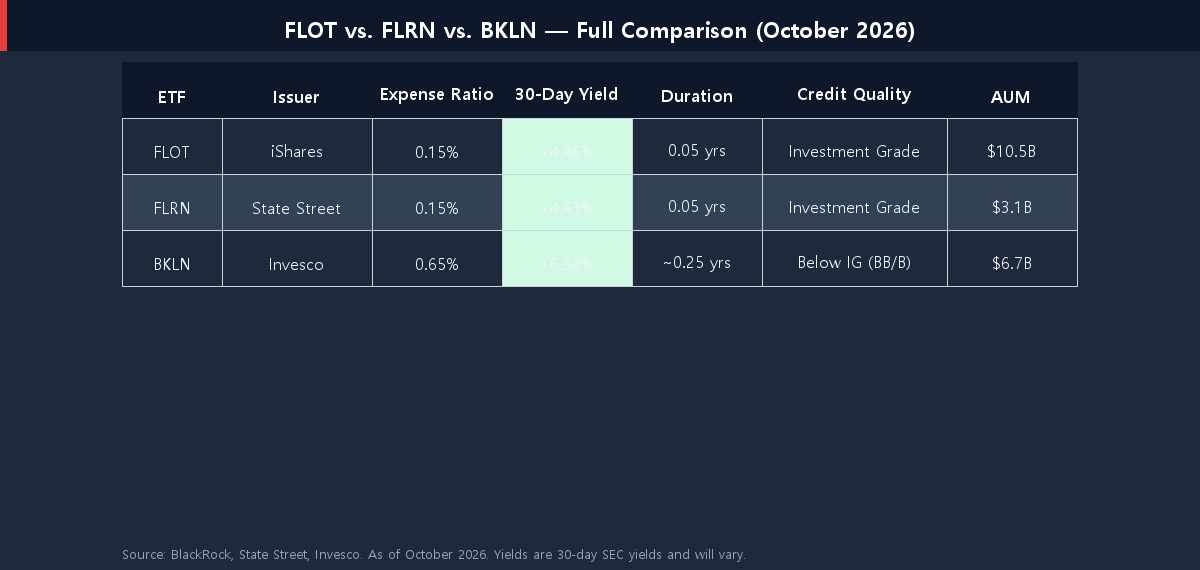
The table below summarizes the key metrics side by side. All figures are as of October 2026.
Who Should Own Floating Rate ETFs in 2026 — and Who Shouldn’t
Best Use Cases for Floating Rate ETFs
- Cash parking with rate-hike upside: If another Fed hike remains plausible, FLOT or FLRN can replace a money market fund with comparable yield and very low NAV volatility. For the full liquidity comparison, see money market funds vs. short-term Treasuries in 2026.
- Fixed income diversification: Blending 10–20% floating rate ETFs into a portfolio of fixed-duration bond funds reduces overall duration without sacrificing much yield in the current flat curve environment.
- Income-seeking investors comfortable with credit risk: BKLN’s ~6.5% yield is attractive in taxable accounts as long as the economic cycle stays benign. Pairing it with FLOT or FLRN moderates the credit concentration.
- Rebalancing hedge against existing fixed-rate exposure: If you already hold long Treasuries or a broad bond ETF, a floating rate sleeve can offset price declines in a second-hike scenario. The step-by-step guide to rebalancing in rising rates walks through the full execution.
What Floating Rate ETFs Do NOT Protect Against
- Credit risk (BKLN especially): A Fed hiking cycle that triggers a recession will widen credit spreads and push BKLN’s price down, even if interest rates remain high. Floating rate ≠ risk-free.
- Inflation risk: Unlike TIPS or I Bonds, FRN coupons track short-term benchmark rates, not CPI. If realized inflation exceeds the Fed’s rate path, purchasing power still erodes.
- Rate cuts: If the Fed reverses and cuts rates in response to a recession, floating rate distributions fall in lockstep. BKLN’s yield could drop to 4–5%, and fixed-rate bonds would outperform instead. The hedge works in one direction only.
- Equity-style drawdowns (BKLN): Senior loans are correlated with equities in stress scenarios. BKLN should not be counted as a defensive bond allocation during a market downturn.
How to Add Floating Rate ETFs to Your Bond Portfolio
There is no universal formula, but the following framework is a practical starting point:
- Define your rate-hike probability: If you believe there is meaningful risk of one or two more hikes through 2027, a 10–25% floating rate allocation within the fixed income sleeve is a reasonable duration buffer.
- Choose your credit tier: Investment-grade only → FLOT (or FLRN). Willing to add credit risk for yield → blend FLOT/FLRN with a smaller BKLN tranche — for example, a 70/30 split within the floating rate portion.
- Avoid overlap with short Treasuries: Short-duration fixed bonds (1–3 year Treasuries) and floating rate ETFs serve overlapping purposes. Choose one, or blend them intentionally. Comparing short-term bonds to high-yield savings accounts clarifies where each fits your liquidity needs.
- Revisit when the Fed pivots: Floating rate ETFs lose their comparative advantage when rates stabilize or fall. If the FOMC dot plot signals cuts, consider rotating back to intermediate fixed-rate bonds to lock in elevated yields before they fade.
Conclusion
Floating rate ETFs — FLOT, FLRN, and BKLN — occupy a rare corner of the bond market where a potential second Fed rate hike translates into higher income rather than a lower price. FLOT and FLRN are the conservative, investment-grade version: near-zero duration, modest yield around 4.4%, and identical 0.15% expense ratios. BKLN adds significant credit exposure in exchange for a yield closer to 6.5%, making it appropriate only for investors who understand the leveraged loan market’s sensitivity to economic cycles. Used thoughtfully, floating rate ETFs fill a genuine gap in a rising-rate bond portfolio — particularly as the Fed’s higher-for-longer posture extends further into 2026.
Worth reading next: How to Rebalance Your Portfolio When Interest Rates Are Rising (2026 Step-by-Step Guide) — a practical framework for adjusting duration, rotating equities, and executing tax-efficiently in the current rate environment.
This article is for informational purposes only and is not investment advice. Do your own research before making any investment decisions.