
SCHD is excellent. So is VYM. But if your entire dividend income stream comes from US companies, you’re running a concentrated geographic bet you may not even realize you’re making. In 2026, international dividend ETFs are paying yields that rival — and in several cases, beat — their American counterparts, all while offering exposure to sectors and currencies that move differently from the S&P 500. This guide covers the six best international dividend ETFs for 2026 and how to decide which one fits your portfolio.
Why Your Dividend Portfolio Needs International Exposure
The US makes up roughly 60% of global equity market cap. That means a US-only dividend strategy skips nearly half the world’s publicly listed companies — including some of the largest dividend payers on Earth. European banks, Japanese industrials, British consumer staples, and Australian resource companies have long paid yields that dwarf their American peers.
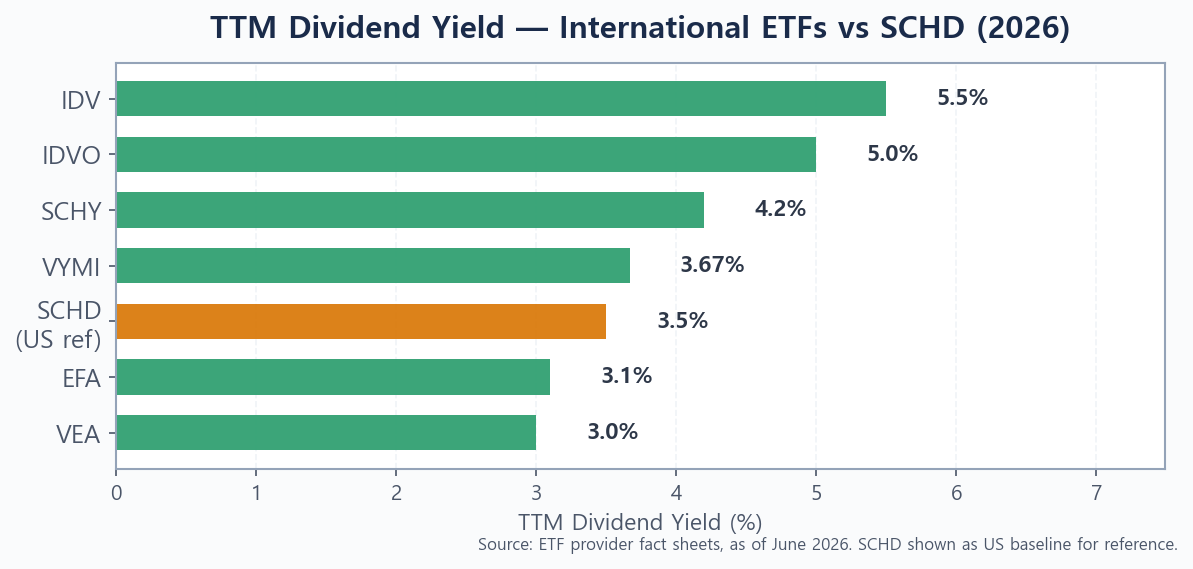
There’s also a valuation argument. As of mid-2026, international developed-market stocks trade at price-to-earnings ratios significantly below US equivalents. Lower valuations tend to support higher starting dividend yields, which is exactly what income investors want. Compare: SCHD currently yields around 3.5% with an expense ratio of 0.06%. Several of the international ETFs below yield 4–5.5% at similar or even lower cost.
Currency diversification matters too. When the US dollar weakens — as it has in several stretches of the 2020s — international assets gain extra return from foreign-exchange translation. That’s a natural hedge if most of your savings and spending are dollar-denominated. (For a deeper look at how currency shifts affect your portfolio, our post on the best high-yield dividend ETFs covers currency considerations in the US context.)
The 6 Best International Dividend ETFs for 2026
Each ETF below takes a different approach to international income. Some screen for quality; others optimize for raw yield or use options strategies to boost distributions. Read the profile that matches your priority — then check the comparison table further down.
1. VYMI — Vanguard International High Dividend Yield ETF
The broad-market anchor pick. VYMI tracks the FTSE All-World ex-US High Dividend Yield Index, which screens developed and emerging-market companies forecast to deliver above-average dividends. With roughly 1,000 holdings spread across Japan, the UK, Canada, Australia, and Europe, it’s one of the most diversified international dividend options available.
- TTM Yield: 3.67%
- Expense Ratio: 0.07%
- Holdings: ~1,000
- Geographic Focus: Global ex-US (developed + emerging markets)
At 0.07%, VYMI’s fee is close to rock-bottom for an actively screened fund. It’s the natural international counterpart to VTI or VT for dividend investors who want global breadth without paying up for it. The yield is modest compared to IDV or IDVO, but the diversification and ultra-low cost make it a strong core holding.
2. SCHY — Schwab International Dividend Equity ETF
The international SCHD twin. SCHY applies the same Dow Jones quality screen to international companies that SCHD applies to US ones — requiring 10 consecutive years of dividend payments and ranking candidates on cash-flow-to-debt, return on equity, dividend yield, and five-year dividend growth. The result is a concentrated 100-stock portfolio of high-quality international dividend growers.
- TTM Yield: 4.2%
- Expense Ratio: 0.14%
- Holdings: 100
- Geographic Focus: Developed markets
If you own SCHD and love its quality-first philosophy, SCHY is the most natural companion. You get the same methodology applied to cheaper international markets, with a higher starting yield (4.2% vs 3.5%) and surprisingly low fees for what it delivers. It excludes emerging markets entirely, which reduces volatility but also limits exposure to faster-growing economies. For a comparison of SCHD against other US dividend growth ETFs, see our SCHD vs VIG breakdown.
3. IDV — iShares International Select Dividend ETF
The high-income specialist. IDV, launched in 2007, is one of the oldest international dividend ETFs and focuses squarely on income. It concentrates in developed-market companies paying the highest yields — heavily weighted toward European financials, utilities, and telecom names that consistently distribute large portions of earnings as dividends.
- TTM Yield: 5.5%
- Expense Ratio: 0.50%
- Holdings: ~100
- Geographic Focus: Developed markets
IDV’s 5.5% yield is among the highest in this group, but the cost is real: the 0.50% expense ratio is meaningfully higher than VYMI or SCHY. It’s best thought of as a high-octane income engine — useful when your priority is current cash flow and the rest of your portfolio already handles growth and diversification. If expense ratios feel opaque, our explainer on how ETF fees quietly eat your returns shows the long-run math.
4. IDVO — Amplify International Enhanced Dividend Income ETF
The covered-call booster. IDVO is the international equivalent of JEPI — it holds roughly 100 international dividend stocks and layers a covered call options strategy on top to generate additional premium income. Launched in September 2022, it’s the newest and smallest fund on this list, but has attracted income-focused investors seeking global exposure with extra yield.
- TTM Yield: 5.0%
- Expense Ratio: 0.66%
- Holdings: ~100
- Geographic Focus: International (covered call overlay)
The covered call strategy caps some upside in strong rallies in exchange for the elevated yield. IDVO’s 0.66% fee is the highest on this list, so make sure the yield advantage justifies the cost in your specific holding period. If you’re already familiar with covered call mechanics from US ETFs, our guide on the best covered call ETFs for monthly income explains the tradeoffs in detail.
5. VEA — Vanguard FTSE Developed Markets ETF
The lowest-cost broad core. VEA tracks nearly 3,900 companies across Europe, Asia-Pacific, and Canada — a true market-cap-weighted slice of developed markets outside the US. It’s not a dedicated dividend screen, but developed-market companies structurally pay higher dividends than US equivalents, and VEA’s 0.05% expense ratio is essentially free.
- TTM Yield: 3.0%
- Expense Ratio: 0.05%
- Holdings: ~3,900
- Geographic Focus: Developed markets
VEA’s yield won’t wow income investors focused purely on distribution size, but its ultra-low fee, massive diversification, and total-return track record make it the go-to international building block in most simple 3-fund portfolios. Think of it as the foundation layer — pair it with a higher-yield tilt like VYMI or SCHY if you want to boost income from the international sleeve.
6. EFA — iShares MSCI EAFE ETF
The original developed-market benchmark. EFA launched in 2001 and remains one of the largest and most liquid international ETFs in existence. It tracks the MSCI EAFE Index — covering developed markets in Europe, Australasia, and the Far East — with roughly 800 holdings. No emerging markets exposure.
- TTM Yield: 3.1%
- Expense Ratio: 0.32%
- Holdings: ~800
- Geographic Focus: Developed markets (Europe, Australasia, Far East)
EFA is a solid, well-known option, but at 0.32% it costs more than VEA (0.05%) for broadly similar developed-market exposure. It’s worth owning if your brokerage offers it commission-free or if you specifically want MSCI index methodology over the FTSE framework used by VEA. For most investors, VEA is the lower-cost alternative.
If you’re comparing this list to US-focused options, the SPYD vs VYM vs SCHD showdown is a useful companion read.
The video above walks through VYMI, SCHY, and IDVO side by side — useful if you want a visual walkthrough of the tradeoffs before committing to one of the higher-yield options.
International Dividend ETF Comparison Table (2026)
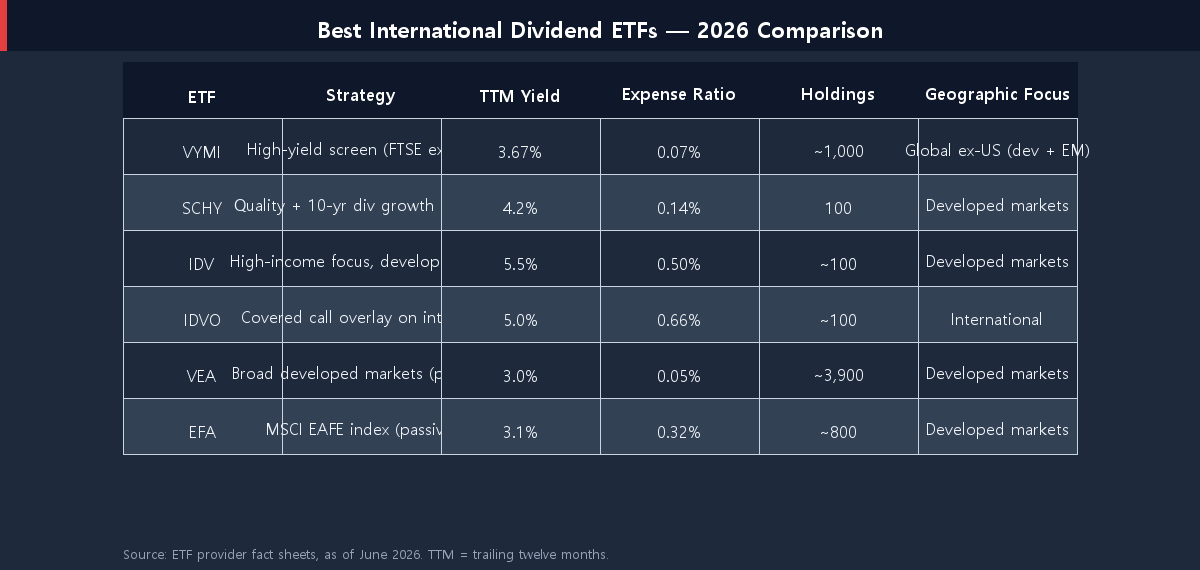
(Source: ETF provider fact sheets and fund data, as of June 2026. TTM = trailing twelve months.)
How to Add International Dividend ETFs to Your Portfolio
The most common approach is to treat international dividend ETFs as a satellite allocation alongside a US core. A straightforward starting point: 70–80% US (SCHD, VYM, or similar) and 20–30% international (VYMI or SCHY). This gives you meaningful geographic diversification without abandoning the strong long-run track record of US dividend growers.
A few practical steps:
- Pick one or two, not six. VYMI and SCHY together cover quality + breadth. Adding IDV or IDVO on top for income makes sense; owning all six creates redundant complexity.
- Check your existing overlap. If you hold VT (Vanguard Total World ETF), you already have ~40% international exposure baked in. Adding VYMI on top may double-count.
- Account for withholding taxes. Many international companies withhold a portion of dividends at source before they reach your account. In a taxable brokerage, you can often reclaim this via the foreign tax credit. In a Roth IRA, you typically cannot — so international dividend ETFs may be better held in a taxable account where the tax credit applies. Consult your tax advisor for your specific situation.
- Rebalance annually. Currency and regional drift can skew your international allocation significantly within 12–18 months. A simple annual rebalance keeps the ratios where you want them.
New to building a diversified portfolio? Our beginner’s guide to asset allocation covers how to think about the overall stock/bond/cash split before adding income-specific tilts.
Key Risks of International Dividend ETFs
International dividend ETFs come with a set of risks that don’t apply — or apply differently — to domestic equivalents. Know these before adding a position:
- Currency risk: Returns are translated from local currencies (euros, yen, pounds) into dollars. A strengthening US dollar reduces the return you see in your account, even if the underlying holdings perform well. The reverse is also true.
- Dividend variability: European and Asian companies often pay dividends semi-annually rather than quarterly, and payout ratios fluctuate more with earnings cycles than their US counterparts. Expect more quarter-to-quarter variation in distributions.
- Withholding tax drag: As noted above, foreign governments withhold taxes on dividends before you receive them. This can reduce the effective after-tax yield meaningfully depending on account type and treaty rates.
- Sector concentration: High-yield international ETFs (especially IDV) skew heavily toward financials, utilities, and energy — sectors that dominated European and Australian dividend payers historically. Economic stress in those sectors hits these funds hard.
- Geopolitical and regulatory risk: Corporate governance standards, shareholder protections, and disclosure requirements vary widely across international markets. Emerging-market exposure (present in VYMI) adds an additional layer of political and currency risk.
Which International Dividend ETF Is Right for You?
Here’s a simple decision framework:
- Want the lowest possible fee and maximum diversification? → VEA (0.05%) or VYMI (0.07%). Use one of these as the core of your international sleeve.
- Already own SCHD and want to mirror the quality methodology globally? → SCHY (4.2% yield, 0.14% ER). It pairs naturally with SCHD and doesn’t add complexity.
- Priority is maximizing current income and you can stomach higher fees and sector concentration? → IDV (5.5% yield, 0.50% ER).
- Want income beyond what pure dividends provide and understand options overlays? → IDVO (5.0% yield, 0.66% ER).
- Building a simple long-term portfolio that needs one international building block? → VEA or EFA. They won’t maximize income, but they’re the most versatile, liquid, and broadly accepted options.
Most income investors building a global dividend portfolio will do well with VYMI or SCHY as the international sleeve, alongside their existing US dividend holdings. The higher-yield options (IDV, IDVO) work better as tactical income boosters once the core is established.
Found this useful? Bookmark it for your next portfolio review. For more income and ETF analysis, explore:
- Best High-Yield Dividend ETFs for 2026
- SCHD vs VIG: Best Dividend Growth ETF for 2026?
- SPYD vs VYM vs SCHD: Best High-Dividend ETF for 2026?
- Best Covered Call ETFs for Monthly Income in 2026
This article is for informational purposes only and is not investment advice. Do your own research before making any investment decisions.