
Two income strategies dominate the conversation for passive investors right now: REIT ETFs and dividend ETFs. Both throw off regular cash. Both are accessible through a single ticker. But they work differently, carry different tax consequences, and react to interest rates in very different ways. If you’re building a passive income portfolio in 2026, this comparison will help you decide where each one belongs — or whether you should own both.

What Are REITs and Dividend ETFs? (A Quick Refresher)
Before comparing numbers, it helps to understand how each vehicle actually generates your income. They look similar on the surface — both pay quarterly distributions — but the underlying mechanics differ significantly.
How REITs Generate Income
A Real Estate Investment Trust (REIT) is a company that owns income-producing real estate: apartment complexes, data centers, hospitals, industrial warehouses, and retail properties. By law, a REIT must distribute at least 90% of its taxable income to shareholders every year. That legal requirement is what creates the naturally high yields.
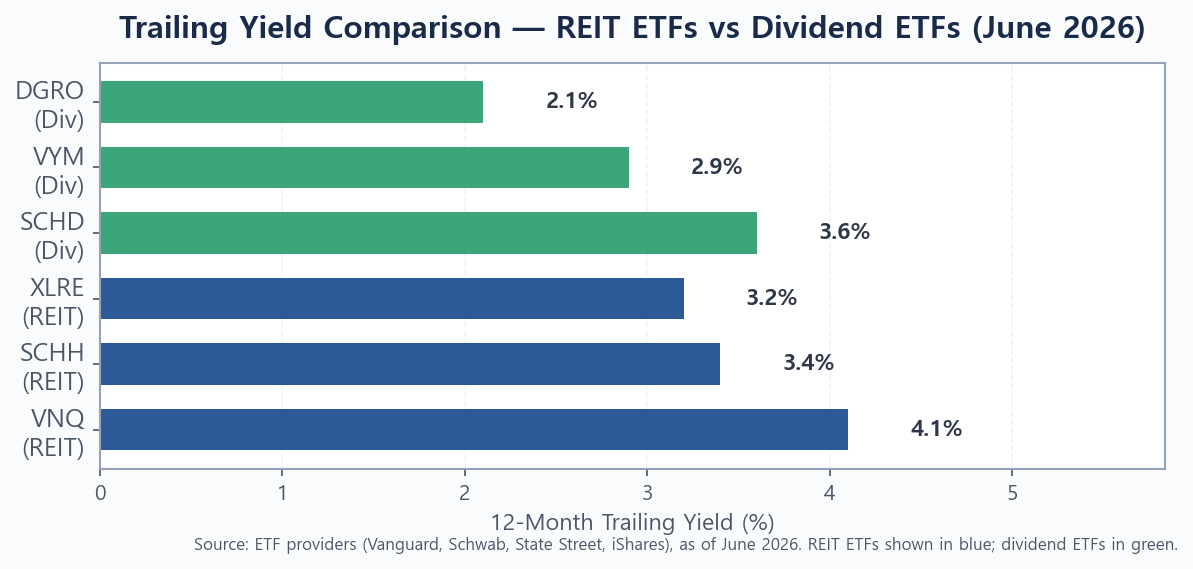
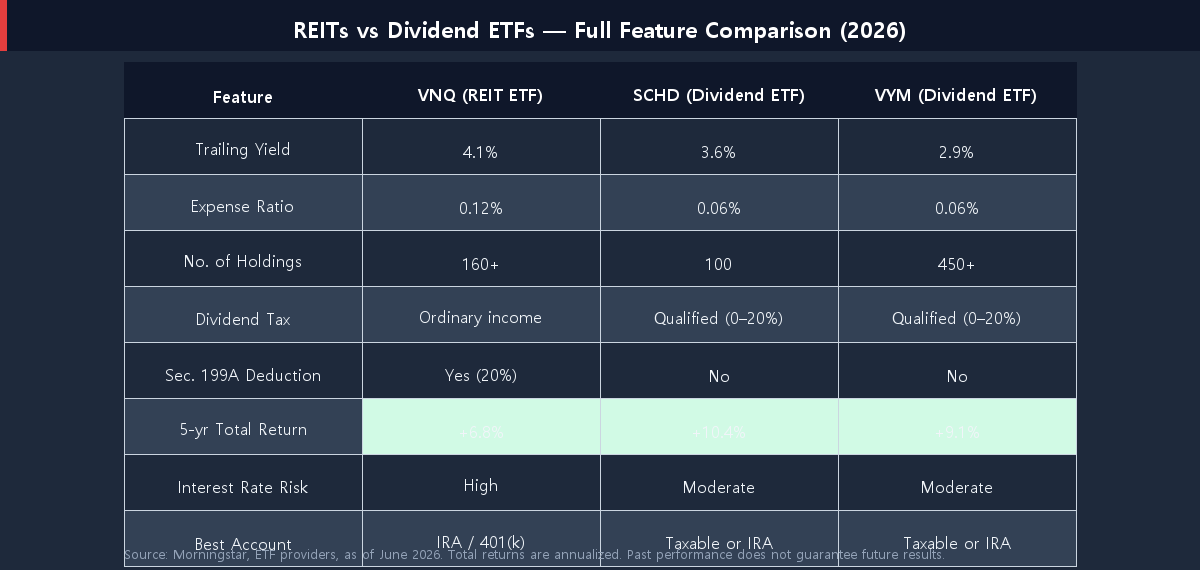
When you buy a REIT ETF like VNQ (Vanguard Real Estate ETF), you get instant exposure to 160+ individual REITs — everything from Prologis industrial properties to Welltower healthcare facilities. The ETF collects rent-based income from all of them and passes it to you quarterly. VNQ’s trailing yield stands at 4.1% as of June 2026 (Source: Vanguard, June 2026), with an expense ratio of just 0.12%.
Other popular REIT ETFs include SCHH (Schwab U.S. REIT ETF) at 3.4% yield and 0.07% ER, and XLRE (Real Estate Select Sector SPDR) at 3.2% yield and 0.09% ER — concentrated in the 30 largest REITs by market cap.
How Dividend ETFs Generate Income
Dividend ETFs hold dividend-paying stocks across multiple sectors — technology, financials, healthcare, consumer staples, industrials, and more. They screen for companies with strong dividend histories, high free cash flow, or consistent dividend growth. The income comes from corporate profits rather than rental income.
SCHD (Schwab U.S. Dividend Equity ETF) is the flagship here: 3.6% trailing yield, 0.06% ER, 100 carefully screened U.S. dividend stocks. VYM (Vanguard High Dividend Yield ETF) casts a wider net — 450+ stocks at 2.9% yield and 0.06% ER. DGRO (iShares Core Dividend Growth ETF) emphasizes dividend growers at 2.1% yield and 0.08% ER. For deeper dives, see our Best High-Yield Dividend ETFs for 2026 guide.
Head-to-Head: Yield, Fees, and 5-Year Total Return
On raw yield, REIT ETFs win. VNQ’s 4.1% beats SCHD’s 3.6% and easily beats VYM’s 2.9%. But yield alone doesn’t tell the full story. Total return — yield plus price appreciation — is what actually builds wealth over time.
Over the five years ending June 2026, SCHD returned approximately 10.4% annualized and VYM returned 9.1% annualized (Source: Morningstar, June 2026). VNQ returned approximately 6.8% annualized over the same period — a meaningful gap. The higher current yield from REITs came with weaker price appreciation, partly because rising rates from 2022 to 2024 crushed real estate valuations.
On fees, the gap is small but real. REIT ETFs cluster around 0.07–0.12% ER. Dividend ETFs like SCHD and VYM both charge just 0.06%. Neither is expensive in absolute terms, but compounding effects accumulate over decades.
The takeaway: if maximum current income is your only goal, REIT ETFs deliver. If you care about total portfolio growth alongside income, dividend ETFs have historically had the edge. For a broader comparison of dividend ETF options, our SPYD vs VYM vs SCHD article breaks down the field in detail.
The Tax Trap Most Income Investors Miss
This is where the comparison shifts decisively — and where many income investors get an unpleasant surprise at tax time.
REIT dividends are mostly classified as ordinary income, not qualified dividends. That means they’re taxed at your marginal rate — potentially up to 37% for high earners. There’s a partial offset: the Tax Cuts and Jobs Act created the Section 199A deduction, which allows non-corporate taxpayers to deduct 20% of qualified REIT dividends. But even with that deduction, REIT income is taxed more heavily than equivalent income from most dividend ETFs.
Dividend ETF payouts, by contrast, are mostly qualified dividends — taxed at the favorable long-term capital gains rates of 0%, 15%, or 20% depending on your income. For a married filer with taxable income under $94,050 in 2026, that rate is 0%.
The practical implication is significant. In a taxable brokerage account at a 22% marginal rate, $1,000 of REIT income might net you around $820 after the Section 199A deduction. The same $1,000 from SCHD’s qualified dividends would net you $850. The difference compounds over decades. The widely accepted approach: hold REIT ETFs in tax-advantaged accounts (IRA, 401(k), Roth IRA) and let dividend ETFs occupy your taxable account.
Interest Rate Sensitivity — REITs Take the Bigger Hit
REITs and interest rates have a famously complicated relationship. REITs borrow heavily to finance property acquisitions. When rates rise, borrowing costs climb, profit margins compress, and REIT valuations fall. Simultaneously, rising rates make bonds more attractive to income investors, pulling capital away from REITs.
The 2022–2023 rate hike cycle illustrated this painfully. As the Fed hiked from 0% to 5.25–5.50%, VNQ fell approximately 26% from January 2022 to October 2023. SCHD fell only around 10% over the same period — a reminder that diversified dividend stocks carry far less interest rate risk than real estate-focused funds.
REITs have rebounded strongly in 2025–2026 as rate cut expectations shifted in their favor. Data center REITs and industrial REITs have been particular standouts. But investors should understand that a sustained “higher for longer” rate environment can weigh on REIT valuations for years. For more on how the current rate environment affects income strategies, see Why Dividend Stocks Are Beating the S&P 500 in 2026.
Which One Belongs in Your Portfolio?
The answer depends on your account type, tax bracket, rate outlook, and diversification goals. Here’s a practical framework.
When to Favor REIT ETFs
- You have tax-advantaged space available (IRA, 401(k), Roth IRA) to shelter the ordinary income tax treatment
- You want genuine real estate exposure in your portfolio — REITs provide diversification that dividend stocks don’t replicate
- You’re constructive on lower rates ahead, which would boost real estate valuations
- You prioritize maximizing current yield above total return
When to Favor Dividend ETFs
- You’re investing in a taxable brokerage account and want tax-efficient income
- You want sector diversification across financials, healthcare, consumer staples, and industrials
- You’re focused on total return (yield + growth) rather than maximum current income
- You want lower interest rate sensitivity in your income sleeve
For a detailed breakdown of dividend ETF options, our SCHD vs VIG comparison walks through yield vs. growth trade-offs. If you’re exploring higher-yield alternatives, Best Covered Call ETFs for Monthly Income covers JEPI and JEPQ.
The Case for Owning Both
Most income investors don’t have to choose. REITs and dividend-paying stocks have historically low correlation — REITs tend to move with real estate cycles, while dividend stocks follow corporate earnings cycles. Holding both in appropriate proportions can smooth overall income stream volatility.
A simple framework: put REIT ETFs (VNQ, SCHH) inside your IRA for maximum tax shelter, and hold dividend ETFs (SCHD, VYM) in your taxable account where the qualified dividend treatment reduces your effective tax rate. This way your overall passive income is diversified across real estate rental income and corporate profit distributions — a more resilient combination than either alone.
For investors still building the foundation, How to Build a Simple 3-Fund Portfolio in 2026 covers the core allocation framework, and A Beginner’s Guide to Asset Allocation explains how income ETFs fit into a broader portfolio.
Bottom Line
REITs vs dividend ETFs isn’t a winner-take-all debate. REIT ETFs offer higher current yields and genuine real estate diversification, but they carry more interest rate risk and less favorable tax treatment in taxable accounts. Dividend ETFs deliver lower but tax-efficient income, better long-term total return, and broader sector exposure. For most passive income investors in 2026, the smart move is using both — REITs sheltered in tax-advantaged accounts and dividend ETFs in taxable accounts — rather than choosing one or the other.
Found this useful? Bookmark it so you can revisit when the market moves. I publish practical investing breakdowns regularly — check back soon.
This article is for informational purposes only and is not investment advice. Do your own research.