
Investment-grade corporate bonds are doing something they haven’t done in over a decade: paying genuinely competitive income. With yields on short-to-intermediate IG bonds now sitting above 5% and the 10-year IG corporate benchmark touching 5.5% (Source: ICE BofA IG Corporate Index, as of July 2026), the case for including IG corporates in a balanced portfolio is stronger than it’s been since before the era of near-zero rates. But elevated yields alone don’t tell the full story. Spreads over Treasuries are historically tight, the 2026 yield curve has shifted meaningfully, and duration risk hasn’t gone away. This mid-year outlook breaks down where investment-grade corporate bonds stand, what the yield curve means for your positioning, and how to build an income strategy that makes sense for the second half of 2026.

Where IG Corporate Bond Yields Stand at Mid-2026
The simplest way to assess the IG corporate bond market is to look at two numbers together: the absolute yield you’re earning, and the spread premium you’re collecting above equivalent-maturity Treasuries. Both numbers matter — and right now, they’re telling a mixed story.
Current Spreads vs. Treasuries — How Tight Is Too Tight?
As of July 2026, the ICE BofA Investment Grade Corporate Index option-adjusted spread (OAS) sits around 95–105 basis points (bps) over comparable Treasuries (Source: ICE BofA / Bloomberg, July 2026). Historically, this is tight. The long-run average spread is closer to 120–130bps, and during stress periods like March 2020 spreads blew out past 350bps. At sub-100bps, the market is pricing in a very benign credit environment — low default risk, stable corporate earnings, and no imminent recession.
That’s the bullish read. The bearish counterpoint: tight spreads leave little cushion if economic conditions deteriorate. If growth slows unexpectedly in H2 2026 or a wave of refinancings hits at higher rates, spreads could reprice quickly toward 130–150bps, generating capital losses that partially offset your coupon income. For a deeper breakdown of how IG spreads compare to high-yield and Treasury alternatives right now, see Corporate Bonds vs. Treasuries in 2026.
The key insight: tight spreads are not necessarily a reason to avoid IG bonds — they’re a reason to be selective about duration and to set realistic expectations about total return.
The 2026 Yield Curve Shape and Its Impact on IG Bonds
The US yield curve in mid-2026 is mildly upward-sloping after spending much of 2023–2024 inverted. The Federal Reserve has held the fed funds rate in the 4.25–4.50% range through H1 2026, anchoring short-term rates while longer maturities have drifted higher on fiscal supply concerns and sticky inflation (Source: Federal Reserve, July 2026 FOMC statement). The 10-year Treasury sits near 4.50% while the 30-year has pushed toward 4.90%.
For IG corporate bonds, this means the entire yield curve is carrying meaningful income — but the steepening from 5- to 30-year maturities introduces real duration risk for longer bonds. A bond with an effective duration of 9 years (like LQD) loses approximately 9% of market value for every 1 percentage-point rise in yields. In a curve that’s still in motion, that’s a meaningful headwind to be aware of.
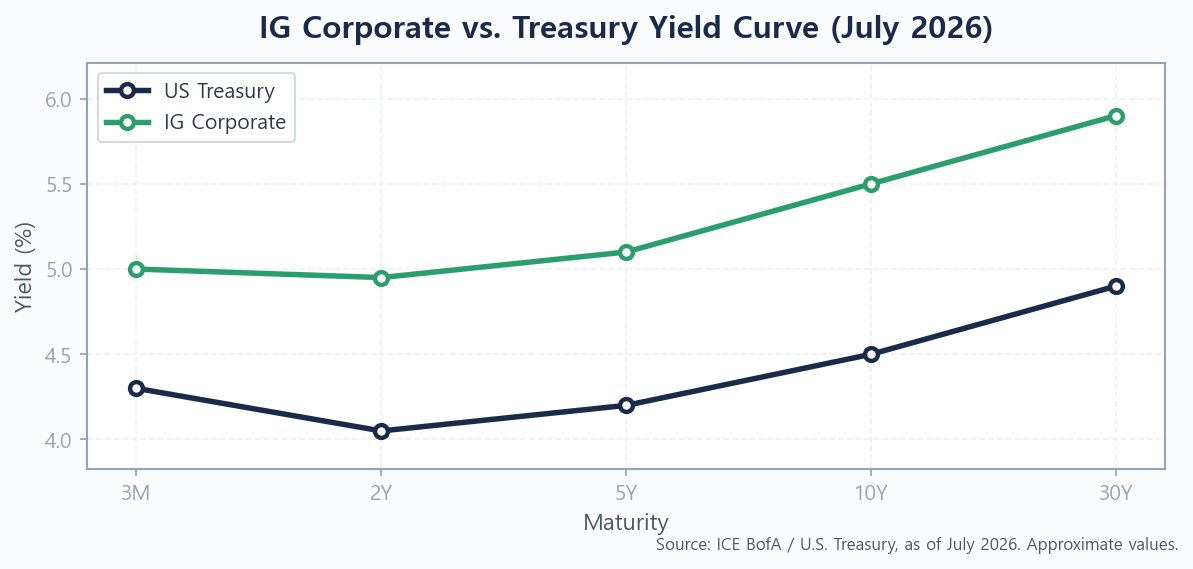
The chart above overlays the IG corporate bond yield curve against the Treasury curve as of July 2026. Notice how the spread between the two series is tightest at the 3-month point (~70bps) and widens modestly toward the 30-year end (~100bps). This compression at the short end reflects strong demand for short-duration IG paper from money-market-adjacent investors. For more on what the broader yield curve shift means for bond investors this year, see our 10-Year Treasury Yield Outlook 2026.
The Case for Investment-Grade Bonds — and the Hidden Risks
There is a genuine bull case for IG corporate bonds entering H2 2026 — but it comes with three specific risks that investors should assess before allocating.
Why IG Bonds Are Generating Real Income Again
The most straightforward argument for IG corporate bonds today is that you’re being paid to own them at levels not seen since 2008–2009. A 5-year IG corporate bond yielding 5.1% gives you a positive real yield (above CPI, which ran at approximately 3.2% year-over-year through June 2026, Source: U.S. Bureau of Labor Statistics, June 2026) — something that was effectively impossible from 2010 to 2022.
That real income matters for several investor profiles. Retirees and near-retirees can fund a meaningful portion of their income needs through IG coupon payments without reaching down the credit ladder into high-yield. Balanced-portfolio investors can use IG bonds to reduce equity exposure without sacrificing all return potential. And for conservative accumulators, locking in 5%+ yields over a 5-to-10-year horizon provides genuine compounding power.
Corporate fundamentals also support the case. Investment-grade issuers — companies rated BBB– or higher by S&P and Moody’s — have, as a class, managed their debt maturities reasonably well. Many locked in low-rate debt during 2020–2021, meaning near-term refinancing walls are not as alarming as feared. Net leverage ratios across IG industrials and utilities remain broadly within historical norms (Source: J.P. Morgan IG Credit Research, Q2 2026).
Three Risks Investors Shouldn’t Ignore in H2 2026
1. Duration risk in a steepening curve. The longer the bond, the more sensitive it is to yield moves. With the 10- to 30-year segment of the Treasury curve still under pressure from heavy government issuance and global demand shifting, long-duration IG bonds carry meaningful price risk in a continued bear steepener scenario. For a full discussion of how the steepening curve affects fixed-income positioning, read our analysis of Treasury Yield Curve Steepening in 2026.
2. Spread compression limits upside. At 95–105bps of spread, IG corporate bonds have limited room to tighten further in a risk-on scenario. In past cycles, spreads compressed to the 75–80bps range at peak cycle optimism, so there’s modest room — but total return upside from spread tightening alone is limited. Most of your return in H2 2026 will come from the coupon, not from price appreciation.
3. Refinancing risk for BBB-rated issuers. The BBB tier — the lowest rung of investment grade — faces the most refinancing pressure over the next 24 months as 2020–2021 vintage debt matures. If growth slows or credit conditions tighten, a wave of BBB downgrades to high-yield (“fallen angels”) could push IG spreads wider. Investors concentrated in the BBB tier via broad IG ETFs are implicitly taking this risk.
Income Strategy: Positioning Your IG Bond Allocation in H2 2026
Given elevated absolute yields, tight spreads, and an uncertain long-end trajectory, the most sensible IG bond strategy for H2 2026 is one that collects income while managing duration exposure deliberately. Two main structural approaches apply: bond laddering and IG bond ETFs.
Bond Laddering vs. IG Bond ETFs
A bond ladder — buying individual IG bonds maturing at staggered dates (say, 1-, 2-, 3-, 5-, and 7-year maturities) — gives you precise maturity control and eliminates the “perpetual” duration risk of an ETF. When a bond matures, you reinvest at current rates. In a steepening or volatile curve environment, this predictability has real value: you know exactly when you get your principal back.
The trade-off is access and scale. Buying individual corporate bonds typically requires $5,000–$10,000 per bond and a brokerage with solid bond inventory. Transaction costs can be material for smaller purchases. For most retail investors, individual bonds in the IG space are practical starting from ~$50,000 of capital dedicated to the strategy. For a detailed comparison of how laddering stacks up against ETF exposure, see Treasury Bond Ladder vs. Bond ETF.
IG bond ETFs solve the access problem immediately: you can buy $500 or $50,000 of diversified IG exposure at any moment. The cost is that the ETF has no maturity date — it rolls its portfolio continuously, meaning your duration exposure persists regardless of where rates go. That’s fine for investors with long time horizons, but it introduces mark-to-market volatility for those with near-term cash needs.
Practical recommendation: Investors with 5+ year horizons who can tolerate some price fluctuation are well served by IG bond ETFs (VCIT or IGIB for intermediate exposure, lower duration risk than LQD). Investors within 3–5 years of needing their capital — retirees especially — should consider a short-to-intermediate bond ladder that matches cash flow needs to maturity dates.
Top IG Bond ETFs to Consider
For investors choosing the ETF route, the table below compares the four most widely held IG corporate bond ETFs as of July 2026. The key variables to weigh are yield to maturity (your expected annual return if held to the fund’s average maturity), effective duration (your price sensitivity to a 1% rate move), and cost.
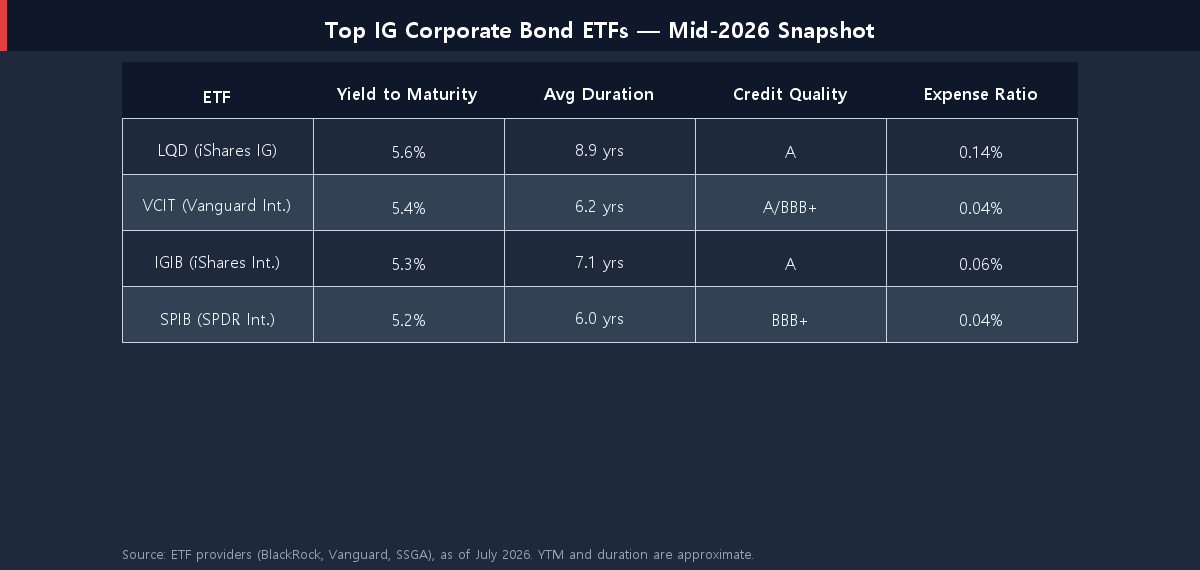
VCIT and SPIB stand out for cost-conscious investors: both carry expense ratios of just 0.04% — a fraction of what LQD charges — while delivering comparable yield at lower duration. LQD’s longer duration (8.9 years) amplifies both upside in a falling-rate scenario and downside in a rising-rate scenario, making it more appropriate for investors with a specific bullish rate view. IGIB offers a middle path — slightly higher quality tilt (A-rated average) and intermediate duration.
One allocation approach for H2 2026: combine VCIT (intermediate exposure) with a small sleeve of shorter-duration IG exposure to keep portfolio duration in the 4–6 year range. This captures the bulk of available income without taking excessive long-end rate risk.
Conclusion: Is Now a Good Time to Buy IG Corporate Bonds?
The investment-grade corporate bond market in mid-2026 presents a genuine income opportunity. Absolute yields above 5% on intermediate IG bonds are historically attractive, corporate fundamentals remain broadly solid, and the fixed-income market is once again doing what it’s supposed to do: paying investors for lending money. The 2026 yield curve and income strategy conversation is fundamentally different from 2019 or 2021 — the income is real, the diversification benefit is restored.
The caution flag is spread tightness. At 95–105bps over Treasuries, IG spreads are not pricing in much credit stress. Investors who want to participate in the income available without taking full long-end duration risk should consider intermediate-duration ETFs like VCIT or IGIB, or a short-to-intermediate bond ladder matching their actual cash-flow timeline.
If you’re not yet convinced IG spreads justify the credit risk versus just owning Treasuries, the Short-Duration Bonds in a 4% World analysis may speak to you — sometimes the simpler, purer income option wins.
Found this breakdown useful? Bookmark it and revisit as the Fed’s H2 2026 path becomes clearer. If a colleague is working through the same portfolio question, share this with them.
This article is for informational purposes only and is not investment advice. Do your own research. All yield and spread figures are approximate and based on publicly available index data as of July 2026; they may have changed by the time you read this.