
Recession probability trackers have been creeping higher throughout 2026. Tariff-driven inflation is sticky, the Fed has kept rates elevated longer than most forecasters expected, and corporate earnings growth is slowing. None of that guarantees a downturn — but it does mean that right now is a sensible time to ask: if a recession hit in the next 12 months, how badly would my portfolio suffer, and what would I wish I’d done differently? This guide walks through the three core defensive levers — bonds, gold, and cash — and shows you how to size each one relative to your risk tolerance.

Why Most Portfolios Crack in a Recession — and How to Fix Yours
The conventional answer to market stress has always been “add bonds.” For decades, a 60/40 stock-bond blend held up reasonably well in downturns because Treasuries rallied when equities sold off. That negative correlation was the whole point. Then 2022 happened.
The 2022 Wake-Up Call: Stocks and Bonds Fell at the Same Time
In 2022, the S&P 500 declined roughly 19% peak-to-trough. A standard 60/40 portfolio — where the bond cushion was supposed to absorb the blow — fell close to 17%. Long-duration Treasuries lost more than 25%. The culprit was a rapid, synchronized rate-hiking cycle: rising rates hammer bond prices at the same time they compress equity valuations. The protective mechanism broke down precisely when investors needed it most.
The lesson isn’t that bonds are useless. It’s that bond duration and type matter enormously, and that a portfolio with no gold or cash buffer may have fewer shock absorbers than it appears. For 2026, with the 10-year Treasury yield outlook for 2026 still hovering near elevated levels, duration management remains critical.
What “Recession-Proofing” Actually Means (It’s Not Zero Risk)
Recession-proofing doesn’t mean eliminating losses — it means reducing maximum drawdown enough to stay invested rather than panic-selling at the bottom. The goal is a portfolio that might fall 10–15% in a bad year instead of 40%, so you can hold through the trough and participate in the eventual recovery. That distinction — between a manageable dip and a portfolio-crushing plunge — often separates investors who build wealth from those who crystallize losses and miss the rebound.
Bonds: Your First Line of Recession Defense
Bonds remain the most reliable recession hedge when chosen correctly. In a genuine economic slowdown, the Fed typically cuts rates, which pushes bond prices higher (yields and prices move inversely). The catch is that you need the right kind of bonds — not the long-duration funds that bled out in 2022.
Short-Duration Treasuries vs. Long Bonds — What Works in 2026
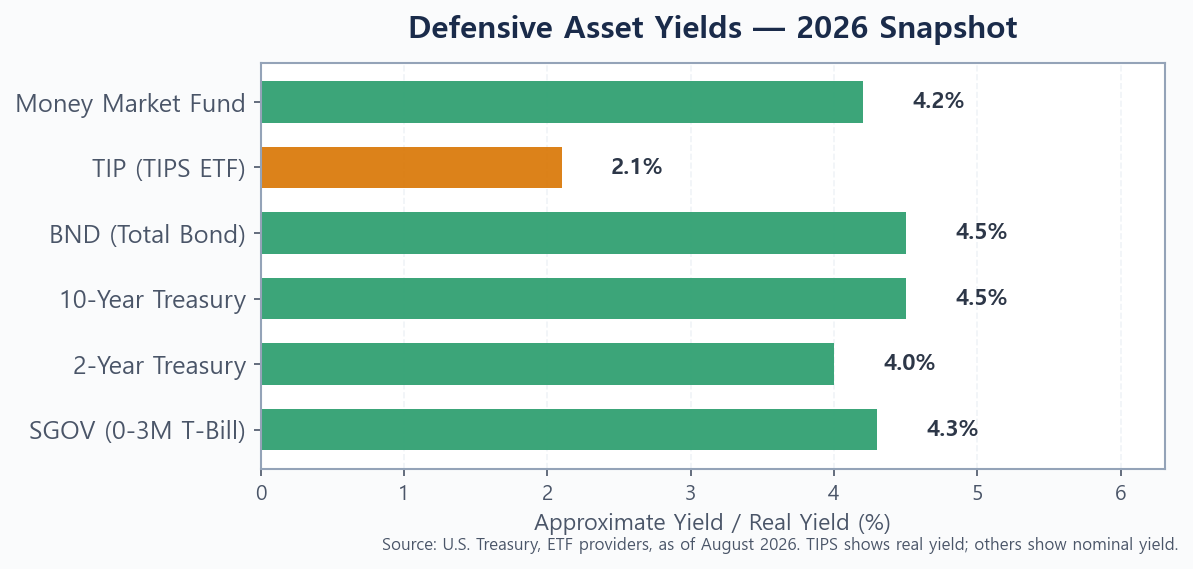
With the yield curve relatively flat in 2026, short-duration Treasuries offer a compelling combination: you pick up most of the yield without taking on significant interest-rate risk. A 2-year Treasury currently yields close to the 10-year, meaning you aren’t being paid enough extra to take the volatility of a 20- or 30-year bond. Short-term Treasuries — maturities of three months to two years — are the sweet spot for defensive positioning right now.
TIPS (Treasury Inflation-Protected Securities) deserve a spot too, particularly if your recession scenario involves stagflation — slow growth plus persistent inflation from tariffs. TIPS adjust your principal with CPI, so real purchasing power is protected even when nominal yields aren’t rising fast enough. For a deeper comparison, our post on TIPS vs. I Bonds breaks down which inflation-protection vehicle makes more sense for different time horizons.
Best Defensive Bond ETFs for 2026
- SGOV (iShares 0–3 Month Treasury Bond ETF) — Pure short-duration safety. Yields around 4.2–4.4% with near-zero interest rate risk. Ideal for the “cash equivalent” portion of your bond sleeve.
- VGIT (Vanguard Intermediate-Term Treasury ETF) — Intermediate 3–10 year Treasuries. Offers meaningful rally potential if the Fed begins cutting. Moderate duration risk (~5 years).
- BND (Vanguard Total Bond Market ETF) — Broad investment-grade exposure including corporates. More diversified but carries some credit risk and longer duration (~6.5 years).
- TIP (iShares TIPS Bond ETF) — Inflation-linked Treasuries. Best held if you expect a stagflationary scenario rather than a deflationary recession.
A reasonable bond sleeve for a recession-defensive portfolio in 2026 might blend SGOV (low duration, yield now) with VGIT (rate-cut optionality) rather than reaching for long bonds.
If you’d like to understand what the current yield environment means for bond investors more broadly, the 10-year Treasury yield outlook for 2026 is a good companion read.
Gold: How to Size Your Safe-Haven Slice
Gold doesn’t pay interest or dividends. That’s exactly what most equity-focused investors use as a reason to ignore it — and exactly why adding a modest gold position can improve your portfolio’s risk-adjusted return. Gold moves largely independently of stocks and bonds, and it tends to appreciate when currency confidence erodes, when real interest rates are low or negative, and when geopolitical or financial stress spikes. All three of those conditions have shown up in 2026.
The Evidence-Based Target: 5–15%
Academic research on gold’s portfolio role consistently lands on a 5–10% allocation as the range where gold adds meaningful diversification without dominating your returns. Some tactically minded investors push to 15% in environments like the current one — elevated debt, tariff uncertainty, dollar pressure. Going above 15% starts to create drag in normal or risk-on markets, and you’ll underperform significantly in strong equity bull runs.
Our dedicated analysis of how much gold to hold in your portfolio walks through the historical data and the specific scenarios where gold earns its keep. The short answer: 5–10% as a baseline, up to 15% if you’re genuinely concerned about inflationary or currency risk.
Best Ways to Own Gold in 2026 (ETFs vs. Physical)
For most investors, ETF exposure is the most practical route:
- GLD (SPDR Gold Shares) — Largest gold ETF by AUM; very liquid, tight bid-ask spread. Expense ratio 0.40%.
- IAU (iShares Gold Trust) — Similar physical gold backing, slightly lower expense ratio at 0.25%. Good for buy-and-hold.
- GLDM (SPDR Gold MiniShares) — Cheapest at 0.10%; ideal for smaller positions or dollar-cost averaging.
Physical gold (coins, bars) offers no counterparty risk but comes with storage costs, insurance, and liquidity friction. For most investors building a defensive portfolio sleeve, an ETF like IAU or GLDM is the cleaner choice. Note also that a falling US dollar amplifies gold’s gains — if that macro dynamic interests you, our post on how a weakening dollar affects your portfolio covers this in detail.
Cash Allocation: The Underrated Recession Power Tool
Cash is the asset class that gets the most contempt in a bull market and the most appreciation in a bear market. In 2026, holding cash isn’t just a defensive move — it’s a yield-generating strategy. With short-term instruments paying 4%+, the opportunity cost of holding defensive cash has narrowed significantly compared to the near-zero rate era.
Where to Park Your Defensive Cash in 2026
Not all “cash” is equal. Leaving money in a checking account earning 0.01% is genuinely costly when alternatives pay 4–4.5%. Here are the practical options for your defensive cash allocation:
- Money market funds (e.g., SPAXX, VMFXX) — Government money market funds currently yielding around 4.0–4.2%. Extremely liquid, FDIC-equivalent safety. Available in most brokerage accounts as a default sweep.
- T-bill ETFs (SGOV, BILS) — Treasury bill ETFs that roll 0–3 or 3–12 month bills. State-tax exempt. Marginally higher yield than most money market funds, with daily liquidity.
- High-yield savings accounts — Online banks still offering 4.0%+ on savings. Less convenient for quick redeployment into equities but fine for true emergency reserves.
Our comparison of money market funds vs. short-term Treasuries digs into the yield, tax, and liquidity tradeoffs in more detail. The short version: if you’re in a high state-income-tax state, SGOV’s state-tax exemption gives it a meaningful edge over most money market funds.
Three Sample Recession-Proof Portfolios for 2026
There is no single right answer for how to allocate defensively — it depends on your time horizon, income needs, and how much short-term volatility you can tolerate without panicking. Below are three sample frameworks, ranging from very conservative to growth-tilted but still defensive. The table in the image below shows the full breakdown:
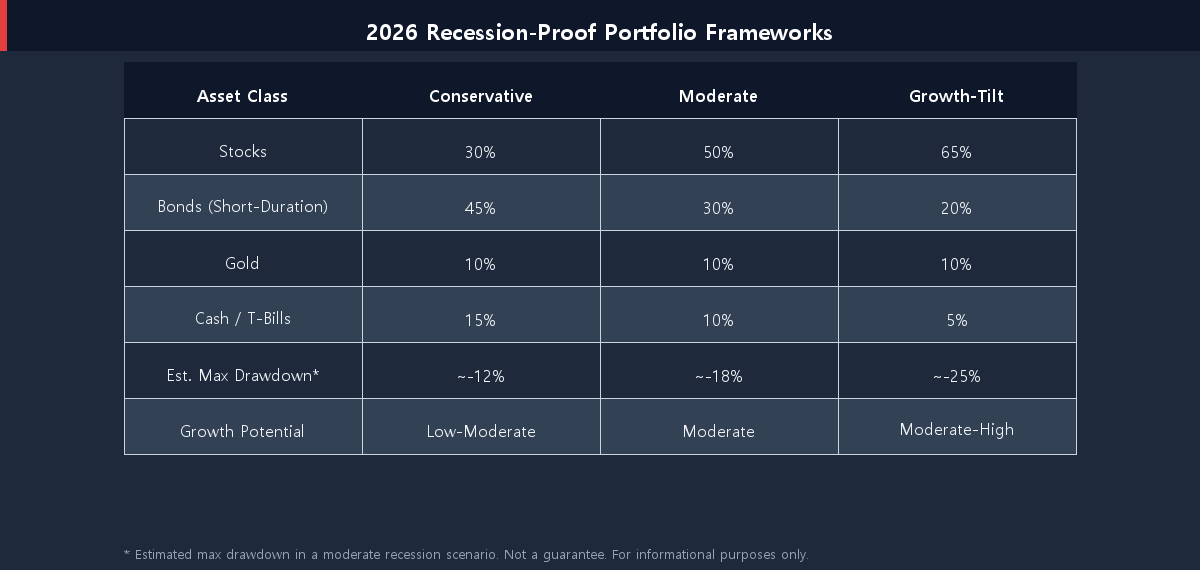
Conservative (Stocks 30% / Bonds 45% / Gold 10% / Cash 15%) — Designed for investors within 5 years of retirement or with very low risk tolerance. The large bond and cash allocation means you’ll underperform in strong equity markets but should weather a deep recession with relatively modest drawdowns. The 15% cash position also gives you dry powder to buy equities during a market trough.
Moderate (Stocks 50% / Bonds 30% / Gold 10% / Cash 10%) — A balanced defensive posture for investors with a 5–15 year horizon. You still participate meaningfully in equity upside, but the bond-gold-cash sleeve provides a meaningful buffer. This is the framework closest to a recession-adjusted 60/40.
Growth-Tilt (Stocks 65% / Bonds 20% / Gold 10% / Cash 5%) — For investors who believe the recession probability is elevated but not overwhelming, and who have a long enough time horizon (15+ years) to recover from a deeper drawdown. The 10% gold acts as a macro hedge; the 20% short-duration bonds add some stability without sacrificing too much growth potential.
If you’re starting from scratch and aren’t sure which framework fits your situation, the beginner’s guide to asset allocation provides a useful baseline for thinking about stocks vs. bonds by life stage before adding the defensive gold and cash layers.
When to Rebalance Back to Growth — Signals to Watch
A defensive allocation is a tactical posture, not a permanent state. Holding 45% bonds and 15% cash indefinitely means you’ll miss significant upside if the recession never materializes or resolves faster than expected. The key is defining in advance what signals would trigger a shift back toward growth.
Historically, the strongest rebalancing signals after a recession include: the Fed cutting rates by 100bps or more, credit spreads narrowing from distressed levels, leading economic indicators (PMI, housing starts) bottoming and turning up, and the equity market recovering 15–20% from its trough. None of these signals alone is conclusive — but when two or three align, it’s typically time to start trimming the defensive sleeve and adding back equity exposure.
For a practical step-by-step approach to executing that rotation, see our post on how to rebalance your portfolio when rates are rising — the same framework applies in reverse when rates start falling.
Bottom Line
Recession-proofing your investment portfolio in 2026 isn’t about moving everything to cash or buying gold coins to bury in the backyard. It’s about deliberate, sized exposure to assets that behave differently from equities when growth slows: short-duration bonds that rally when the Fed cuts, a modest gold position that hedges currency and systemic risk, and enough cash to survive a downturn without forced selling. The exact mix depends on your time horizon, but any of the three sample frameworks above is a meaningful upgrade over a pure equity portfolio heading into an uncertain macro environment.
Worth reading next: our full breakdown of how much gold to hold in your portfolio and the detailed TIPS vs. I Bonds comparison for inflation protection. Found this useful? Bookmark it — market conditions shift, and this framework is worth revisiting whenever recession probability rises.
This article is for informational purposes only and is not investment advice. Do your own research and consult a licensed financial professional before making any investment decisions.