
Gold crossed new all-time highs in 2026, and Goldman Sachs now projects the spot price reaching $4,900 per ounce by year-end. If you have decided to add gold exposure to your portfolio — and you have already thought through how much gold to hold in your portfolio — the next question is which gold ETF actually gives you the best deal. Three physically-backed funds dominate retail flows: GLD (SPDR Gold Shares), IAU (iShares Gold Trust), and GLDM (SPDR Gold MiniShares). Their one-year returns are nearly identical. The cost to own them is not.

This comparison cuts through the noise on expense ratios, AUM, liquidity, options depth, and tax treatment so you can choose the right gold ETF for your specific strategy — whether you are a long-term buy-and-hold investor, an active trader, or somewhere in between.
What Are GLD, GLDM, and IAU?
All three funds hold physical gold bullion stored in secure, LBMA-approved vaults. None use futures contracts or derivatives. When you buy a share, you own a fractional claim on actual gold bars sitting in custodian vaults — GLD and GLDM with HSBC in London and Zurich, IAU primarily with JPMorgan. This matters because physically-backed gold ETFs track spot gold far more accurately than futures-based alternatives and avoid the roll-cost drag that plagues commodity futures funds.
GLD launched in November 2004 as the first major US-listed gold ETF. It is issued by State Street Global Advisors (SPDR) and remains the largest commodity ETF in the world by assets. IAU followed in January 2005 under BlackRock’s iShares brand, deliberately pricing its shares at a lower dollar amount to appeal to smaller investors. GLDM — also from State Street — arrived in 2018, offering an even cheaper entry point and a rock-bottom expense ratio designed to compete directly with IAU on cost.
On any given day, the performance difference between GLD, IAU, and GLDM is negligible. They all move with the gold price. The structural differences that matter are the annual fee, the liquidity profile, and the per-share price — and over a long holding period, those differences compound into real money.
Expense Ratios — The Fee That Quietly Compounds Against You
The expense ratio is the single most important variable when comparing these three gold ETFs. It is deducted daily from the fund’s NAV, meaning you never write a check — it just quietly erodes your returns year after year. Understanding the full impact of an ETF expense ratio is essential before choosing any fund.
- GLD: 0.40% per year
- IAU: 0.25% per year
- GLDM: 0.10% per year
The gap between GLD and GLDM is 0.30 percentage points annually — a difference that might sound trivial but is actually a fourfold cost premium. As a concrete reference point, IAU delivered a 1-year return of 67.2% as of January 2026, while GLDM returned 66.2% over the same period (Source: Bloomberg, January 2026). That 1-percentage-point gap over a single year is almost entirely explained by the 0.15% expense ratio difference, amplified by the compounding of a very strong base return.
The 30-Year Math on $10,000
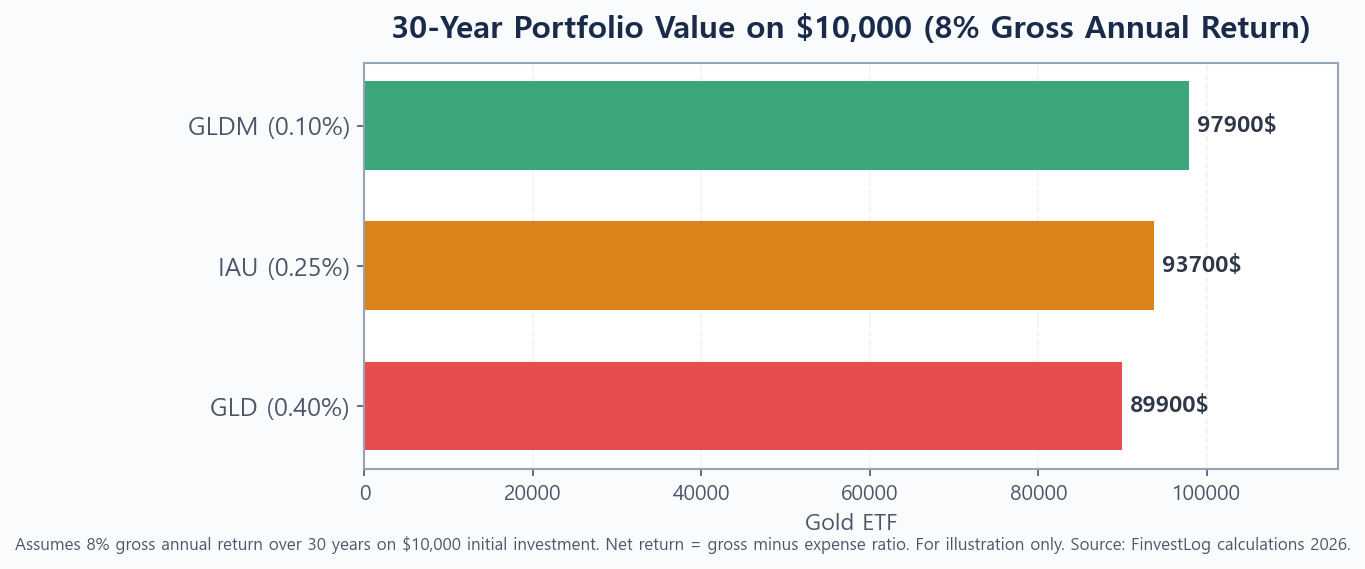
Assume you invest $10,000 in each fund and gold delivers an 8% gross annual return over 30 years — roughly in line with gold’s long-run performance during periods of dollar uncertainty. After subtracting each fund’s expense ratio, here is where your money ends up:
- GLD (7.60% net): $89,900
- IAU (7.75% net): $93,700
- GLDM (7.90% net): $97,900
Choosing GLD over GLDM costs you approximately $8,000 on a $10,000 initial investment over 30 years — before taxes. That is an 8% haircut on your starting capital, surrendered entirely to management fees. Choosing IAU over GLDM costs roughly $4,200 over the same horizon. These are not edge-case scenarios; this is the straightforward arithmetic of compounding applied to a persistent annual fee drag. (Calculations assume constant gross return of 8% p.a. for illustration only.)
Full Metrics Comparison: AUM, Liquidity, and Share Price
Expense ratio is the headline number, but four other metrics shape the real-world experience of owning each fund: assets under management (AUM), average daily trading volume, bid-ask spread, and per-share price. Here is how the three gold ETFs compare across all key dimensions as of mid-2026.
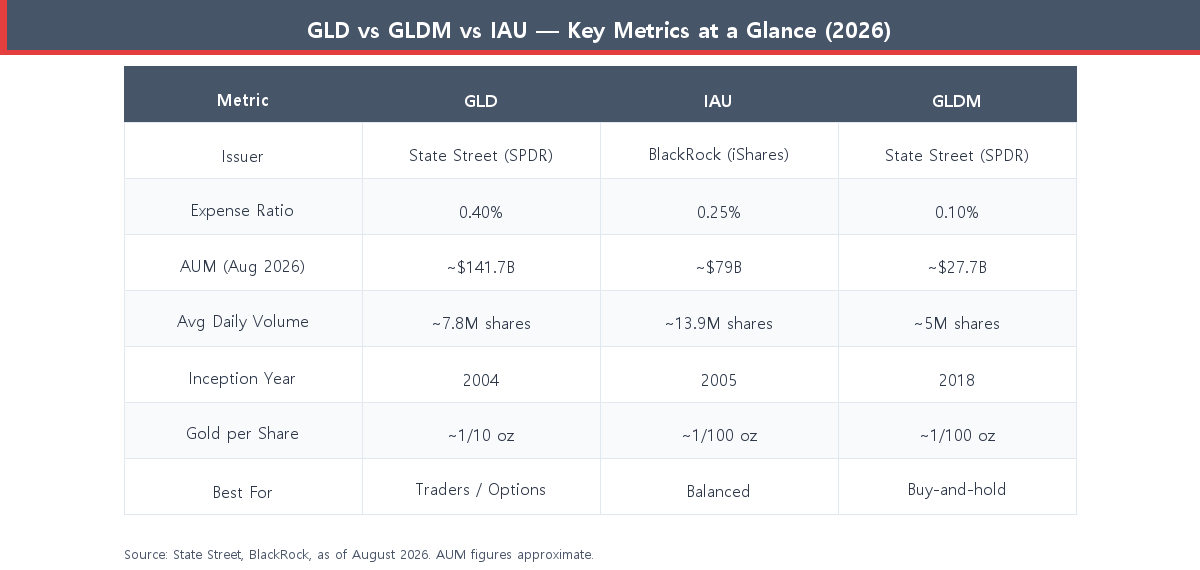
GLD’s $141.7 billion in AUM (Source: State Street, as of June 2026) makes it the largest gold ETF on the planet by a wide margin, but sheer size does not automatically translate to the best outcome for retail investors — it mainly benefits institutional traders who need to move extremely large positions without disturbing the market. IAU’s $79 billion AUM and 13.9 million shares of average daily volume actually make it more actively traded on a share-count basis than GLD, which averages 7.8 million shares per day. GLDM, with $27.7 billion in AUM (Source: State Street, as of July 2026), is large enough that liquidity is rarely an issue for individual investors making routine purchases or sales.
The per-share price difference is practically meaningful for investors using platforms without fractional share support or for those contributing fixed dollar amounts each month in a tax-advantaged account. GLD’s higher per-share price (approximately 10 times the amount of gold per share compared to GLDM) can make dollar-cost averaging less precise on platforms that only allow whole-share purchases. GLDM and IAU’s lower per-share prices give investors more flexibility in sizing contributions exactly.
Liquidity and Options Trading
For the vast majority of retail investors, the liquidity differences between GLD, IAU, and GLDM are irrelevant. All three funds have bid-ask spreads measured in pennies, and a standard market or limit order at any size a retail investor would trade executes cleanly in normal market conditions. The liquidity argument only becomes material at institutional scale — think hedge funds moving tens of millions of dollars at once, where even a fraction of a basis point in execution slippage matters.
Where the liquidity picture changes dramatically is in the options market. GLD has, by far, the deepest and most liquid gold options ecosystem of any ETF. Open interest in GLD options routinely runs into the hundreds of thousands of contracts across dozens of strike prices and expiration dates. Institutional hedgers, structured product desks, and sophisticated retail traders all converge on GLD options because the bid-ask spreads in the options chain are tight enough to make strategies viable.
If you plan to trade covered calls against your gold position, buy protective puts, or execute any multi-leg options strategy, GLD is the only gold ETF where the options liquidity is deep enough to give you a fair fill. IAU has some options activity, but the spreads are wider and open interest is a fraction of GLD’s. GLDM’s options market is essentially unusable for active strategies. This is the one genuine structural advantage that justifies GLD’s premium expense ratio — but only for investors who actively use options.
Tax Considerations
All three ETFs — GLD, IAU, and GLDM — are structured as grantor trusts holding physical gold, which means the IRS classifies them as collectibles for US tax purposes. Long-term capital gains on collectibles are taxed at a maximum rate of 28%, compared to 20% (plus the 3.8% net investment income surtax) for most equity ETFs. This applies regardless of which fund you choose; there is no tax advantage to picking one gold ETF over another from this angle.
Short-term gains (holding period under one year) are taxed as ordinary income for all three. If you hold any of these funds in a traditional IRA or 401(k), the collectibles classification is irrelevant — gains compound tax-deferred. In a Roth IRA, qualified distributions are tax-free regardless of asset type. The tax treatment is a reason to think carefully about where you hold gold in your portfolio, but it does not differentiate between GLD, IAU, and GLDM.
Who Should Buy Each Fund?
The right gold ETF is not universal — it depends on how you invest, how long you plan to hold, and whether you use options. Here is a direct breakdown by investor type.
Choose GLDM if…
- You are a long-term, buy-and-hold investor with a holding horizon of five or more years
- You want to minimize total cost of ownership and maximize net return
- You dollar-cost average in smaller amounts and want a lower per-share entry price
- You do not trade options on your gold allocation
- You are contributing to an IRA or 401(k) where cost efficiency compounds tax-advantageously
For most individual investors accumulating gold as a long-term portfolio hedge, GLDM is the strongest choice available. Its 0.10% expense ratio is four times cheaper than GLD and delivers nearly identical exposure.
Choose IAU if…
- You want a proven, large fund with a long track record (launched 2005) and deep institutional participation
- You trade in and out of gold occasionally — perhaps quarterly rebalancing — and want somewhat better liquidity than GLDM
- Your brokerage platform favors iShares products or offers commission-free trading on IAU
- You want the balance between low cost and high credibility without committing to GLD’s premium fee
IAU is the “never have to think about it again” choice for straightforward long-term gold allocation. Its $79 billion AUM and 0.25% expense ratio represent a solid value proposition, even if GLDM beats it on pure cost efficiency.
Choose GLD if…
- You actively trade gold options — covered calls, protective puts, or multi-leg spreads
- You are making institutional-size trades (seven figures or more) where execution quality and spread matter
- You need short-term tactical gold exposure — GLD’s liquidity and volume make entry and exit frictionless at any scale
- Your investment strategy explicitly depends on gold options depth, and no other fund can meet that requirement
Outside of these specific use cases, GLD’s 0.40% expense ratio is a drag that does not pay for itself for buy-and-hold investors. Its only genuine advantage over GLDM and IAU is options market depth — and that advantage only matters if you actually trade options.
Our Verdict: Best-Value Gold ETF in 2026
For most individual investors, GLDM is the best-value gold ETF in 2026. Its 0.10% expense ratio is the lowest among major physically-backed gold funds, its $27.7 billion AUM is more than sufficient for retail trading, and its long-term cost advantage over GLD compounds to roughly $8,000 per $10,000 invested over 30 years. The differences in daily return are essentially zero on any single day; the difference over a decade is a meaningful sum of money surrendered purely to fees.
IAU is an excellent second choice for investors who prefer the iShares brand, want BlackRock’s custodianship, or find that their brokerage platform prices IAU more favorably. Its 0.25% expense ratio is significantly cheaper than GLD and delivers very similar value to GLDM over shorter holding periods.
GLD earns its place only for options traders and institutional-scale investors. If neither describes you, there is little justification for paying 0.40% annually for the same underlying gold exposure you can get from GLDM at 0.10%.
Once you have settled on the right gold ETF, the next step is thinking about how it fits within a broader asset allocation framework — including how it interacts with your equity holdings, bonds, and cash. Gold can serve as a meaningful volatility buffer in a diversified portfolio, but position sizing matters as much as the vehicle you choose.
Frequently Asked Questions
Q: Is there a tax difference between GLD, GLDM, and IAU?
A: No. All three are structured as grantor trusts holding physical gold and are classified as collectibles under US tax law. Long-term capital gains are taxed at a maximum rate of 28% for all three — no fund offers a tax advantage over the others. The tax treatment is identical.
Q: Can I hold GLD, GLDM, or IAU in an IRA or Roth IRA?
A: Yes. All three are eligible to be held in traditional IRAs, Roth IRAs, and most employer-sponsored retirement plans that allow ETF investing. Inside a Roth IRA, qualified withdrawals are tax-free regardless of the collectibles classification.
Q: Is GLDM safe? Its AUM is much smaller than GLD.
A: GLDM is issued by State Street Global Advisors, the same firm behind GLD and one of the world’s largest asset managers. Its $27.7 billion in AUM (as of July 2026) is large by any reasonable standard — well above the threshold where fund closure risk becomes a concern. The lower AUM relative to GLD reflects GLDM’s shorter history (launched 2018) and lower per-share price, not a meaningful difference in safety.
Q: Which gold ETF has the lowest tracking error relative to spot gold?
A: All three track spot gold very closely on a daily basis. Over a full year, the difference in returns between GLD, IAU, and GLDM is almost entirely explained by the expense ratio difference — not by any structural tracking error. In the 12 months ending January 2026, IAU returned 67.2% and GLDM returned 66.2%, a gap consistent with their 0.15% expense ratio difference. GLD’s return would trail GLDM by approximately 0.30% over the same period, matching its fee differential.
This article is for informational purposes only and is not investment advice. All figures are sourced from publicly available fund data and are accurate as of the dates cited. Past performance does not guarantee future results. Consult a qualified financial advisor before making investment decisions.