
The Federal Reserve’s September 15–16, 2026 meeting may be the most consequential policy decision of the year. After the July 29 FOMC vote — a 9-to-3 decision to hold rates steady at 3.50–3.75% — three regional Fed presidents dissented and voted for an immediate 25 basis point hike. That split sent a clear signal to markets: the committee’s patience is not unlimited, and September is a live meeting.
Add a geopolitical oil shock driving crude toward $85 per barrel, tariff-driven core CPI still running at 3.4%, and a labor market that sent mixed signals in the July jobs report — and you have the recipe for one of the most uncertain FOMC meetings in years. This guide breaks down what the Fed is actually debating, where markets are pricing the September outcome, and the concrete repositioning moves to consider before the 2:00 PM ET decision on September 16.
What the Fed Is Actually Debating Ahead of September
The July hold was not unanimous, and that matters. The three dissenting votes from regional Fed presidents represent the largest three-dissent split the committee has seen in several cycles. They reflect a growing faction that believes the current 3.50–3.75% target range is insufficient to bring inflation sustainably back to 2%.
The core debate inside the FOMC centers on three economic fault lines heading into September:
- Sticky core inflation: Core CPI remains at 3.4% (Source: BLS, as of July 2026), well above the Fed’s 2% target. Tariff-driven price pressures in goods — electronics, autos, and building materials — are proving harder to shake than policymakers expected when the year began. For more on how tariffs are feeding inflation, see our breakdown: How Tariffs Are Fueling Sticky Inflation in 2026.
- Oil shock from the Middle East: The ongoing Iran-related supply disruption pushed crude oil above $85 per barrel in late July. Energy costs sit outside core CPI, but they push up headline inflation and — more importantly for the Fed — shape consumer inflation expectations, which the committee watches closely as a leading indicator.
- Softening labor market: The July 2026 payrolls report came in significantly below expectations, unemployment edged higher, and job openings continued to decline. This is the main counterweight keeping a hold in the base case: the Fed does not want to hike into a labor market that is clearly slowing.
The resulting picture is a genuinely divided committee: hawks who see inflation credibility at risk if the Fed waits too long, doves who fear overtightening into an economy that may already be cooling. The September meeting also produces a Summary of Economic Projections (SEP) — the Fed’s quarterly dot plot — which will reveal exactly which camp is winning. That makes this meeting doubly market-moving: the rate decision and the dot plot land simultaneously.
What Markets Are Pricing In — CME FedWatch Signals
Market expectations for September have swung dramatically over the past six weeks, making this one of the most volatile pre-FOMC windows in recent memory.
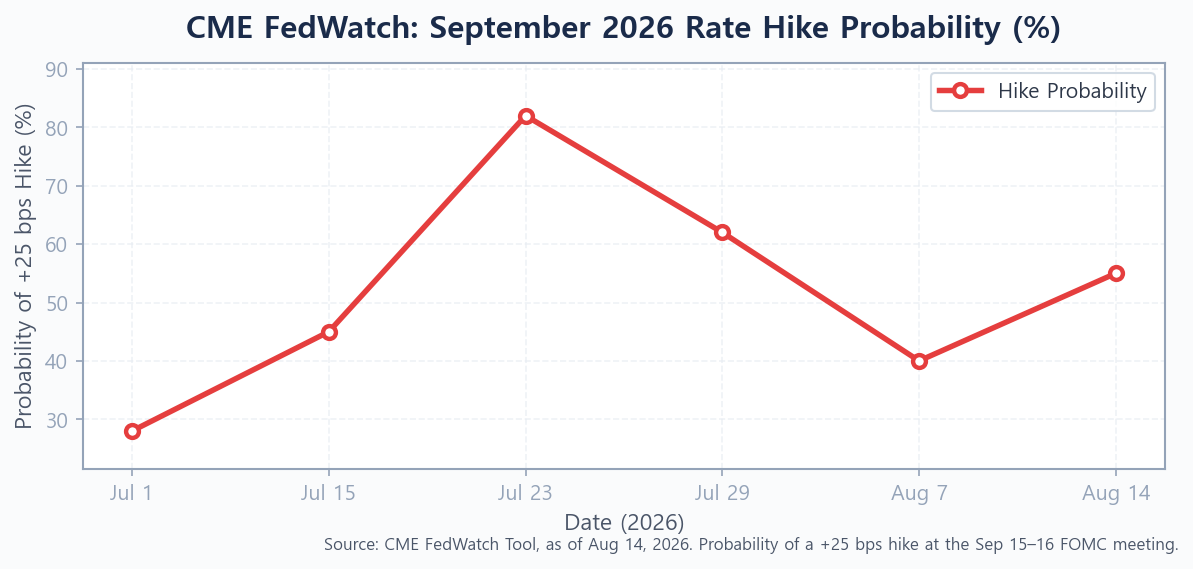
The sequence tells the story. Heading into July, rate hike odds for September sat near 28% — the base case was clearly a prolonged hold. Then three developments shifted the calculus: the July 29 FOMC meeting produced three dissents (the hawkish signal), oil prices spiked above $80, and Fed officials in post-meeting interviews signaled growing impatience with above-target inflation. By late July, CME FedWatch was pricing an 82% probability of a September hike — a number that shocked fixed-income markets and sent 2-year Treasury yields sharply higher.
Then came the August 7 jobs report. Payrolls missed consensus by a wide margin, pushing hike probabilities back down toward 40%. As of mid-August, the market sits near 50/50 — a genuine coin flip that will remain sensitive to the August CPI print (due September 10) and any Fed communication in the blackout period preceding the meeting.
This volatility has a clear implication: when markets cannot confidently price an outcome, assets react sharply when the decision drops. A hold will surprise the ~45% of the market priced for a hike; a hike will surprise the ~55% priced for a hold. For deeper context on how the Fed communicated its rate path earlier in 2026, see: Will the Fed Hike Rates in 2026? Higher for Longer.
Bloomberg’s Businessweek Daily from August 7 covers the market reaction to the jobs report and what it means for the Fed’s September calculus:
Three September FOMC Scenarios and Portfolio Moves for Each
Rather than guessing a binary outcome, the most effective approach is to map your portfolio against each realistic scenario and identify where you have unintended concentrations. Here are the three outcomes, their rough probabilities as of mid-August 2026, and the immediate asset-class impact.
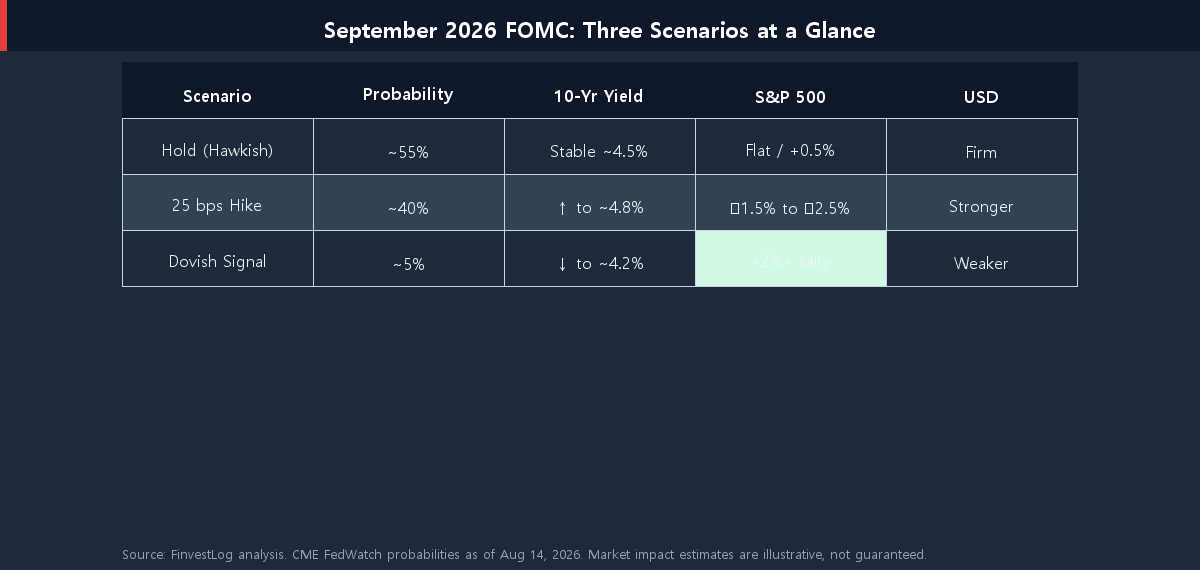
Scenario 1 — Hawkish Hold (~55% Probability, Base Case)
The Fed holds rates at 3.50–3.75% but signals strongly through the dot plot and Powell’s press conference that September is the last pause before a hike — likely October or November. Language such as “we are prepared to act if data warrants” or a dot plot median that raises the terminal rate would constitute a hawkish hold. The market reaction would be moderate: mild flattening of the yield curve, a modest USD firming, and a slight equity relief rally on the headline.
Portfolio move: This is the most portfolio-neutral outcome. Maintain current duration and equity allocation. Reinforce short-term Treasury exposure — 6-month T-bills at ~4.2% offer attractive income with minimal price risk ahead of potential additional hikes. Avoid extending duration in long bonds before the dot plot is confirmed. See our analysis of where long yields are heading: 10-Year Treasury Yield Outlook 2026.
Scenario 2 — 25 bps Rate Hike (~40% Probability)
The Fed raises the target range to 3.75–4.00%, citing persistent core inflation, oil-driven headline CPI risk, and the credibility cost of repeated pauses while inflation stays above 2%. The dot plot shows a higher terminal rate — possibly one additional hike in Q4. This is the scenario that causes the sharpest asset repricing: the 10-year Treasury yield could spike 15–25 bps within hours, growth stocks would sell off 1.5–3%, and the USD would strengthen meaningfully against DM peers.
Portfolio move: If a hike is your base case, the most effective pre-meeting hedges are: (1) trim long-duration bond positions now — each 25 bps rate rise inflicts roughly a 4–5% price loss on a 20-year duration bond fund, (2) increase allocation to short-term Treasuries and money market funds, and (3) reduce exposure to rate-sensitive equities, particularly REITs, utilities, and high-P/E growth names. The step-by-step framework: How to Rebalance Your Portfolio When Interest Rates Are Rising (2026).
Scenario 3 — Dovish Shift or Pivot Signal (~5% Probability)
The Fed holds and — contrary to expectations — removes or softens hawkish language in the statement, or the dot plot shows cuts possible in H1 2027. This is a low-probability tail scenario given three July dissents and oil prices above $80, but markets would react powerfully if it materialized. Long-duration Treasuries, rate-sensitive dividend stocks, REITs, and high-multiple growth names would all rally. The yield curve would steepen sharply.
Portfolio move: This scenario requires no pre-meeting action — the risk/reward of positioning for a 5% tail does not justify meaningful portfolio shifts ahead of September 16. If it materializes, move quickly post-decision to add duration and interest-rate-sensitive equity exposure. For context on how a steepening yield curve plays out for bond investors: Treasury Yield Curve Steepening in 2026: What It Means.
Which Asset Classes Are Most Rate-Sensitive Right Now
Not all assets respond equally to a surprise September hike. Here is a quick-reference breakdown of rate sensitivity heading into the meeting — organized by how directly each asset class is tied to the policy rate decision:
- Short-term Treasuries (2-year, T-bills): The most directly tied to the fed funds rate. A 25 bps hike pushes 2-year yields up proportionally — good for new buyers, a modest capital loss for existing holders. Currently yielding approximately 4.2%, these instruments compensate investors well for the uncertainty. See: Money Market Funds vs. Short-Term Treasuries (2026).
- Long-duration Treasuries (10-year, 30-year): Higher interest rate sensitivity — every 25 bps of yield increase translates to roughly a 2–5% price decline depending on duration. A hawkish surprise on September 16 could push the 10-year above 4.8% and the 30-year above 5.2%. Highest risk going into the meeting.
- REITs and utilities: Compete directly with bond yields for income-seeking capital. Rate-sensitive sectors underperform in hike scenarios as their yield spread over Treasuries compresses. Utilities are also operationally leveraged to borrowing costs.
- High-multiple growth stocks: Discounted cash flow valuations extend when long rates rise. Technology names with P/E ratios above 30–40x are meaningfully exposed to a hike scenario — their long-duration earnings stream is worth less in present-value terms when discount rates increase.
- Cash and money market funds: The immediate beneficiary of a rate hike. A 25 bps increase passes through to money market yields within days of the announcement, making cash more competitive with riskier assets.
- USD and international equity: A hike strengthens the dollar against most developed-market currencies, creating a headwind for international equity holdings (currency drag) and a tailwind for dollar-denominated cash and short Treasuries.
For a comprehensive view of how Fed rate decisions have historically moved each of these asset classes: How Fed Rate Decisions Affect the Stock Market (2026).
Your Pre-FOMC Portfolio Checklist (Before September 16)
You do not need to predict the September FOMC outcome to act wisely. The goal is to ensure your portfolio can absorb either a hold or a 25 bps hike without a catastrophic drawdown. Here is a five-point pre-meeting checklist:
- Audit your bond duration exposure. If your fixed-income allocation contains significant 10+ year Treasury exposure or long-duration bond funds (TLT, EDV, VGLT, BLV), measure your weighted average duration. A 20-year duration portfolio loses approximately 5% in price for every 25 bps of yield increase. If that loss would push you into uncomfortable territory, trim now — before September 16.
- Park short-term cash in T-bills or money market funds. At ~4.2%, 6-month T-bills provide meaningful income with negligible price risk. Roll them over after the September decision once the new rate environment is established. Avoid leaving idle cash in low-yield checking accounts through the meeting.
- Review your rate-sensitive equity concentration. If utilities and REITs make up more than 15–20% of your equity allocation, a hike scenario creates concentrated downside. Consider rebalancing modestly into broad-market equity ETFs (VOO, VTI) or lower-duration dividend growers less sensitive to interest rates.
- Resist dramatic pre-meeting repositioning. The difference between a hawkish hold and a 25 bps hike is roughly 15–25 bps in 10-year yields — a meaningful but not catastrophic market move. Going all-cash or shorting Treasuries introduces timing risk that typically exceeds the risk you are trying to hedge. Marginal adjustments, not wholesale shifts.
- Watch the dot plot, not just the headline rate decision. The SEP and dot plot are released simultaneously with the rate decision at 2:00 PM ET on September 16. The median dot for 2026 and 2027 — not the hold/hike binary — will drive the most durable market repricing. A hold with an elevated dot plot can be more hawkish than a hike with a lowered terminal rate estimate.
For the complete step-by-step rebalancing framework for rising-rate environments: How to Rebalance Your Portfolio When Interest Rates Are Rising (2026 Step-by-Step Guide).
To revisit what the July 29 meeting said and how it set the table for September: July 2026 FOMC Preview: How to Position Your Portfolio Before July 29.
The Bottom Line
The September 2026 FOMC meeting is the rarest kind of policy event: a genuine coin flip between a hold and a 25 basis point hike, with a divided committee and market pricing that has swung 40 percentage points in under two months. That uncertainty is the signal — not a reason to panic, but a clear mandate to stress-test your portfolio’s rate sensitivity before September 16.
The most practical pre-meeting posture: shorten bond duration modestly, ensure short-term cash is earning 4%+, and hold broad-market equity exposure rather than concentrated bets in rate-sensitive sectors. Whether the September 2026 FOMC delivers a rate hike or a hawkish hold, the portfolio calibrated to absorb either outcome is the one positioned to outperform over the full rate cycle.
Found this useful? Bookmark it — you will want it in hand when the 2:00 PM ET decision drops on September 16.
This article is for informational purposes only and is not investment advice. Do your own research before making any investment decisions.