
The AI infrastructure buildout has turned semiconductor ETFs into some of the hottest funds on the market. Two names dominate the conversation: SMH (VanEck Semiconductor ETF) and SOXX (iShares Semiconductor ETF). They track the same industry, charge nearly identical fees — and yet in 2026, one has outperformed the other by more than 20 percentage points year-to-date. If you are trying to decide which semiconductor ETF wins the AI chip boom, the answer hinges less on expense ratios and more on how each fund is built from the inside out.
The Fast Facts: SMH and SOXX Side by Side
Before diving into the construction differences, here is a quick-reference snapshot of both funds as of August 2026. The numbers are close enough on the surface to feel like a coin flip — until you look at what is actually in the portfolio.
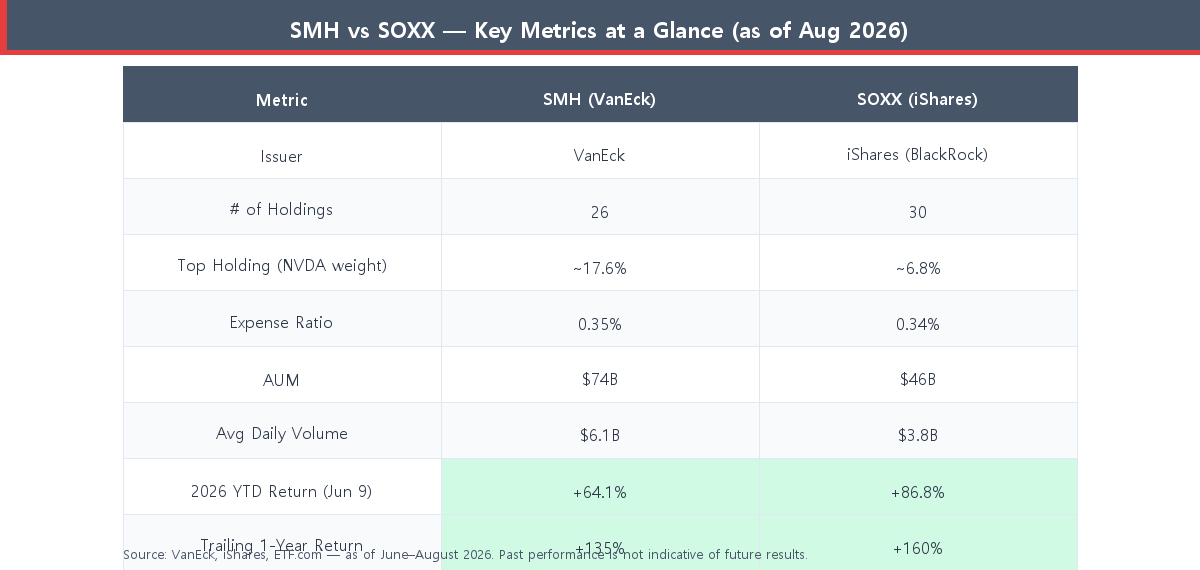
SMH is the larger and more liquid fund: $74 billion in assets under management versus SOXX’s $46 billion, and average daily dollar volume of $6.1 billion versus roughly $3.8 billion for SOXX. For institutional traders or investors using options, that liquidity gap matters. For a long-term buy-and-hold investor putting in a few thousand dollars per month, it is almost irrelevant.
Holdings Deep Dive — Where the Two ETFs Diverge Most
The expense ratio difference between SMH (0.35%) and SOXX (0.34%) is worth a few dollars per year per $10,000 invested — not a deciding factor. What actually separates these two funds is portfolio construction philosophy.
SMH: Concentrated in AI Mega-Caps and the Global Supply Chain
VanEck’s SMH holds just 26 names and is modified market-cap weighted. The result is a fund where NVIDIA commands roughly 17.6% of the portfolio (Source: VanEck, as of June 2026). That single position is larger than the entire allocation to the bottom 10 holdings combined. Beyond NVIDIA, SMH gives significant weight to Taiwan Semiconductor Manufacturing (TSMC) and ASML Holding — two international names that give the fund real global supply-chain exposure. If you believe the AI chip cycle is driven by a handful of dominant players, SMH’s concentrated structure is a feature, not a flaw.
The tradeoff: when NVIDIA stumbles or when the market rotates away from AI mega-caps, SMH’s concentrated top-of-book takes the hit first. Its 10-year total return of +2,148% (Source: VanEck, as of June 2026) is largely a NVIDIA concentration story — brilliant in hindsight, volatile in real time.
Worth reading alongside this: NVIDIA vs TSMC: Which AI Chip Stock Is the Smarter Long-Term Buy? walks through the individual-stock case for each of SMH’s two largest holdings.
SOXX: A Broader, More Equal-Weight Approach with Deeper Equipment Exposure
iShares’ SOXX holds 30 stocks with a modified equal-weight tilt — individual holdings are capped so that even NVIDIA sits at just 6.8% of the portfolio. The practical effect is a fund that spreads its bets across design leaders, analog chip makers, and crucially, semiconductor equipment companies. Names like Applied Materials (AMAT), Lam Research (LRCX), and KLA Corporation carry meaningful weight in SOXX but are much lighter or absent in SMH.
This construction gives SOXX a different risk profile. It is less sensitive to NVIDIA’s price action and more sensitive to the broader semiconductor capital expenditure cycle — the tools, chemicals, and deposition equipment that every chip fab needs before it can produce a single wafer.
2026 Performance: SOXX Surprised the Market — Here’s the Reason Why
Through June 9, 2026, SOXX returned +86.8% year-to-date while SMH gained +64.1% over the same period (Source: ETF.com, as of June 9, 2026). Over the trailing one-year window, SOXX leads with +160% versus SMH’s +135%. For a fund widely seen as the more “conservative” of the two, that is a striking result.
The explanation is straightforward once you understand the 2026 AI buildout narrative. Hyperscalers — Microsoft, Amazon, Google, Meta — committed hundreds of billions of dollars to AI data center construction. That capital spending does not just flow to chip designers like NVIDIA. It flows downstream to equipment makers: the companies that build the deposition machines, etching tools, and lithography systems that every advanced fab must run. SOXX’s heavier allocation to AMAT, LRCX, and KLA meant it captured this “picks and shovels” re-rating that SMH largely missed due to its mega-cap concentration.
The video below breaks down exactly how the two funds performed through the first half of 2026, with a clear-eyed look at whether SOXX’s outperformance is structural or cyclical.
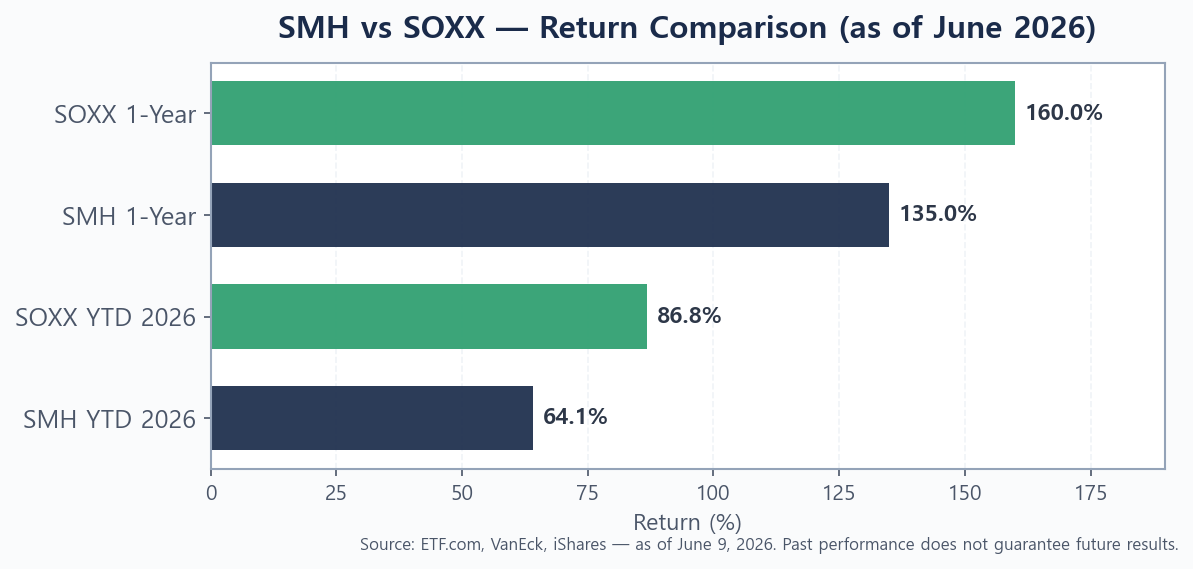
Note the 10-year picture: SMH’s +2,148% still dwarfs SOXX’s +1,833% over a decade. That long-run edge reflects the periods — particularly 2020 through 2024 — when NVIDIA’s explosive growth rewarded concentration heavily. The 2026 reversal suggests that when the chip cycle broadens beyond design into manufacturing, SOXX’s wider net catches more of it.
Expense Ratio, AUM, and Liquidity: Are the Costs Worth It?
On cost, the two funds are effectively tied: SMH at 0.35% and SOXX at 0.34% (Source: VanEck and iShares, as of August 2026). On a $50,000 position, you pay $175 per year in SMH versus $170 in SOXX — a $5 annual difference that will never be the reason you chose one over the other.
Liquidity is where SMH has a genuine structural advantage. Its $6.1 billion in average daily dollar volume means tighter bid-ask spreads and easier execution for large trades. SOXX’s $3.8 billion daily volume is still excellent by any standard — this advantage is meaningful primarily for institutional traders executing block orders or investors running options strategies around the position.
If you are evaluating the full universe of AI-themed ETFs beyond just these two — including QQQ and thematic plays like BOTZ — Best AI-Themed ETFs for 2026: QQQ vs SOXX vs BOTZ runs a complete side-by-side comparison.
Which ETF Fits Your Strategy?
Neither fund is objectively better. They are optimized for different investor theses. Here is how to think about which one belongs in your portfolio.
Choose SMH if …
- You want maximum NVIDIA exposure without owning individual shares. SMH’s 17.6% NVDA weight gives you significant single-stock leverage inside an ETF wrapper.
- You believe the AI chip cycle stays narrow — that dominance accrues to a few hyperscale designers and their foundry partners (TSMC, ASML) rather than spreading to equipment makers.
- Liquidity matters to you — you trade frequently, use options, or manage a larger position that requires tighter spreads.
- You want global chip supply-chain exposure inside a single US-listed ticker, including TSMC and ASML alongside US names.
Choose SOXX if …
- You want a broader semiconductor bet that is less dependent on NVIDIA’s near-term price action. SOXX’s 6.8% NVDA cap reduces concentration risk meaningfully.
- You believe the AI capex wave benefits equipment makers as much as chip designers — AMAT, LRCX, and KLA are well-positioned if fab construction accelerates through 2027.
- You prefer US-listed holdings and want to minimize geopolitical risk from Taiwan or Dutch export-control exposure (though neither fund eliminates it entirely).
- You are dollar-cost averaging a long-term position and want lower single-stock volatility within the semiconductor theme.
The Verdict: Which Semiconductor ETF Actually Wins the AI Chip Boom?
In 2026, SOXX wins the year-to-date scoreboard — and the reason matters. When AI capital spending broadened from chip design into the manufacturing infrastructure layer, SOXX’s equal-weight tilt and equipment exposure captured that upside that SMH’s mega-cap concentration missed. If the AI capex cycle continues to deepen through 2027, SOXX’s structural advantage in equipment names could persist.
Over a full decade, SMH’s concentrated bet on mega-cap chip leaders has historically outperformed. That makes SMH the stronger choice for investors who believe AI leadership stays narrow and that NVIDIA-led names continue to dominate the cycle — which remains a reasonable thesis given NVIDIA’s data center revenue trajectory.
The honest answer for most investors: both funds are reasonable ways to play the AI chip boom, and owning either is far better than trying to time individual names. If you are building a new position today, SOXX’s broader diversification and 2026 momentum make it a compelling entry point. If you already hold SMH and are sitting on substantial gains, the case for switching is less clear — the tax implications of a taxable-account swap can easily outweigh a marginal performance difference.
If you are running a concentrated semiconductor position, it is also worth stress-testing your portfolio against an AI valuation correction. How to Protect Your Portfolio From an AI Bubble covers the practical steps for managing that tail risk without abandoning your chip thesis entirely.
Found this useful? Bookmark it so you can revisit when the market moves. I publish practical investing breakdowns regularly — check back soon.
This article is for informational purposes only and is not investment advice. Do your own research.