
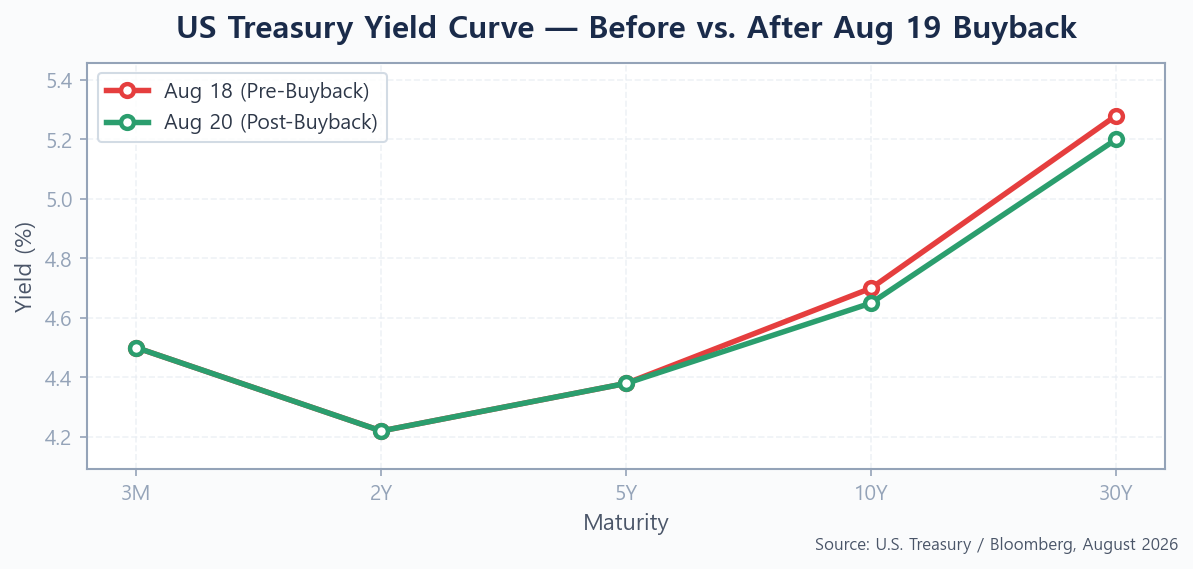
On August 19, 2026, the US Treasury Department made a surprise announcement that rippled through the bond market: it would at least double the size of its long-bond buyback operations — from $2 billion to $4 billion per operation — targeting the 10-to-30-year sector of the Treasury market. Within one trading session, the 30-year Treasury yield tumbled 9 basis points to 5.196%, and the 10-year fell 5.7 basis points to 4.647%.
If you’ve been watching Treasury yields climb and wondering what the government is actually doing when it buys back its own debt, this guide breaks it down — what the program is, why it escalated so sharply in 2026, and what it means for your bond portfolio.
What Is a Treasury Buyback — and Why Does It Happen?
A Treasury buyback is simply the US government purchasing its own previously issued bonds from the open market before they mature. The Treasury retires the old bonds and funds the purchase by issuing new ones — so total debt outstanding stays roughly the same. Think of it as refinancing a mortgage: you pay off an old loan with a new one, choosing better terms or extending the maturity in the process.
This is emphatically not quantitative easing. When the Federal Reserve buys Treasuries, it creates new money — expanding its balance sheet and the monetary base. When the Treasury buys back bonds, it is a debt management (liability management) operation. No new money is created. The bond market’s total supply of Treasuries barely changes; only the vintage and maturity profile shift.
The Treasury used buybacks regularly between 1999 and 2002, when the government ran rare budget surpluses. The modern program — restarted in 2024 — operates for two reasons:
- Liquidity support: Buying “off-the-run” (older, less actively traded) bonds improves secondary market functioning and narrows bid-ask spreads, making the $28 trillion Treasury market more efficient for all participants.
- Maturity management: Smoothing out debt maturity cliffs prevents the Treasury from having to refinance enormous chunks of debt at once — a particular concern when over $36 trillion in total debt matures over different horizons.
For context on where the 10-year yield stood heading into this announcement, see our 10-Year Treasury Yield Outlook 2026.
Why the Treasury Doubled Down in August 2026
The Long-Bond Buyers’ Strike Since June
The immediate trigger for the August escalation was a sustained buyers’ strike that began in late June 2026. Foreign central banks, sovereign wealth funds, and institutional investors quietly pulled back from purchasing long-dated Treasuries — bonds with 10 to 30 years to maturity. Demand thinned. Treasury supply continued at its regular pace. The result was predictable: the 30-year yield climbed past 5.3% by mid-August, nearing levels last seen in late 2023.
The structural causes were not new: persistent US fiscal deficit concerns, uncertainty over the Federal Reserve’s rate trajectory, and a global portfolio shift toward shorter-duration assets. But the speed of the move rattled markets. The long end was bear-steepening — short-term rates held relatively stable while long-end yields marched higher. For a detailed look at how this steepening dynamic works and what it typically means for investors, see our guide on Treasury Yield Curve Steepening in 2026.
Bessent’s Yield Management Playbook
Treasury Secretary Scott Bessent responded on August 19 with an acceleration of the buyback program. The Treasury announced it would target the 10-to-20-year and 20-to-30-year nominal coupon sectors, with buyback operations running from September 9 through November 4 at the new $4 billion-per-operation scale.
The day after, Bessent signaled further escalation was possible: “It could be more than $4 billion per issue.” Reports emerged that the Treasury was also considering tapping its General Account — which held close to $1 trillion — to fund an even larger program if necessary. The message to the market was clear: the Treasury was not willing to watch long yields spiral without a fight.
How Buybacks Move Bond Prices and Yields
Understanding the mechanics helps you anticipate what might happen next. When the Treasury announces a buyback, it creates immediate demand for a specific set of off-the-run bonds in the long-maturity range. Sellers — who know a well-funded, reliable buyer is entering the market — can afford to hold out for better prices. Prices rise. Yields fall, since bond prices and yields move in opposite directions by mathematical definition.
The effect radiates outward. Higher prices on off-the-run bonds compress the liquidity premium — the extra yield investors normally demand for holding less-traded paper. New on-the-run bonds (the benchmark, most recently issued bonds) also benefit, because the benchmark yield anchors lower. Swap rates, mortgage rates, and corporate bond spreads all respond to the Treasury benchmark, amplifying the buyback’s reach.
For a plain-English explanation of how the mechanics work from a market-structure perspective, this August 2026 video is worth 15 minutes of your time:
On-the-Run vs. Off-the-Run: The Key Distinction
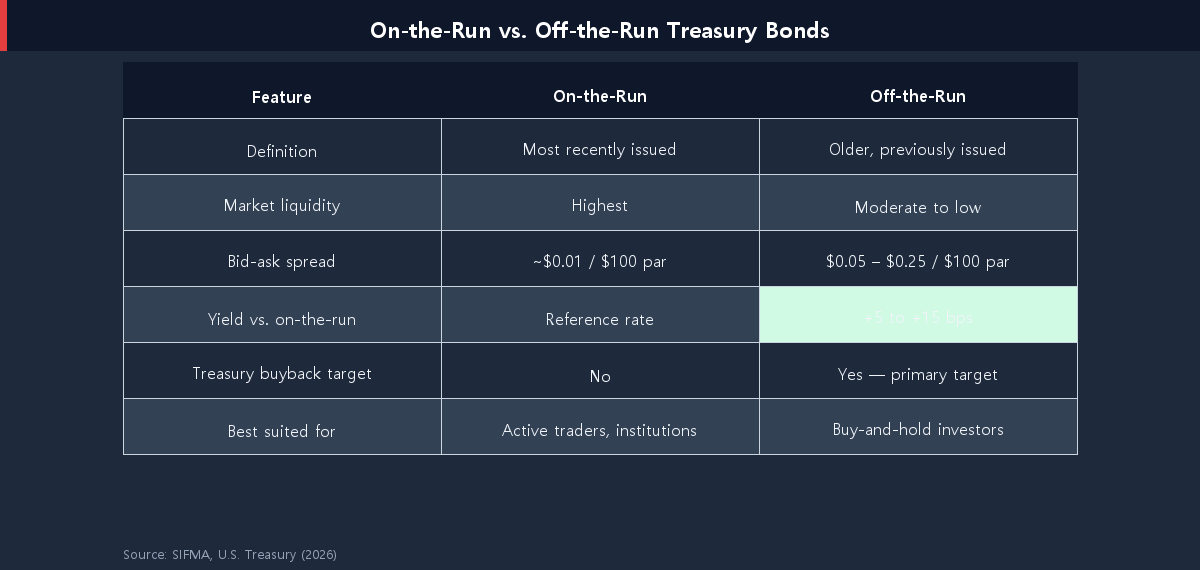
Every time the Treasury issues a new bond in a maturity slot, the previous bond in that slot becomes “off-the-run.” Off-the-run bonds trade less frequently and carry a small yield premium — the liquidity premium — to compensate investors for lower tradability. Buybacks primarily target these bonds.
For buy-and-hold investors, off-the-run bonds can be attractive: they typically offer a slightly higher yield with no meaningful difference in credit quality or default risk. The extra 5–15 basis points is often a free lunch — unless you suddenly need to sell quickly in a thin market.
The Scale: $4 Billion Per Operation — and $1 Trillion in Reserve
To put the scale in perspective: the Treasury typically runs multiple buyback operations per week across different maturity buckets. At $4 billion per long-bond operation, the cumulative buyback between September and November could reach $50–80 billion in the long-duration sector alone — a significant force in a market where daily trading volume in the 20-to-30-year sector is often $15–25 billion.
The wildcard is the Treasury General Account (TGA) — the government’s operating cash account at the Federal Reserve. As of late August 2026, the TGA held close to $1 trillion. If Bessent chooses to draw it down to fund buybacks, the Treasury could theoretically sustain a much larger and longer-duration program without needing to issue additional net new debt immediately. Markets will watch TGA drawdown rates closely as a signal of program intent.
What This Means for Long-Term Investors
If You Already Hold Long-Duration Treasuries
If you hold long bonds — individual 10-, 20-, or 30-year Treasuries, or duration-heavy ETFs like TLT or EDV — the buyback program is directionally positive news. Increased, consistent government demand for long bonds provides meaningful price support and can compress yields further over the September-to-November buyback window.
However, this is price support, not a structural trend reversal. Once the buyback window closes, yields could rebound if the underlying reasons for the buyers’ strike — fiscal trajectory concerns, Fed uncertainty — have not improved. The buybacks are a stabilizer, not a cure.
For investors deciding between individual bonds and bond ETFs in this environment, our analysis of Treasury Bond Ladder vs. Bond ETF walks through the income-certainty vs. liquidity trade-off in detail.
If You’re Thinking About Adding Bonds Now
The buyback program creates a near-term tailwind for long bonds, but it also signals that the Treasury is actively concerned about demand. That context matters. Yields of 4.65–5.20% across the 10-to-30-year range remain historically attractive for locking in long-term income — the last time the long end sustained these levels was 2023.
The primary risk for new buyers is that yields rise further after the buyback program ends in November, particularly if foreign demand does not return. One way to manage this is a barbell approach: allocate a core position to short-duration T-bills yielding around 4.4% (which the current buybacks are not targeting), then add long-duration exposure gradually over the buyback window rather than all at once.
For a current spread analysis of Treasuries versus investment-grade corporate bonds — and whether the extra yield is worth it — see Corporate Bonds vs. Treasuries in 2026. New to Treasury investing entirely? How to Buy US Treasury Bonds as a Foreigner covers the mechanics of purchasing from abroad.
Key Takeaways
- The US Treasury doubled its long-bond buyback program in August 2026 — from $2 billion to $4 billion per operation — targeting 10-to-30-year nominal Treasuries, running September 9 through November 4.
- This is a debt management tool, not Fed QE. Total debt outstanding does not decrease; the Treasury is improving its maturity profile and providing liquidity support to the long end of the curve.
- Buybacks create immediate price support for off-the-run long-duration Treasuries and compress the liquidity premium — directionally positive for holders of long bonds.
- The near-$1 trillion Treasury General Account could fund further program expansion; watch TGA drawdown data as a leading indicator.
- At current long yields of 4.65–5.20%, Treasuries offer historically attractive income for long-term investors — the buyback window provides a tactical tailwind, but the structural demand story bears monitoring.
Found this useful? Bookmark it so you can revisit when the market moves. I publish practical investing breakdowns regularly — check back soon.
This article is for informational purposes only and is not investment advice. Do your own research before making any investment decisions.