
Warren Buffett has compounded Berkshire Hathaway’s book value at roughly 19% per year since 1965 — a track record no index fund, algorithmic strategy, or Wall Street quant has matched over the same horizon. Yet his method is not a secret. Buffett has described his stock-picking framework in shareholder letters, interviews, and annual meetings for six decades. The problem is that most summaries reduce it to vague platitudes: “buy quality,” “think long-term,” “look for moats.” This guide turns those principles into a concrete, eight-criteria checklist you can apply to any stock today.
Why Value Investing Still Works in 2026 — And Why Most Investors Get It Wrong
Value investing — buying a business for less than it is intrinsically worth and holding it long enough for the gap to close — has faced repeated obituaries. In the late 1990s, growth stocks buried value. In 2020–2021, zero interest rates inflated speculative tech multiples. Yet over any rolling 20-year period on record, disciplined value investing has outperformed pure momentum or growth strategies on a risk-adjusted basis (Source: Fama-French factor data, as of 2025).
Why do most investors fail at it? They misapply the first step. Value does not mean cheap in price-to-earnings terms alone. A stock trading at 8× earnings can be a value trap if the underlying business is in structural decline. Buffett’s approach is to buy quality businesses at fair prices rather than mediocre businesses at bargain prices. That distinction — drilled into him by Charlie Munger — is the foundation of the eight-criteria checklist below.
If stock picking sounds like more commitment than you want to make right now, that is a valid position. Buffett himself recommends low-cost index funds for most individual investors. You can explore that path in our guide to How to Build a Simple 3-Fund Portfolio in 2026. But if you want to understand how Berkshire evaluates businesses, read on.
The 8-Criteria Checklist Warren Buffett Uses Before Buying a Stock
Buffett has never published a formal checklist, but the criteria he applies consistently — drawn from decades of shareholder letters and documented in Robert Hagstrom’s The Warren Buffett Way — map cleanly onto eight questions. Every stock Berkshire owns passes all eight. A single hard failure is usually enough to walk away.
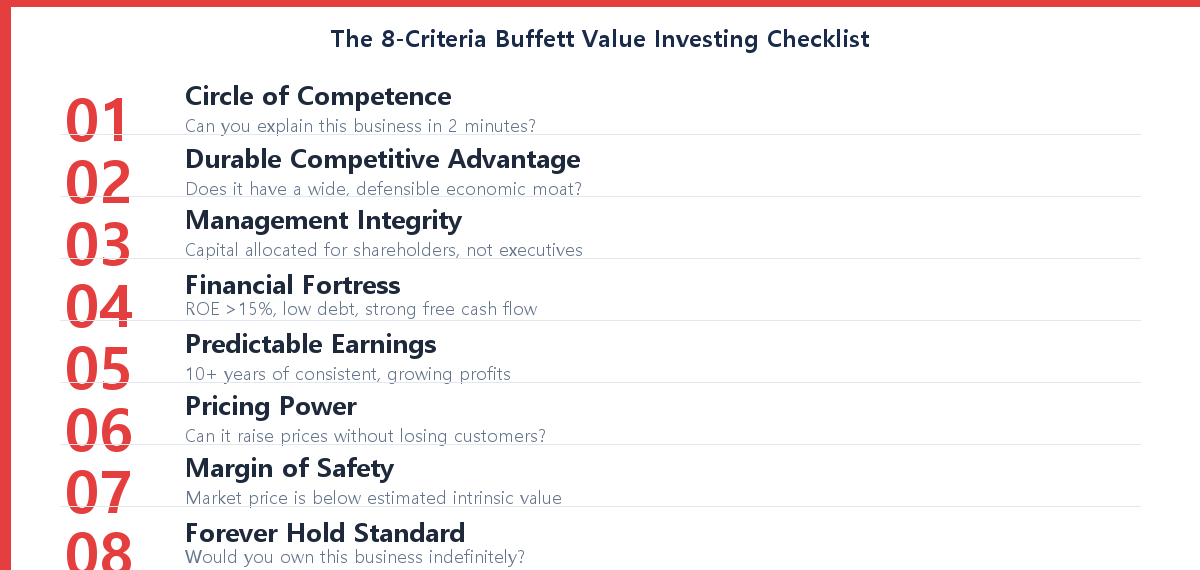
1. Circle of Competence — Can You Explain This Business in 2 Minutes?
Buffett refuses to invest in businesses he cannot explain simply. His infamous avoidance of most technology stocks in the 1990s was not stubbornness — it was a genuine acknowledgment that he could not reliably forecast which tech companies would still be dominant a decade later. He made an exception for Apple only after concluding it was, at its core, a consumer loyalty and ecosystem business he understood deeply.
The practical test: write down in plain language how the company makes money, what drives its revenue growth, and what could permanently impair it. If that explanation requires more than two minutes or more than one page, you may be outside your circle of competence. That does not mean the stock is bad — it means you are not yet the right person to evaluate it.
2. Durable Competitive Advantage (Economic Moat)
Buffett’s most famous concept is the economic moat — a structural advantage that protects a company’s profits from competition over time. He looks for moats built from one or more of the following sources:
- Brand loyalty (consumers pay a premium, as with Coca-Cola or American Express)
- Switching costs (customers are locked in by habit, data, or integration costs)
- Network effects (the product becomes more valuable as more people use it)
- Cost advantages (scale, proprietary processes, or geography give a permanent cost edge)
- Regulatory or licensing barriers (governments restrict competition in certain industries)
The key word is durable. A five-year competitive advantage is interesting; a twenty-year one is investable. Buffett asks: will this moat be wider or narrower a decade from now?
3. Management Integrity and Shareholder-First Capital Allocation
Buffett describes the ideal management team as both “able and trustworthy.” Ability is visible in the income statement and operating history. Trust is harder to quantify but shows up in how executives allocate the capital the business generates. Watch for:
- Consistent return of excess capital via dividends or buybacks at reasonable prices (not at peaks)
- Acquisitions that enhance rather than dilute shareholder value
- Candid communication about mistakes — Buffett explicitly praises CEOs who report bad news the same way they report good news
- Compensation tied to long-term business results, not short-term stock price
Red flag: a CEO who celebrates earnings-per-share growth driven entirely by buybacks while the underlying business stagnates.
4. Financial Fortress: ROE >15%, Low Debt, Strong Free Cash Flow
Buffett’s financial screen is straightforward. He looks for businesses that:
- Generate return on equity (ROE) consistently above 15% without excessive leverage
- Carry debt-to-equity ratios appropriate to their industry (consumer staples near zero; financials necessarily higher)
- Convert earnings reliably into free cash flow — he is deeply skeptical of “earnings” that require large ongoing capital expenditures just to stay in place
- Require minimal reinvestment to maintain their competitive position (low maintenance capex = more cash for shareholders)
Coca-Cola’s ROE has stayed above 40% for decades. Apple’s exceeds 150% — a function of its asset-light software ecosystem layered on top of hardware. Both pass this screen comfortably.
5. Predictable, Growing Earnings Over 10+ Years
Buffett wants to buy a business whose economics he can forecast with confidence — not precision, but confidence. He prefers companies whose products do not need to change materially decade to decade: insurance, consumer staples, payment networks, energy. Erratic earnings, cyclical peaks and troughs, or frequent restructuring charges all make it difficult to estimate what a business is truly worth.
A practical screen: pull 10 years of earnings-per-share data. If the trend is consistently upward (even if imperfect), that is encouraging. If EPS is all over the map, the business is likely too cyclical or operationally uncertain for a value investing approach.
6. Pricing Power — Can the Company Raise Prices Without Losing Customers?
In Buffett’s own words: “The single most important decision in evaluating a business is pricing power.” A company that can raise prices annually without losing meaningful volume has both a strong moat and a built-in inflation hedge. Coca-Cola has raised the price of a Coke multiple times over the past 50 years; its unit volumes have declined in some periods but cash flows have grown. That is pricing power.
A useful test: check whether gross margins have been stable or expanding over the past decade even as input costs rose. Margin erosion during inflationary periods often signals a company with limited pricing power — a structural weakness that compounds negatively over time.
7. Intrinsic Value and Margin of Safety
Even the best business is a bad investment if you overpay. Buffett estimates intrinsic value as the present value of all future free cash flows the business will generate. The arithmetic is simple; the difficulty lies in making reliable cash flow projections for the next 10–20 years — which circles back to criteria 1 through 6. Only businesses you understand deeply, with durable moats, honest management, and predictable cash flows, can be forecast with enough confidence to be useful.
Once you have an intrinsic value estimate, Buffett buys only when the market price offers a meaningful discount — the “margin of safety” concept borrowed from his mentor Benjamin Graham. He does not define the margin rigidly (Graham required 33%; Buffett is willing to pay closer to fair value for exceptional quality). The principle is: your estimate of intrinsic value is almost certainly imprecise, so pay a price that leaves room for error.
For the mechanics of deciding when and how much to invest, see our comparison of Dollar-Cost Averaging vs. Lump-Sum: Which Wins in 2026?
8. The “Would I Own This Forever?” Standard
Buffett’s preferred holding period is “forever.” That does not mean he never sells — Berkshire has exited many positions over the years — but it does mean he buys with the intention of holding indefinitely if the business continues to perform. This mental commitment forces discipline at the purchase stage: you will only buy businesses you would be comfortable holding through market corrections, recessions, and short-term volatility. Anything you would sell at the first sign of trouble probably should not be bought in the first place.
Berkshire’s Top Holdings — How They Pass the Checklist (2026 Examples)
Buffett’s current Berkshire Hathaway portfolio is the most transparent expression of his checklist in practice. The table below shows his five largest equity holdings and how they score on key financial metrics (Source: Berkshire Hathaway 13-F, Q1 2026; company filings).
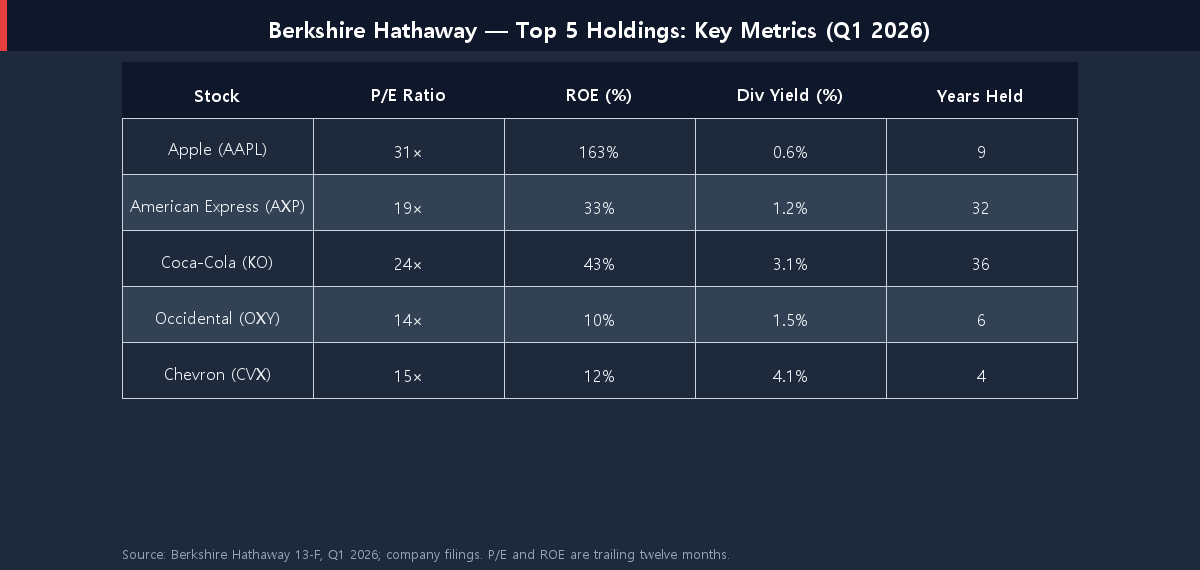
A few observations worth noting:
- Apple (AAPL): The stratospheric ROE (163%) reflects Apple’s asset-light software and services revenue layered on top of hardware. Buffett has described it as Berkshire’s best business — not a tech bet but a consumer loyalty bet.
- Coca-Cola (KO): Berkshire has held KO for 36 years, through multiple market cycles. With a 3.1% dividend yield and pricing power intact, it exemplifies criteria 4, 5, and 6 simultaneously.
- American Express (AXP): AXP demonstrates that a financial company can pass Buffett’s screen if it has a sufficiently powerful brand and affluent-customer switching cost moat. Buffett has held it for 32 years.
- Occidental (OXY): A lower ROE than Buffett’s typical targets — included because of its massive domestic oil reserves and management’s disciplined capital allocation under CEO Vicki Hollub.
If the dividend-paying characteristics of Berkshire’s portfolio appeal to you, see our breakdown of the Best High-Yield Dividend ETFs for 2026 as an alternative route to income-generating equities.
What Buffett Avoids: 6 Red Flags That Disqualify a Stock Immediately
Understanding what Buffett will not buy is as instructive as knowing what he will. Six patterns recur repeatedly across stocks he has passed on or exited:
- Businesses he cannot understand — not stupidity, but honest acknowledgment of limits. Buffett skipped most dot-com and biotech stocks not because he thought they would fail but because he could not estimate their value reliably.
- Commoditized industries with no pricing power — airlines (which he famously called a “death trap for investors” before eventually buying and then selling them), steel, basic chemicals. Undifferentiated products force permanent margin competition.
- Excessive debt relative to cash flow — leverage amplifies both gains and losses, and it puts businesses at risk during credit crunches that the business itself did nothing to create.
- Accounting that obscures rather than illuminates — large differences between reported earnings and free cash flow, aggressive revenue recognition, or frequent non-GAAP adjustments that always seem to paint a rosier picture.
- Management that prioritizes personal enrichment over shareholders — excessive stock compensation, related-party transactions, or acquisitions designed to justify empire-building rather than create value.
- Dependence on a single product, customer, or technology cycle — concentration risk is tolerable when the moat around that product is extraordinary (as with Apple), but when a single contract or product generation determines survival, the business is fragile.
Applying the Checklist as a Retail Investor: A Practical 2026 Guide
Buffett operates at a scale — and with informational access — that most retail investors cannot replicate. He sits on boards, meets with CEOs, and can deploy billions in a single transaction. That said, the checklist is fully applicable at the individual level. Here is a practical workflow:
- Start with industries you already know — your profession, the companies whose products you use daily, the businesses your employer competes with. Your existing knowledge is your circle of competence. Do not ignore it.
- Screen for ROE >15% sustained over 10 years — this filter alone eliminates most of the market and narrows you to genuinely high-quality businesses. Use free screeners at Macrotrends, Wisesheets, or Morningstar.
- Read the last 5 annual reports, not just the last quarter — look for consistent messaging, candid discussion of challenges, and capital allocation decisions that compound over time rather than inflate short-term metrics.
- Estimate a range of intrinsic values, not a single number — build a bear case, a base case, and a bull case for free cash flow growth. Only buy when the current price is below even your bear-case intrinsic value estimate.
- Size positions for the long term — Buffett concentrates in his highest-conviction ideas. Retail investors often own 30–50 stocks, which dilutes the benefits of research. Five to ten thoroughly understood businesses typically produce better results than a hundred superficially understood ones.
- Use dollar-cost averaging to build positions gradually — even at Buffett’s level, timing a full position entry is difficult. Spreading purchases over 6–12 months reduces the risk of buying the entire position at a temporary peak. See our DCA vs. Lump-Sum analysis for the data on this strategy.
For context on how individual stock positions fit within a broader portfolio, see A Beginner’s Guide to Asset Allocation, which covers how to balance equities, bonds, and cash across different risk tolerances.
If you prefer quality dividend growth without the research overhead of individual stock picking, our comparison of SCHD vs VIG: Best Dividend Growth ETF for 2026? covers two ETFs built around criteria that closely mirror Buffett’s financial quality screen.
Conclusion: Value Investing Is a Discipline, Not a Formula
Warren Buffett’s value investing checklist — eight questions covering competence, moat, management, financial strength, earnings predictability, pricing power, intrinsic value, and long-term conviction — is straightforward to describe and genuinely difficult to execute consistently. The difficulty is not mathematical. It is behavioral: the discipline to say no to hundreds of interesting-looking stocks that fail one or two criteria, and the patience to hold through inevitable short-term volatility once you own the right ones.
Berkshire’s portfolio in 2026 is a live demonstration of the checklist at work. Apple, Coca-Cola, and American Express were not purchased because they were cheap — they were purchased because they were exceptional businesses at prices that offered an acceptable margin of safety. The businesses have compounded for decades. The market price has followed.
Whether you apply this checklist to individual stocks or use it simply to evaluate the quality of what goes into your portfolio, the underlying discipline — buy what you understand, at a fair price, and hold it long enough for the business’s quality to express itself — remains one of the most durable frameworks in investing.
Found this useful? Bookmark it and check back — I publish practical investing breakdowns regularly. Worth reading next: SCHD vs VIG: Best Dividend Growth ETF for 2026?
This article is for informational purposes only and is not investment advice. Do your own research.