
The Federal Reserve meets on October 27–28, 2026, with a rate decision due at 2:00 PM ET on October 28. Markets are pricing roughly an 81% chance the Fed holds rates at 3.75%–4.00% — but an 18% tail risk of another 25-basis-point hike is not trivial. This October 2026 FOMC preview walks through what to expect, what each scenario means for bonds, gold, and stocks, and three concrete moves you can make before the Fed speaks.

What to Expect at the October 27–28 FOMC Meeting
Current Rate: 3.75%–4.00% After September’s Hike
The FOMC raised its target range by 25 basis points at the September 15–16, 2026 meeting in a unanimous 12–0 vote, bringing the policy rate to 3.75%–4.00%. That follows an aggressive tightening cycle that started in 2022. With inflation proving stickier than expected and employment still resilient, the committee has signaled it is prepared to tighten further if the data demands it.
October’s meeting is the seventh of eight scheduled FOMC meetings in 2026. The calendar matters: whatever the committee decides in October directly shapes the stakes for the December 9–10 meeting — and the December meeting does come with an updated dot plot and Summary of Economic Projections.
Market Pricing — 81% Hold, 18% Hike
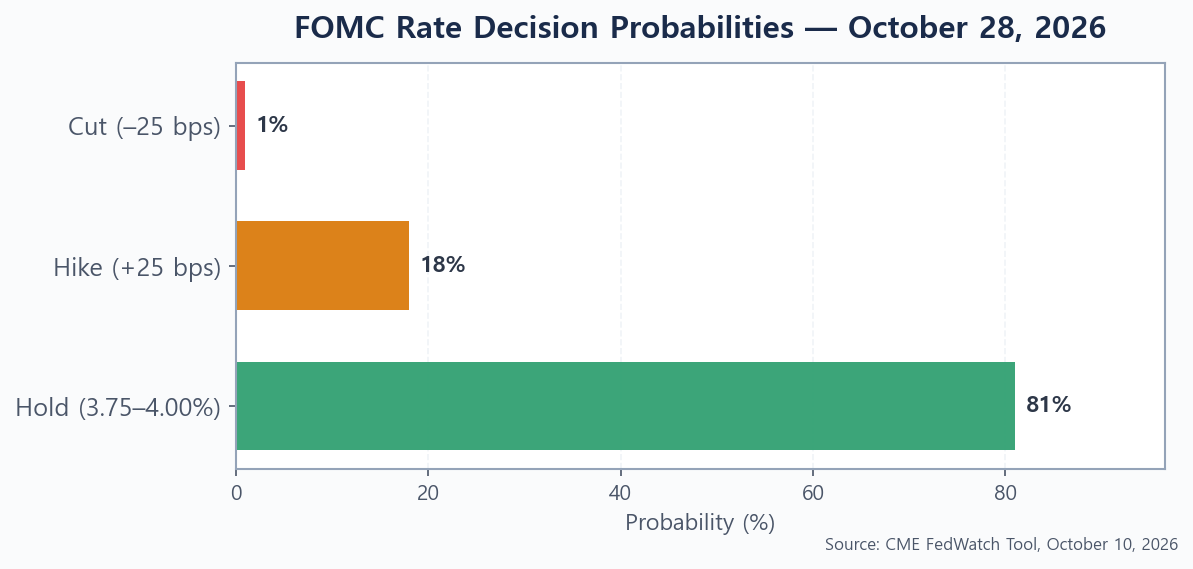
As of October 10, 2026, the CME FedWatch tool puts the probability of an October hold at 81.6%, a hike at roughly 18%, and a cut at less than 1% (Source: CME Group FedWatch, October 10, 2026). Most major Wall Street banks — Goldman Sachs, J.P. Morgan, Morgan Stanley, Barclays, Deutsche Bank, HSBC, Nomura, and UBS — all project the next hike will come in December, not October. The lone dissenter in the bank consensus is Bank of America, which calls for hikes at both October and December.
No Dot Plot: Why This Meeting Has No New Projections
One detail that separates October from September and December: this is a non-SEP meeting. The Fed releases its Summary of Economic Projections — the famous “dot plot” showing individual officials’ rate forecasts — only at the March, June, September, and December meetings. October gives you the policy decision and Chair Powell’s press conference, but no new economic forecasts and no updated rate path. That makes the press conference language especially important: investors will parse every word for signals about December.
For a deeper look at how to read the dot plot for your portfolio, see Will the Fed Cut Rates in 2026? Reading the Dot Plot.
Scenario Analysis — Hold vs. Hike and What It Means for Markets
Scenario 1: Hold (Base Case — ~81% Probability)
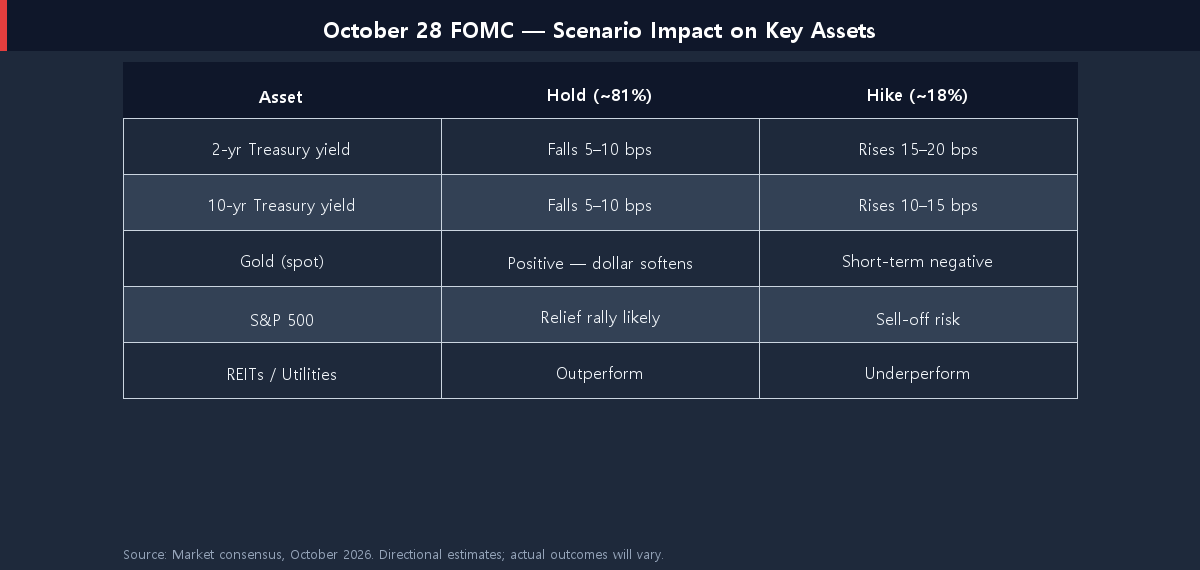
A hold at 3.75%–4.00% is the base case. The likely market reaction is a modest relief rally across risk assets — equities bounce, the dollar softens, and shorter-duration bond yields dip 5–10 basis points as the market temporarily prices in a slightly less aggressive December. Gold would likely benefit from a softer dollar.
The key question in this scenario is the tone of Powell’s press conference. A “hawkish hold” — hold now, but hike in December is squarely on the table — could cap the equity rally and keep Treasury yields elevated. The September minutes already showed officials expect further tightening, so the bar for a dovish read is high.
Scenario 2: Hike to 4.00%–4.25% (Tail Risk — ~18%)
If the Fed surprises with a 25 bps hike, short-end yields would spike 15–20 basis points immediately. The 10-year would likely rise 10–15 bps as well. Equities — particularly rate-sensitive sectors like REITs and utilities — would sell off. Growth stocks, already under pressure from a 4%+ funds rate, would face additional multiple compression. Gold’s immediate reaction would likely be negative on a stronger dollar, though it has historically recovered quickly once the “surprise” premium fades.
Bank of America argues the inflation data and the still-robust jobs market justify an October move, noting that waiting until December gives inflation an extra six weeks to re-accelerate. That view is a minority one on the Street — but it explains why the market hasn’t fully discounted the hike probability to zero.
The December Implication
Whether the Fed holds or hikes in October, the December 9–10 meeting is widely seen as a “live” meeting for another hike, with futures currently pricing an 83–88% probability of a December increase (assuming an October hold). That means the December dot plot — showing where officials see rates in 2027 — will be pivotal for longer-term bond and equity positioning heading into year-end.
For context on how the current tightening cycle has evolved, Will the Fed Hike Rates in 2026? Higher for Longer covers the shift from the cut consensus that dominated 2025 to the hike reality of 2026.
How to Position Your Bond Portfolio Before October 28
Stay Short Duration — The BlackRock Signal
BlackRock — the world’s largest asset manager — recently upgraded US Treasuries while simultaneously downgrading US equities to neutral. Crucially, their preference is for short-term Treasuries, not long-duration bonds. That distinction matters. When you hold a 2-year T-note versus a 10-year bond and rates rise an extra 25 basis points, the price impact is roughly 4x smaller on the short end.
In practical terms, ETFs like SGOV (0–3 month T-bills), SHY (1–3 year Treasuries), or VGSH (short-term government bond fund) give you the yield pickup from 3.75%–4.00%+ while minimizing duration risk if the Fed surprises in October or follows through in December. At current rates, short Treasuries are genuinely competing with equity dividend yields — a dynamic that has shifted portfolio math significantly from the zero-rate era.
For a full breakdown of where long-term yields are heading, read 10-Year Treasury Yield Outlook 2026: A 4% World. And for context on the yield curve shape, Treasury Yield Curve Steepening in 2026 explains what a bear steepener means for long-duration holders.
TIPS and Inflation-Linked Bonds as Rate Insurance
If the hike scenario materializes — driven by sticky inflation — TIPS (Treasury Inflation-Protected Securities) and I Bonds carry a built-in hedge. Their principal adjusts with CPI, so an inflationary surprise that forces the Fed’s hand is also the scenario where TIPS outperform nominal bonds. Short-term TIPS, in particular (via ETFs like STIP or VTIP), give you inflation protection with minimal duration risk — a combination well-suited to the current environment. For a side-by-side comparison, TIPS vs. I Bonds: Best Inflation Protection for 2026 covers the key trade-offs.
Gold’s Playbook Around the October FOMC
Why Gold Thrives in Policy Uncertainty
Gold has a nuanced relationship with the Fed. In the very short term, a hike typically strengthens the dollar and pressures gold prices. But over a 3–6 month horizon, gold tends to perform well when the policy path is uncertain, when real yields are capped by inflation, and when fiscal concerns around government debt weigh on confidence in fiat currency. All three conditions are present heading into October 28.
The Federal Reserve’s balance sheet, persistent fiscal deficits, and central bank buying from emerging markets — particularly China and Turkey — have provided structural support to gold throughout 2026. A brief FOMC-driven dip, if it occurs, has historically attracted buyers who see the macro backdrop as favorable over the medium term.
Morgan Stanley’s $5,050 Target — What Analysts Are Watching
Morgan Stanley has named gold its top commodity pick, projecting an average price of $5,050 per ounce in 2027 (Source: Morgan Stanley, October 2026). The bank’s thesis rests on three pillars: continued central bank buying, potential government intervention to cap long-term bond yields in indebted nations, and a structural de-dollarization trend in reserve management.
For investors, this does not mean buying gold at any price is risk-free. It does mean a modest allocation — the evidence-based 5–10% range — can serve as a portfolio ballast regardless of whether the Fed holds or hikes in October. How Much Gold Should You Hold in Your Portfolio in 2026? covers the sizing framework in detail.
Stock Market Positioning Before the Fed Speaks
Sectors That Win on a Hold: Utilities, REITs, Dividend Growers
Rate-sensitive equity sectors — utilities, real estate investment trusts (REITs), and dividend-paying consumer staples — have been under pressure throughout the tightening cycle. A hold removes an immediate headwind and allows these sectors to trade on fundamentals rather than rate-shock fears. If Powell’s press conference comes across as neutral or leaning toward a pause cycle, utilities and REITs could see a meaningful catch-up rally.
Dividend growth ETFs like SCHD and VIG have held up relatively well in 2026 compared to high-multiple growth names precisely because their underlying businesses generate cash flows that are less sensitive to the discount rate at the margin. A hold reinforces this relative outperformance thesis.
To understand the broader mechanism of how Fed decisions flow through to equity valuations, How the Fed Rate Decision Affects the Stock Market walks through the four transmission channels clearly.
If the Fed Surprises With a Hike: Where to Shelter
An October hike would likely trigger a risk-off rotation. Financials — particularly banks with variable-rate loan books — could benefit from a steeper net interest margin, but the broader market impact would be negative in the short term. Short-term T-bills and money market funds, already yielding above 4%, would become an even more compelling alternative to equities on a risk-adjusted basis.
Within equities, sectors with pricing power and low debt loads (energy, some industrials, select healthcare) are better positioned to absorb higher-for-longer rates than leveraged, growth-oriented companies. The playbook mirrors what worked in 2022–23: quality over speculation, cash flow over narrative.
Three Portfolio Moves to Make Before October 28
You don’t need to predict the Fed perfectly to position intelligently. These three moves are defensible in both scenarios — hold or hike:
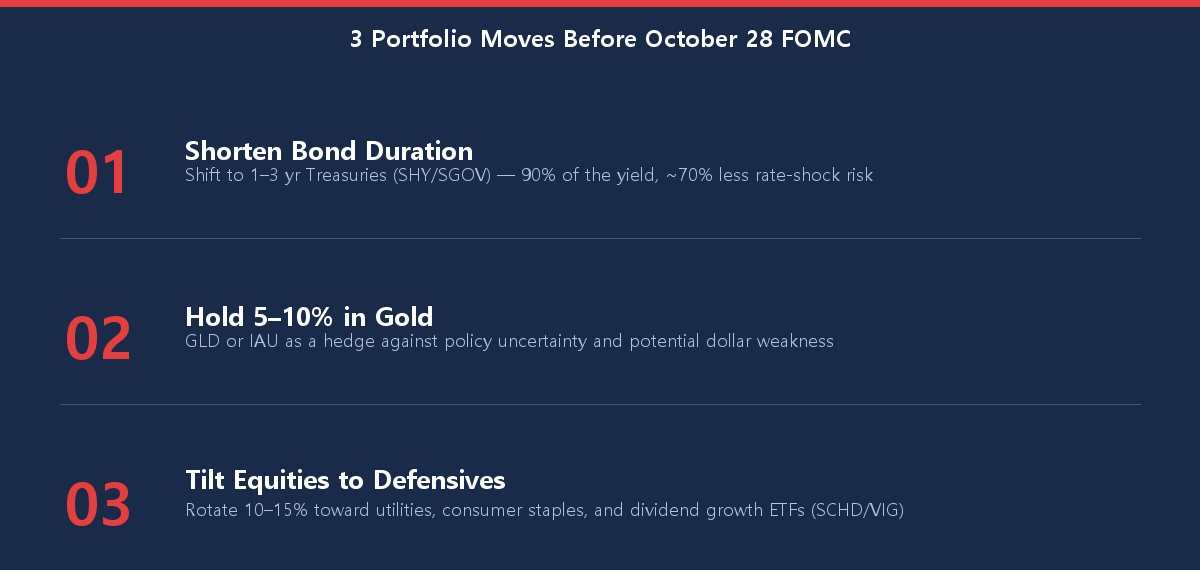
- Shorten bond duration. Swap any meaningful allocation to long-duration bonds (TLT, EDV, or 20-year+ Treasuries) toward the 1–3 year part of the curve (SHY, SGOV, VGSH). You capture 90%+ of the current yield while reducing your mark-to-market exposure to an October or December surprise hike by roughly 70%. If you haven’t revisited your bond duration since rates started rising, now is the time. See How to Rebalance Your Portfolio When Interest Rates Are Rising for a step-by-step framework.
- Hold a 5–10% gold allocation. GLD or IAU both track spot gold closely with reasonable expense ratios. If you’re already in this range, the FOMC event doesn’t require action. If you’re at zero, the period around a high-uncertainty Fed meeting — when the market isn’t sure whether October is the last hike or not — is a reasonable entry window. The key is sizing: gold is a hedge, not a bet.
- Tilt equity exposure toward defensives and value. Trim high-multiple, rate-sensitive growth names and add to utilities, consumer staples, and dividend growth ETFs. This doesn’t require a wholesale portfolio overhaul — shifting 10–15 percentage points of equity exposure toward lower-beta sectors reduces your drawdown risk if October surprises, without abandoning equity upside if the hold is well-received.
These moves are incremental, not binary. They reflect the probability-weighted reality that an 81% hold and an 18% hike deserve meaningful — but not panicked — portfolio adjustment.
Conclusion
The October 2026 FOMC meeting on October 27–28 is the most consequential pre-year-end catalyst for bonds, gold, and stocks. Markets are pricing an 81% probability of a hold at 3.75%–4.00%, with an 18% tail risk of another hike to 4.00%–4.25%. Because this is a non-SEP meeting, Powell’s press conference tone will drive the market’s interpretation of what December holds.
The actionable takeaway from this October 2026 FOMC preview: stay short on bond duration, maintain a 5–10% gold allocation, and tilt equities toward defensives and dividend growers. These moves protect against the tail risk of an October hike while keeping you positioned to participate in a relief rally if the hold is delivered as expected.
Looking back at the July 2026 FOMC cycle is useful context here — the Fed held in July, signaled data-dependence, and then moved in September anyway. History doesn’t repeat, but the playbook of watching data more closely than promises applies to October 28 just as much. For the full timeline, July 2026 FOMC Preview: How to Position Your Portfolio Before July 29 has the breakdown.
Found this useful? Bookmark this page so you can revisit when the October 28 decision drops. I cover FOMC outcomes and portfolio positioning on FinvestLog regularly — check back soon.
This article is for informational purposes only and is not investment advice. Do your own research before making any investment decisions.