
The 10-year Treasury yield has climbed above 5% — territory it last visited during the 2023 rate shock — and that single number reshapes the fixed-income calculus for every investor. When the long end offers only a modest yield pickup over the short end, taking on extra duration risk becomes a losing trade. The best short-duration bond ETFs for Q4 2026 let you pocket a competitive yield while keeping your portfolio’s interest-rate sensitivity in check.
This guide covers six of the strongest options on the market, comparing their yields, durations, expense ratios, and ideal use cases so you can decide which fits your portfolio right now.

Why a 5%+ 10-Year Yield Rewards Short Duration
The relationship between yield and duration works like this: the higher a bond’s duration, the more its price drops when yields rise. A bond fund with a duration of 7 years loses roughly 7% of its market value for every 1-percentage-point jump in rates. Short-duration funds — those holding bonds maturing in three years or less — suffer far smaller price declines, often just 0.1 to 2.7% per point of rate movement.
With the 10-year Treasury above 5%, the Treasury yield curve is steepening in a bear pattern: long yields are grinding higher while the Fed keeps the short end anchored. That means you sacrifice little yield by staying short, and you avoid the duration punishment that longer-dated funds absorb if rates keep rising.
As of Q4 2026, the 1–3 year portion of the Treasury curve yields roughly 5.0–5.1% (Source: U.S. Treasury, October 2026). Compare that to the 10-year at ~5.1–5.2%: the term premium has nearly evaporated. In other words, you are being paid almost nothing to take duration risk. That asymmetry argues strongly for short duration — and the ETFs below are the cleanest ways to access it.
5 Best Short-Duration Bond ETFs for Q4 2026
1. SGOV — iShares 0-3 Month Treasury Bond ETF (Ultrashort Cash Proxy)
SGOV is the largest fixed-income ETF in its category, with over $112 billion in assets under management (Source: BlackRock, Q4 2026). It holds only Treasury bills maturing in 90 days or less, which gives it an effective duration near zero. Price volatility is negligible — SGOV behaves more like a money-market account than a bond fund.
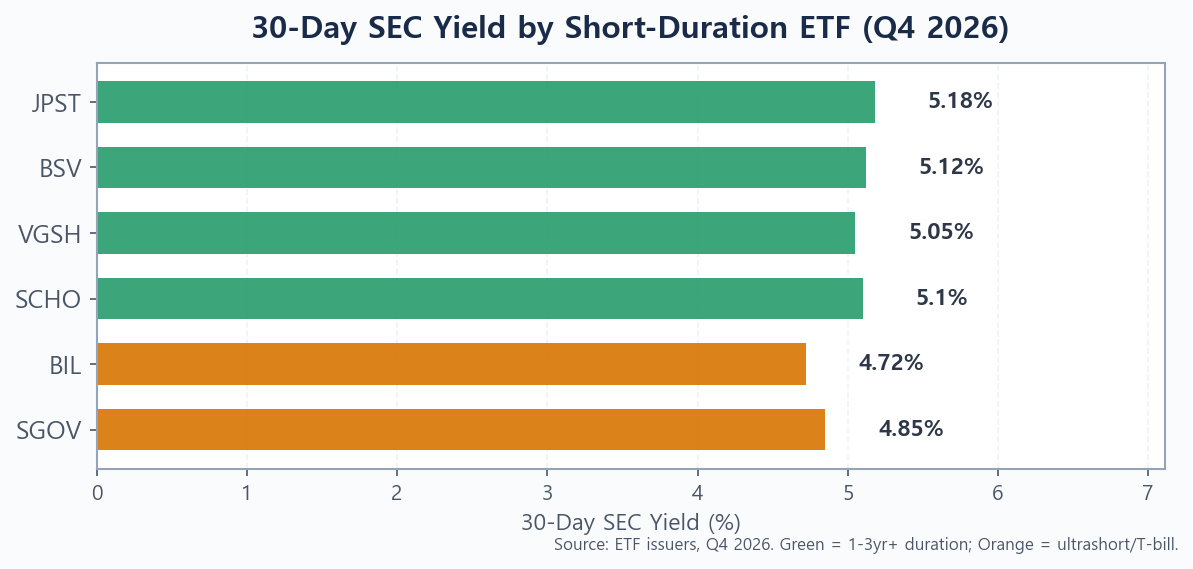
The trade-off is yield: at 4.85% (30-day SEC yield), SGOV lags the 1–3 year cohort by about 25 basis points. But for investors who need instant liquidity or who prefer zero mark-to-market risk, that gap is an acceptable cost. Expense ratio: 0.09%.
2. SCHO — Schwab Short-Term U.S. Treasury ETF (Best Yield per Dollar of Expense)
SCHO tracks the Bloomberg U.S. Treasury 1–3 Year Index, holding only government-backed securities with maturities between one and three years. Its 30-day SEC yield of 5.10% and its rock-bottom 0.03% expense ratio make it one of the most cost-efficient ways to own short Treasuries. Effective duration sits at 1.9 years — enough to capture a yield pickup over T-bills, but modest enough that a 50-basis-point rate spike would cost less than 1% in price.
SCHO is the core holding for investors who want pure Treasury exposure and maximum yield efficiency at the short end. AUM: ~$12 billion.
3. VGSH — Vanguard Short-Term Treasury ETF (Low-Cost Treasury Purity)
VGSH tracks the same Bloomberg 1–3 Year Treasury index as SCHO, also charges 0.03%, and carries an essentially identical 1.9-year duration. Its 30-day SEC yield of 5.05% is marginally below SCHO’s, a difference explained by minor index-sampling variation. With ~$25 billion in AUM and Vanguard’s deep institutional liquidity, VGSH is often the default choice among passive investors already in the Vanguard ecosystem.
Both SCHO and VGSH are excellent; the decision between them is largely brokerage preference. Vanguard investors pay no commission on VGSH; Schwab investors pay none on SCHO.
4. BSV — Vanguard Short-Term Bond ETF (Broader Short-End Exposure)
BSV widens the mandate beyond Treasuries. It holds bonds maturing in one to five years across U.S. Treasuries (~75%) and investment-grade corporate bonds (~25%), giving it a slightly longer effective duration of 2.7 years and a yield of 5.12% (Source: Vanguard, Q4 2026). The corporate exposure adds a thin layer of credit risk — spreads on investment-grade paper remain historically tight — but also provides a modest yield edge over pure-Treasury alternatives.
BSV suits investors who are comfortable with a small allocation to high-quality corporate debt and want to squeeze an extra few basis points without moving materially up the duration ladder. AUM: ~$30 billion.
5. JPST — JPMorgan Ultra-Short Income ETF (Active Manager Premium)
JPST is the only actively managed fund on this list. JPMorgan’s team invests across ultra-short investment-grade instruments — commercial paper, short-term corporates, asset-backed securities — targeting a duration under one year. The result is a 5.18% 30-day SEC yield with a 0.4-year duration, the best yield-per-unit-of-duration ratio among the five. The catch is cost: at 0.18%, JPST’s expense ratio is six times higher than SCHO or VGSH.
For yield-maximizers who still want near-zero price sensitivity, JPST’s active positioning can add value — particularly when investment-grade spreads widen and the manager rotates toward Treasuries. AUM: ~$41 billion.
Head-to-Head: Key Metrics at a Glance
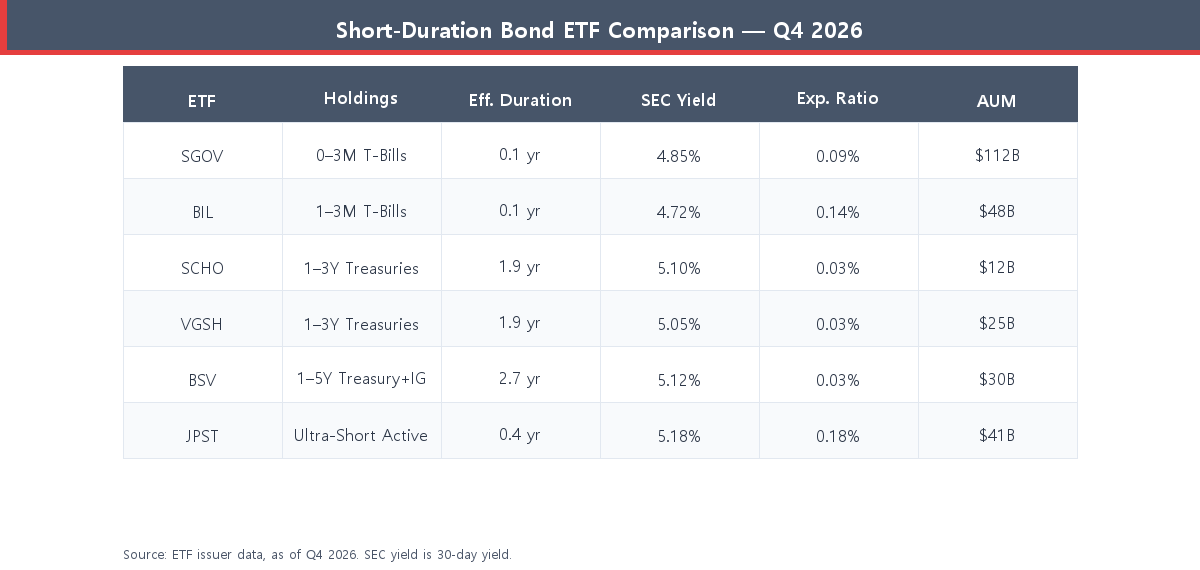
The table below compares all six ETFs across the metrics that matter most when the 10-year yield is above 5%. For a broader look at cash parking options, see our comparison of money market funds vs. short-term Treasuries.
The video above walks through several of these ETFs and explains the core mechanics of short-duration investing — worth watching if you want a visual breakdown before committing to a position.
How to Choose the Right ETF for Your Situation
The right pick depends on three variables: how quickly you might need the money, how much credit risk you will accept, and which brokerage you use.
- Need the cash within months? Stick with SGOV or BIL. Their near-zero duration and T-bill-only mandate make them the closest thing to a yield-bearing checking account.
- Investing for 1–3 years and want pure government safety? SCHO or VGSH are the optimal choices. They are commission-free on their home brokerages and charge the lowest expense ratios available in the category.
- Comfortable with a touch of investment-grade corporate risk? BSV’s broader mandate and slightly higher yield make sense for taxable brokerage accounts where the extra basis points compound over time.
- Want active management and maximum yield for ultra-short duration? JPST delivers, provided you are comfortable with the higher fee and its exposure to non-Treasury short paper.
If you are considering a Treasury bond ladder rather than an ETF, bear in mind that ladders eliminate reinvestment-rate risk but require more management — ETFs reinvest automatically and trade intraday.
Also worth reading: short-term bonds vs. high-yield savings accounts — a useful framework for deciding whether an ETF or a bank account is the better home for your near-term cash.
Risks to Keep in Mind for Q4 2026
Short-duration funds are not risk-free. Three dynamics deserve attention in the current environment:
- Reinvestment risk. If the Fed pivots and rates fall sharply, the T-bills and short notes inside these ETFs will roll into lower-yielding securities faster than long-duration funds. Your yield advantage could shrink quickly. Our 10-year Treasury yield outlook discusses where forecasters see rates heading.
- Tariff-driven inflation. Sticky core CPI, fueled in part by tariffs, has kept the Fed on hold longer than markets expected. That backdrop is actually favorable for short-duration holders today — but any sudden inflation reversal could change the Fed’s trajectory rapidly.
- Credit risk in JPST and BSV. Investment-grade spreads are historically tight. If spreads widen in a risk-off episode, the corporate-paper exposure in JPST and BSV will underperform pure-Treasury alternatives. The impact is modest given their short durations, but it is not zero.
For context on how corporate spreads compare to Treasury yields in this environment, see our post on corporate bonds vs. Treasuries in 2026.
The Bottom Line
The best short-duration bond ETFs for Q4 2026 — SGOV, SCHO, VGSH, BSV, and JPST — all offer competitive yields above 4.7% while keeping duration low enough to limit price damage if the 10-year Treasury yield climbs further. With the yield curve offering little term premium for extending maturity, parking capital in the 0-to-3-year range is both well-compensated and prudent.
For most investors, the decision comes down to SCHO or VGSH for pure Treasury efficiency, SGOV or JPST for near-zero duration, and BSV for a broad short-end blend. Bookmark this page — as yields and ETF data shift heading into year-end, the relative ranking among these funds may evolve.
This article is for informational purposes only and is not investment advice. Do your own research before making investment decisions.