
You’ve already maxed your 401(k) and Roth IRA — now every extra dollar flows into a taxable brokerage account. The problem is that not all ETFs behave the same way outside a tax shelter. Pick the wrong fund and the IRS quietly takes a cut every April, even if you never sold a single share. This guide identifies the best tax-efficient ETFs for taxable brokerage accounts in 2026, explains exactly why they beat the alternatives, and shows you which popular funds to park elsewhere.

Already wondering which account should come first? See our breakdown of Roth IRA vs. Taxable Brokerage: Which to Fund First? before deciding how much to send here.
Why Tax Efficiency Matters in a Taxable Account
Inside a 401(k) or IRA, dividends and capital gains compound untouched until withdrawal. In a taxable brokerage account, every distribution is a taxable event — even if it lands automatically back in your account. Over decades, that drag compounds in reverse, silently eroding your real return.
How ETF Dividends and Capital Gains Are Taxed
Dividends fall into two categories. Qualified dividends — paid by most US stocks held over 60 days — are taxed at the lower long-term capital gains rate (0%, 15%, or 20% depending on your income). Non-qualified dividends, common in REITs, covered-call ETFs, and some international funds, are taxed as ordinary income, which can reach 37% for high earners. Capital gains distributions from a fund that turns over its holdings frequently are taxed the same way: short-term gains at ordinary income rates, long-term gains at the preferential rate.
The goal in a taxable account is simple: minimize ordinary income distributions, minimize capital gains distributions, and hold for long-term appreciation you control when you realize it.
The ETF In-Kind Redemption Advantage
ETFs have a structural tax edge over mutual funds. When institutional investors redeem large blocks of ETF shares (called “creation units”), the fund delivers the underlying stocks in kind rather than selling them for cash. Because no sale occurs inside the fund, no capital gain is triggered for remaining shareholders. This mechanism is why broad index ETFs like VOO and VTI have distributed near-zero capital gains for years, while equivalent mutual funds sometimes declare surprise capital gains distributions in December. It is one of the core reasons broad index ETFs are the default choice for tax-efficient ETF investing in taxable accounts.
What Makes an ETF Tax-Efficient? (The 3 Rules)
- Low or no capital gains distributions: Broad index ETFs with low portfolio turnover rarely need to sell holdings, so they rarely trigger distributions.
- Low dividend yield (or qualified-only dividends): Less income thrown off means less annual tax drag. Growth-tilted ETFs naturally win here since most of their return comes from price appreciation, not dividends.
- Low expense ratio: An ultra-low fee means less cost eating your return before the IRS even gets involved. See our deep-dive on what an ETF expense ratio actually costs you.
ETFs You Should NOT Hold in a Taxable Account
Before the buy list, a clear avoid list matters just as much. These funds make perfect sense inside a tax-sheltered IRA or 401(k), but create unnecessary tax drag when held in a brokerage account.
High-Yield Dividend ETFs (SCHD, VYM, JEPI)
SCHD and VYM distribute roughly 3–4% in dividends annually (Source: Vanguard / Schwab fund data, as of September 2026). Even though most of those dividends are qualified, the sheer volume means a significant portion of your total return is taxed each year rather than compounding tax-deferred. JEPI goes further: its covered-call strategy generates yields near 8% in 2026, but a large portion of that income is classified as ordinary income — not qualified dividends — taxed at your full marginal rate. These funds are best held in a Roth IRA or traditional 401(k).
REIT ETFs (VNQ)
REITs are legally required to distribute at least 90% of taxable income to shareholders, and most REIT dividends are non-qualified, meaning they are taxed as ordinary income. VNQ’s yield sits near 3.5% in 2026, nearly all of it taxed at the top ordinary rate for many investors. A Roth IRA is the ideal home for REIT exposure.
Bond ETFs (BND, AGG)
Bond funds pay interest income, and interest is taxed as ordinary income — there is no preferential rate like qualified dividends. BND’s yield is approximately 4.2% as of mid-2026 (Source: Vanguard, September 2026). Holding BND in a taxable account means a significant portion of your bond return is taxed at your highest marginal rate every year. Bonds belong in tax-deferred accounts for most investors.
The 7 Best Tax-Efficient ETFs for Taxable Accounts in 2026
Each of the following funds earns its place through low turnover, minimal or qualified-only distributions, and the ETF in-kind mechanism. They are listed roughly in order of tax-efficiency simplicity.
1. VOO — Vanguard S&P 500 ETF
The S&P 500 index has a naturally low 3–5% annual turnover. VOO’s 0.03% expense ratio is as cheap as it gets, its 12-month yield sits around 1.3% (all qualified dividends), and it has not distributed a capital gain since its 2010 inception (Source: Vanguard, 2026). For a US large-cap core, VOO is hard to beat in a taxable account.
2. VTI — Vanguard Total Stock Market ETF
VTI extends VOO across mid- and small-cap US stocks for broader diversification. Its expense ratio is identical at 0.03%, yield near 1.4%, and turnover under 4% (Source: Vanguard, 2026). Because it holds over 3,800 stocks, individual company churn barely moves the needle on capital gains distributions.
3. VXUS — Vanguard Total International Stock ETF
International exposure is valuable in a taxable account for one underappreciated reason: the foreign tax credit. Foreign governments withhold taxes on dividends paid to US investors, but that withheld amount is generally claimable as a tax credit on your return — only when the fund is held in a taxable account, not inside an IRA. VXUS carries a 0.07% expense ratio and a 2.8% yield, but the foreign tax credit partially offsets the higher distribution (Source: Vanguard, 2026). This unique credit makes VXUS more tax-efficient in taxable accounts than in tax-deferred accounts for many investors.
4. VT — Vanguard Total World Stock ETF
VT is the one-fund solution: roughly 60% US, 40% international, all in a single ETF at 0.07% expense ratio. For investors who want simplicity, VT delivers global diversification with minimal management overhead. Its 12-month yield is approximately 1.9%, and like all Vanguard broad index ETFs, it benefits from the in-kind mechanism to suppress capital gains distributions.
5. VUG — Vanguard Growth ETF
Growth ETFs tilt toward companies reinvesting earnings rather than paying them out. VUG’s 12-month yield is only around 0.5% — one of the lowest among broad US equity ETFs — which means minimal annual taxable income. Its expense ratio is 0.04%, turnover is low, and it has grown to become one of the most tax-efficient ways to overweight growth factors in a taxable account (Source: Vanguard, 2026).
6. QQQ — Invesco Nasdaq-100 ETF
QQQ holds the 100 largest non-financial Nasdaq companies — heavy on mega-cap tech — with a 0.20% expense ratio and a dividend yield near 0.6% (Source: Invesco, 2026). The yield is low because the underlying companies return capital through buybacks, not dividends. The higher expense ratio (compared to Vanguard alternatives) is the primary drawback; QQQM offers the same exposure at 0.15%.
7. ITOT — iShares Core S&P Total U.S. Stock Market ETF
ITOT is BlackRock’s answer to VTI: a total US market ETF at 0.03% expense ratio. It is functionally interchangeable with VTI for most investors and represents a solid alternative for those who prefer iShares or have it available in their brokerage at zero commission. Yield near 1.4%, near-zero capital gains distributions history (Source: BlackRock, 2026).
The video above covers the core reasoning for why these broad index ETFs dominate taxable account portfolios in 2026 — worth watching before you finalize your allocation.
Tax-Efficient ETF Comparison Table (2026)
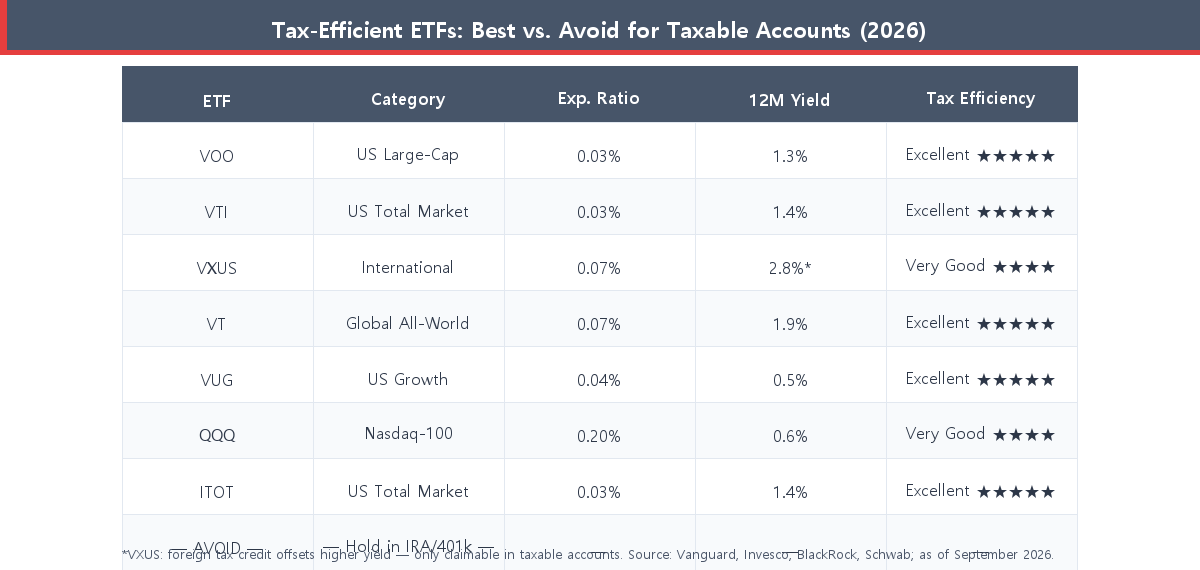
The table above contrasts the seven recommended ETFs against the five common tax-draining funds. Pay attention to the 12-month yield column: every percentage point of yield distributed annually is a taxable event you cannot defer. Low yield + low turnover + ETF structure = the trifecta of tax efficiency.
Asset Location Strategy: What Goes Where
Tax efficiency is not just about picking the right ETFs — it is about putting each asset class in the right type of account. Once you see the full picture, asset location becomes one of the highest-leverage moves available to any investor. For the foundational framework, see our Beginner’s Guide to Asset Allocation.
Taxable Account (Best Fit)
- Broad US equity ETFs (VOO, VTI, ITOT) — low yield, in-kind mechanism
- International equity ETFs (VXUS, VT) — foreign tax credit available only here
- Growth ETFs (VUG, QQQ) — minimal dividend yield
- Municipal bond funds — interest exempt from federal tax (not covered here but relevant for high earners)
Tax-Deferred Accounts (401k, IRA)
- Bond ETFs (BND, BNDX, AGG) — ordinary income shielded from annual tax
- REIT ETFs (VNQ) — non-qualified dividends sheltered
- High-yield dividend ETFs (SCHD, VYM) — high qualified dividends compound tax-free in Roth
- Covered-call ETFs (JEPI, QYLD) — ordinary income from options premium sheltered
A practical starting point: place your entire bond allocation in tax-deferred accounts first. Then fill those accounts with REIT and high-dividend ETFs. Whatever broad equity exposure remains in tax-deferred accounts is fine — it is simply less urgent to hide there. Worth reading next: How to Build a Simple 3-Fund Portfolio in 2026, which shows how VTI, VXUS, and BND fit together across multiple account types.
5-Step Checklist to Optimize Your Taxable Account
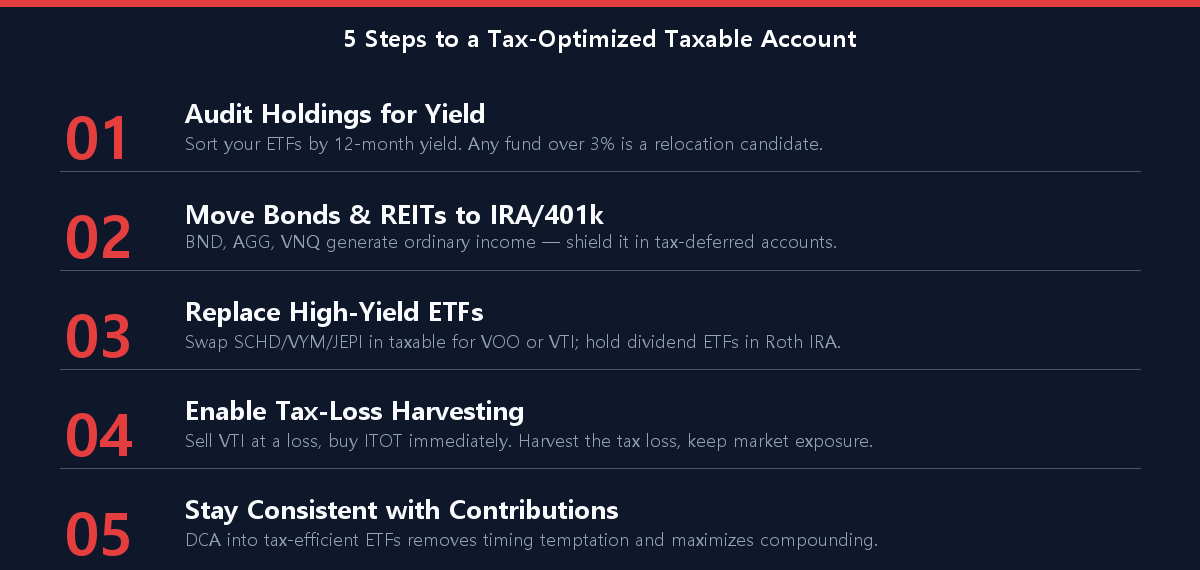
- Audit your current holdings for yield: Sort your brokerage ETFs by 12-month distribution yield. Any fund yielding over 3% is a candidate to swap or relocate.
- Move bond and REIT ETFs to tax-deferred accounts: If you hold BND, AGG, or VNQ in a taxable account, consider relocating to your IRA or 401(k) and replacing with equity ETFs in the brokerage.
- Replace high-yield dividend ETFs with total market ETFs: SCHD and VYM are excellent funds — just in the wrong account for most investors. Swap to VOO or VTI in taxable, and move SCHD to Roth IRA where qualified dividends compound tax-free.
- Enable tax-loss harvesting: When markets dip, sell VTI at a loss and immediately buy ITOT (or vice versa). You harvest the tax loss while maintaining nearly identical market exposure. The “wash sale” rule prevents buying the same fund back within 30 days, but VTI and ITOT are different enough to avoid triggering it.
- Be consistent with your contribution method: Dollar-cost averaging into tax-efficient ETFs removes the temptation to time entries. See our analysis of Dollar-Cost Averaging vs. Lump-Sum in 2026 to pick the approach that fits your situation.
Frequently Asked Questions
Is VOO or VTI better for a taxable account?
Both are equally tax-efficient — near-zero capital gains distributions, 0.03% expense ratio, and qualified dividends only. VTI offers broader diversification (mid- and small-cap included); VOO tracks only the S&P 500. The tax treatment is functionally identical. Choose based on which diversification scope you prefer.
Can I hold SCHD in a taxable account?
You can, but it is not optimal. SCHD’s ~3.8% yield (Source: Schwab, 2026) creates significant annual taxable income. It is better suited to a Roth IRA where dividends reinvest without any annual tax. If you already hold SCHD in a taxable account and are sitting on gains, a forced swap may cost more in realized gains than you’d save in future tax drag — consult a tax professional before acting.
Does holding VXUS in a taxable account really help with the foreign tax credit?
Yes, for most investors. The foreign tax credit reduces your US tax bill dollar-for-dollar (up to the credit limit) for taxes already paid to foreign governments. This credit is only available when the fund is held in a taxable account — it cannot be claimed from within an IRA or 401(k). The size of the credit depends on your individual tax situation, so verify with a tax advisor.
What is the difference between tax efficiency and tax-loss harvesting?
Tax efficiency is about choosing funds that generate fewer taxable events (low yield, low turnover). Tax-loss harvesting is an active strategy of selling a losing position to realize a deductible loss, then replacing it with a similar fund. Both strategies work together in a taxable account — start with tax-efficient funds, then harvest losses when market corrections provide the opportunity.
Conclusion
The best tax-efficient ETFs for taxable brokerage accounts in 2026 are broad, low-turnover index funds: VOO, VTI, or ITOT for a US core; VXUS for international (with its unique foreign tax credit benefit); VT for a one-fund global solution; and VUG or QQQ for a growth tilt with minimal yield drag. The funds to keep out of taxable accounts — SCHD, VYM, JEPI, VNQ, and BND — are excellent ETFs in the right account, just not here. Get the location right and the tax drag nearly disappears. Pair that with occasional tax-loss harvesting and you’ve captured most of the low-hanging fruit available to individual investors without any additional complexity.
Found this useful? Bookmark it so you can revisit when rebalancing season arrives. New to the basics? Start with How to Start Investing With Only $100 for the foundational context.
This article is for informational purposes only and is not investment advice. Do your own research. All data sourced from fund providers and publicly available disclosures; expense ratios and yields are approximate as of September 2026 and subject to change.