
Every October, the same window quietly opens for taxable account investors: the chance to turn paper losses into real tax savings before December 31. Tax-loss harvesting is the practice of intentionally selling positions at a loss to offset capital gains — and when executed correctly, it can shave hundreds or even thousands of dollars off your 2026 tax bill without permanently changing your investment strategy. This guide walks through the mechanics, the rules, and the exact steps to execute before the year-end deadline.
One important framing: tax-loss harvesting is only relevant to taxable brokerage accounts. Losses in IRAs, Roth IRAs, or 401(k)s cannot be harvested — these accounts are already tax-advantaged, so the IRS does not allow you to claim losses inside them. If you’re still deciding how to balance your account types, the breakdown in Roth IRA vs. Taxable Brokerage: Which to Fund First? covers the structural trade-offs.

What Is Tax-Loss Harvesting — And Why Year-End Is the Best Time to Act
Tax-loss harvesting works by converting an unrealized loss (a position worth less than you paid) into a realized loss that the IRS formally recognizes. That realized loss then offsets capital gains you’ve already locked in elsewhere in your portfolio. If your losses exceed your gains, up to $3,000 of the surplus can offset ordinary income in the same tax year — with any remaining amount carried forward indefinitely to future years.
Year-end is the most natural execution window for three reasons. First, by October or November you have a clear picture of your realized gains for the year — the exact amount you need to offset is known. Second, you still have time to act before December 31. Third, the psychological pressure of watching a losing position recover in January is lower when you replace it with a similar — not identical — security the same day, maintaining your market exposure throughout.
This strategy is not a loophole. The IRS explicitly acknowledges it, but enforces one important guardrail: the wash sale rule, covered in detail below.
The 2026 Capital Gains Tax Rates: What You’re Actually Saving
The value of a harvested loss depends entirely on the tax rate it offsets. In 2026, the IRS distinguishes sharply between short-term and long-term gains — and the difference matters more than most investors realize.
Short-term capital gains (assets held one year or less) are taxed as ordinary income, at your marginal rate — anywhere from 10% to 37% depending on your bracket. A $10,000 short-term gain could cost you $3,700 at the top marginal rate. Harvesting short-term losses to offset short-term gains first is almost always the priority.
Long-term capital gains (assets held more than one year) are taxed at preferential rates: 0%, 15%, or 20%, depending on your total taxable income for the year.
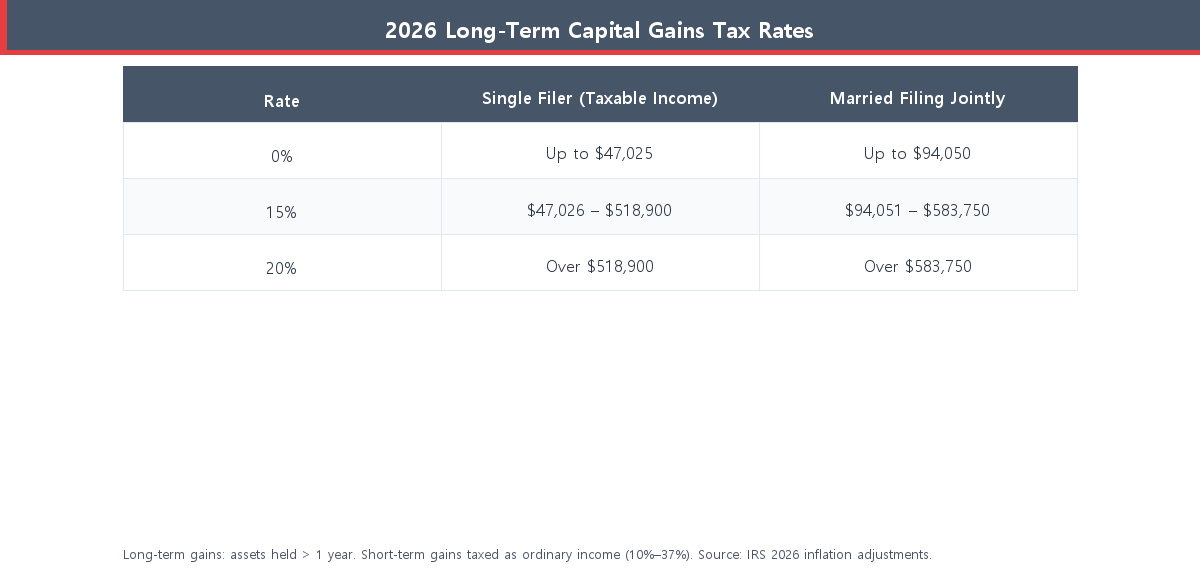
The IRS requires you to net losses against gains of the same type first: short-term losses against short-term gains, long-term losses against long-term gains. Leftover losses then cross over to offset gains of the opposite type. Any surplus beyond all capital gains reduces ordinary income up to $3,000 per year, with the remainder carrying forward to 2027 and beyond — loss carryforwards do not expire.
(If reducing tax drag in your taxable account is a persistent concern, it may also be worth reviewing which funds you hold there. The post Best Tax-Efficient ETFs for Taxable Brokerage Accounts in 2026 ranks the most structurally tax-friendly options.)
Step-by-Step: How to Execute Tax-Loss Harvesting Before December 31
The process is more mechanical than complex. The key is getting organized before you trade, not after.
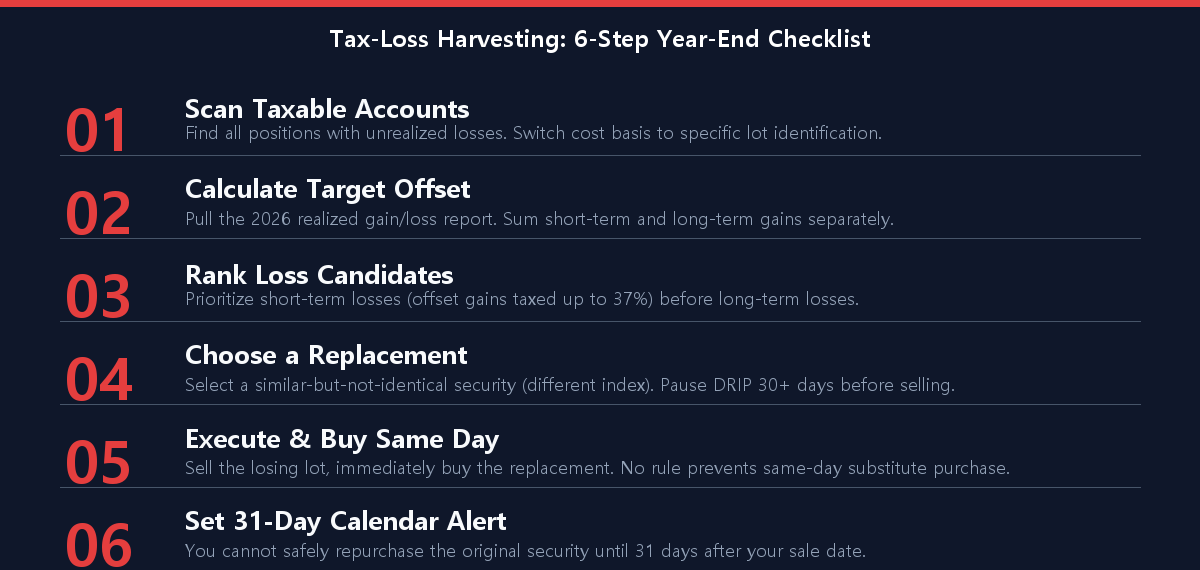
Step 1 — Scan Your Taxable Accounts for Unrealized Losses
Log in to every taxable brokerage account you hold. Most platforms display an “unrealized gain/loss” column in the positions view — use this as your starting point. Pay attention to individual tax lots, not just the aggregate position: you may have purchased the same ETF at multiple prices over time, and only some lots may be at a loss. Switch your cost basis method to specific identification (SpecID) if you haven’t already — this lets you choose which lots to sell, rather than using an automatic method like FIFO that may sell profitable lots first.
Step 2 — Calculate Your Net Realized Gain (Your Target Offset Amount)
Pull the “realized gain/loss” report from every taxable account for the full 2026 calendar year. Sum all realized gains, subtract realized losses already booked, and separate the totals into short-term and long-term buckets. The net short-term gain and net long-term gain figures are your targets — you want to harvest losses in amounts that reduce these toward zero (or a level you’re comfortable paying tax on).
Step 3 — Rank Loss Candidates: Short-Term First, Then Long-Term
Not all losses are equal. A short-term loss offsets gains taxed at up to 37%; a long-term loss offsets gains taxed at up to 20%. Prioritize harvesting short-term losses to offset short-term gains first. Only after eliminating short-term gains should you use long-term losses against long-term gains. This sequencing maximizes the tax rate at which each dollar of loss is deployed.
Step 4 — Choose a Replacement Security to Avoid the Wash Sale Rule
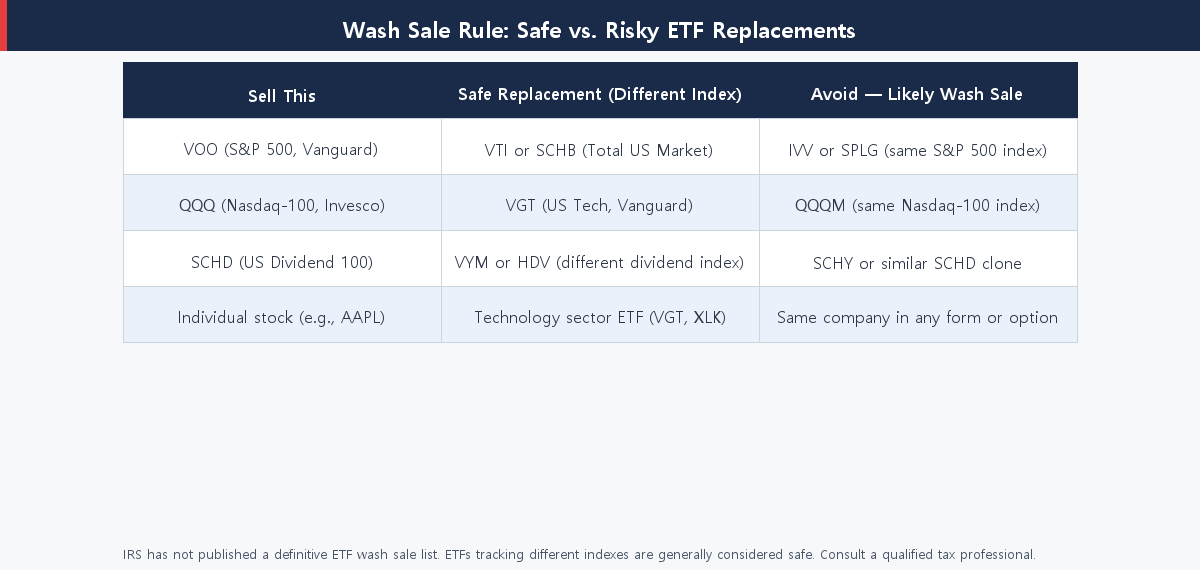
This is where most first-time harvesters stumble. You need a security that keeps your portfolio exposure roughly intact, but is not substantially identical to the one you’re selling. The safest pairs involve ETFs tracking different underlying indexes — for example:
- Sell VOO (S&P 500, Vanguard) → Buy IVV or SPLG? Likely too similar — same index. Better: Buy VTI (Total US Market, different index) or SCHB.
- Sell QQQ (Nasdaq-100) → Buy QQQM? Same index, different share class — likely identical. Better: Buy VGT (US Information Technology, different index).
- Sell SCHD (Dow Jones US Dividend 100) → Buy VYM (FTSE High Dividend Yield, different index) — generally considered safe.
- Sell an individual stock at a loss → Immediately buy a broad ETF covering that sector — always safe, since the ETF is clearly not the same security as one company’s stock.
The IRS has not published a definitive list of what counts as “substantially identical” for ETFs. The consensus among tax professionals is that ETFs tracking different indexes are safe substitutes, even if they cover the same asset class. Two ETFs from different providers tracking the same index (e.g., VOO and IVV both tracking the S&P 500) are more likely to be considered substantially identical — avoid this pairing for wash sale purposes.
Step 5 — Execute the Sale and Buy the Replacement Immediately
Sell the losing position. Then buy the replacement security the same day — there is no IRS rule preventing a same-day purchase of the substitute. The wash sale rule only prohibits repurchasing the original security within 30 days before or after the sale; the substitute is a different security entirely. Buying immediately eliminates the risk of the market moving against you during the transition.
Note on settlement: US stocks and ETFs now settle on a T+1 basis (one business day after the trade date). To ensure your tax loss settles within the 2026 tax year, execute by December 30, 2026 at the latest. Many advisors recommend targeting December 26–29 to avoid last-minute operational issues.
Step 6 — Set a 31-Day Calendar Alert Before Repurchasing the Original
If you want to return to the original security, you must wait at least 31 days after the sale date before buying it back (the 30-day window runs from the day before and after the sale, so 31 days is the conservative safe harbor). Set a calendar reminder now. If the market rallies sharply and you want back in before the window closes, you can stay in the substitute — or accept that the wash sale rule will apply and the disallowed loss will be added to your cost basis in the new position, deferring rather than permanently losing the tax benefit.
The following video from a CFP professional walks through the complete harvesting process with real portfolio examples — particularly useful if you’re executing for the first time this year and want to see the mechanics applied to an actual brokerage account.
The Wash Sale Rule: The #1 Mistake That Erases Your Tax Benefit
The wash sale rule (IRS Code Section 1091) disallows a capital loss if you purchase a substantially identical security within the 61-day window: 30 days before the sale, the day of the sale, and 30 days after the sale. This rule applies across all your accounts — including your spouse’s accounts and your IRAs. Buying the same ETF back in your IRA within the window while selling it in your taxable account triggers a wash sale, and the disallowed loss cannot be recovered.
When a wash sale is triggered, the disallowed loss is not permanently gone — it is added to the cost basis of the replacement security, effectively deferring the loss to a future sale. But if you’re trying to offset 2026 gains, a deferred loss does nothing for this year’s tax bill. The practical rule: wait 31 days, or choose a substitute you’re comfortable holding indefinitely.
One nuance: dividend reinvestment plans (DRIPs) can inadvertently trigger wash sales. If you sell a fund at a loss but your DRIP automatically reinvested dividends into the same fund within 30 days before or after the sale, you’ve created a wash sale on those purchased shares. Pause DRIPs on any position you’re considering harvesting for at least 30 days before the trade.
When Tax-Loss Harvesting Isn’t Worth It — and Common Pitfalls
Tax-loss harvesting adds value in specific situations, but it is not always the right move:
- You’re in the 0% long-term capital gains bracket. Single filers with taxable income up to ~$47,025 (2026 estimate) owe nothing on long-term gains. Harvesting losses to offset gains you would have paid zero tax on anyway generates no benefit — and potentially creates tracking complexity for no reason.
- The loss is too small to justify transaction costs or complexity. For a $200 unrealized loss in a mid-20s marginal bracket, the after-tax benefit may be $50–$70. If your broker charges commissions or the bid-ask spread is wide, the math may not pencil out.
- The position is in a retirement account. You cannot harvest losses inside a traditional IRA, Roth IRA, or 401(k).
- The replacement fund behaves very differently. If you sell a sector ETF and replace it with a broad-market ETF to be safe on wash sale rules, your portfolio’s risk profile changes. Make sure the substitute actually fits your allocation. (See A Beginner’s Guide to Asset Allocation for a framework on intended portfolio structure.)
- You’re moving from a low-basis position you intend to donate. Highly appreciated securities are often better donated directly to charity (at fair market value, avoiding capital gains entirely) rather than sold and harvested.
Key Deadlines: When to Pull the Trigger in 2026
The IRS cares about the trade date (when you execute), not the settlement date, for determining which tax year a gain or loss falls in. However, your broker reports settled transactions, so most practitioners use the T+1 settlement date as a conservative backstop. The practical 2026 calendar looks like this:
- Now through December 20: Ideal window. Plenty of time to sort through multiple positions, research replacements, and avoid year-end illiquidity in smaller ETFs.
- December 21–26: Still straightforward for standard stocks and ETFs with tight spreads.
- December 29–30: Last realistic trading days for US equities. December 31, 2026 is a Thursday, meaning the final T+1 settlement day for positions entered December 30 falls on December 31 — generally safe, but confirm with your broker.
- December 31: Theoretically valid as a trade date, but risky due to reduced liquidity and potential execution delays. Not recommended unless you missed the earlier window.
If you want to return to the original security after harvesting, your 31-day repurchase window begins from the sale date. A December 29 sale means you cannot safely repurchase the original security until January 30, 2027 — a span that could include significant market movement. Be comfortable holding the substitute for at least that window before you trade.
Conclusion
Year-end tax-loss harvesting in a taxable account is one of the few strategies where careful housekeeping generates a quantifiable, permanent tax benefit without requiring you to abandon your long-term investment thesis. The mechanics are straightforward — scan for losses, rank by tax rate, pick a non-identical replacement, execute, and wait 31 days — but the wash sale rule and account-level cross-contamination are easy to overlook. Run through the checklist systematically, and consider pausing DRIPs on target positions well before December.
The tax savings are most meaningful for investors in the 22% bracket or above who have accumulated significant short-term gains in 2026. For investors still building their initial portfolio structure, pairing this strategy with a considered account type decision — as covered in Roth IRA vs. Taxable Brokerage: Which to Fund First? — can reduce the future need for harvesting in the first place.
Found this useful? Bookmark it so you can revisit when the market moves, and check back for new investing breakdowns published regularly at FinvestLog.
This article is for informational purposes only and is not investment advice. Tax rules are complex and change over time — consult a qualified tax professional before making decisions based on this content. Do your own research.