
The 30-year US Treasury yield crossed 5.33% on August 21, 2026 — a level not seen in 19 years. At the same time, the federal government’s year-to-date deficit for FY2026 has already hit $1.8 trillion with two months still remaining in the fiscal year, and the national debt has surpassed $40 trillion (Source: U.S. Treasury / CNBC, August 2026). This is not coincidence. A widening US fiscal deficit is one of the most powerful — and underappreciated — forces pushing Treasury yields higher right now.
This article explains exactly how rising deficit spending transmits into higher bond yields through three distinct mechanisms, where the data stands as of August 2026, and a five-move playbook bond investors can act on today. For context on where the 10-year yield has been heading this year, see our 10-year Treasury yield outlook for 2026.

Why the US Fiscal Deficit Has Ballooned to Record Levels in 2026
The Numbers at a Glance
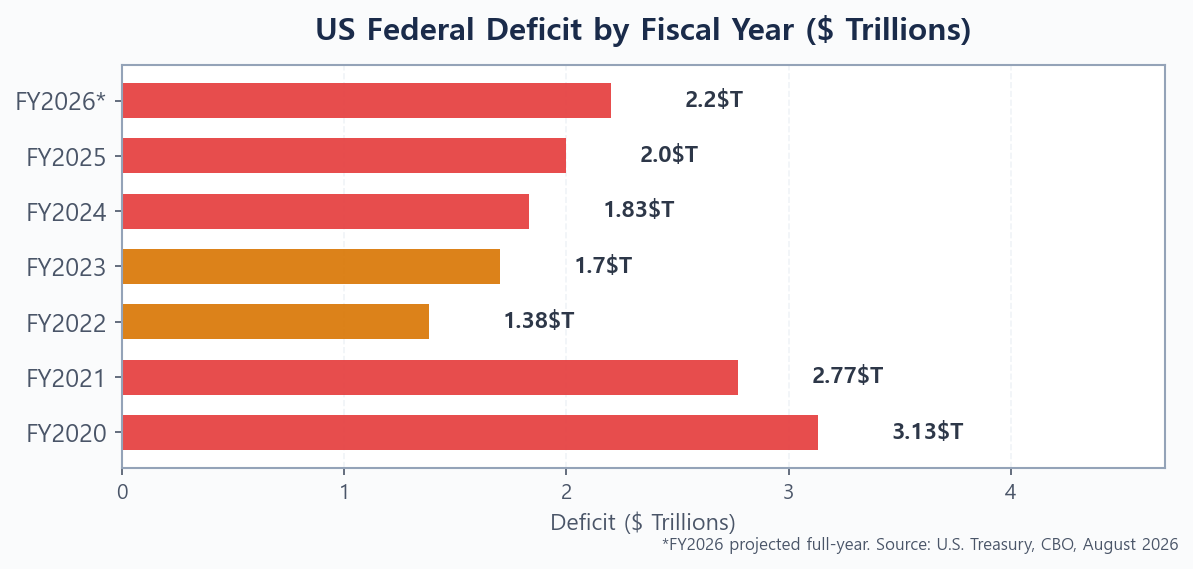
The US government’s fiscal position has deteriorated sharply since 2022 — and the trajectory shows no sign of reversing. Here are the headline figures as of August 2026:
- FY2026 year-to-date deficit: ~$1.8 trillion through July 2026 (Source: U.S. Treasury, August 2026)
- July 2026 monthly deficit alone: $432.3 billion — the largest single-month shortfall since March 2021
- FY2026 full-year projection: ~$2.2 trillion, roughly 8.2% of GDP
- US national debt: surpassed $40 trillion in August 2026
- Annual interest expense: Now the single largest federal expenditure line item, surpassing defense
To put the 8.2% deficit-to-GDP ratio in context: the post-war peacetime average sits around 3–4%. Running a deficit nearly double that norm — outside of a recession or wartime emergency — is historically unusual and puts sustained upward pressure on borrowing costs.
What’s Driving the Spending?
Three structural forces are keeping the deficit wide — and none of them are easy to close quickly.
- Mandatory spending: Social Security, Medicare, and Medicaid grow automatically as baby boomers age into retirement. These programs represent more than 60% of federal outlays and are not subject to annual appropriations cuts.
- Interest expense feedback loop: When the Treasury refinanced low-rate pandemic-era debt at today’s 4–5% rates, its annual interest bill jumped by hundreds of billions. Higher yields widen the deficit, which requires more borrowing, which pushes yields higher still — a self-reinforcing cycle.
- Elevated discretionary spending: Defense appropriations, domestic infrastructure programs, and industrial subsidies remain at elevated levels despite fiscal-consolidation rhetoric in Washington.
Three Mechanisms Linking Deficit Spending to Higher Treasury Yields
The link between fiscal deficits and bond yields is not automatic — economic slack, Fed policy, and foreign demand all interact. But in 2026’s environment, three transmission channels are clearly active at once.
1. The Supply Shock: Flooding the Market with New Bonds
To finance a $2.2-trillion-plus deficit, the US Treasury must issue an enormous volume of new debt every quarter. In FY2026, Treasury coupon auctions — the 2-year, 5-year, 10-year, and 30-year notes and bonds — have been running at near-record sizes, with 10-year auctions reaching $25–28 billion per cycle. When the supply of any asset rises sharply, its price falls. For bonds, a lower price means a higher yield. Treasury auction results in 2026 have repeatedly shown weak bid-to-cover ratios and elevated tail sizes, signaling that the market needs a higher yield to clear the supply (Source: U.S. Treasury auction data, 2026).
2. The Term Premium: Compensation for Fiscal Uncertainty
The term premium is the extra return investors demand for locking up money in a long-term bond instead of rolling over short-term bills. When the long-term fiscal outlook looks uncertain — when investors question whether the US can sustainably service a $40-trillion debt load — that premium rises. The New York Fed’s ACM model estimate for the 10-year term premium has climbed back into positive territory in 2026, after spending most of 2022–2023 below zero. This is also why the Treasury yield curve has been steepening in a classic bear-steepener pattern: long-end yields are climbing faster than short-end yields, driven by fiscal risk rather than growth expectations.
3. The Inflation Channel: Deficits, Monetization Risk, and the Fed
Large, persistent deficits raise a troubling question for bond markets: will the Federal Reserve eventually be pressured to purchase Treasuries at scale to keep yields artificially suppressed? Even the risk of that scenario — often called “fiscal dominance” — keeps long-term inflation expectations elevated. Investors demand higher nominal yields as insurance against future inflation. This channel overlaps directly with how tariffs are fueling sticky inflation in 2026, where core CPI has remained stickier than Fed projections anticipated, making the inflation-risk premium more credible. Meanwhile, questions about whether the Fed will hike rates further in 2026 add another layer of uncertainty to long-end pricing.
Where Treasury Yields and the Deficit Stand Right Now (August 2026 Data)
Here is a snapshot of the Treasury yield curve as of August 21, 2026, and how far each maturity has moved since January:
| Maturity | Yield (Aug 2026) | Change vs. Jan 2026 |
|---|---|---|
| 2-Year Treasury | 4.31% | +0.12% |
| 5-Year Treasury | 4.52% | +0.25% |
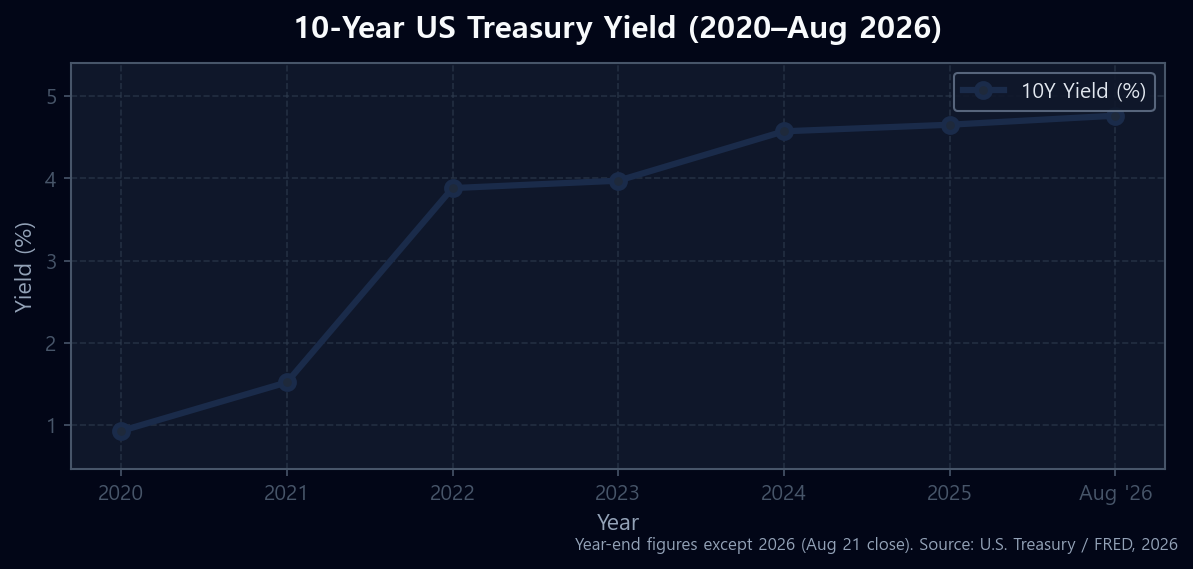
| 10-Year Treasury | 4.76% | +0.38% |
| 30-Year Treasury | 5.33% | +0.62% |
Source: U.S. Treasury / CNBC, as of August 21, 2026. For informational reference only.
The pattern is clear: the longer the maturity, the larger the year-to-date move. The short end is anchored by the Fed’s policy rate; the long end is being pushed up by fiscal supply pressure and rising term premiums. This is the deficit-driven bear steepener in action.
The following Bloomberg segment explains how surging US borrowing costs and weak Treasury auction demand are reshaping the bond market in real time.
Five Moves for Bond Investors Right Now
Understanding why yields are rising is only half the work. Here is a practical five-move playbook for bond investors navigating a high-deficit, persistently elevated-yield environment.
1. Shorten Duration
Duration measures how sensitive a bond’s price is to a change in yields. Long-duration bonds — 10-year and 30-year Treasuries, long-term bond ETFs like TLT — absorb the most price pain when yields rise. Shortening duration by shifting allocation toward 1-year, 2-year, and 5-year maturities protects capital while still capturing attractive yields of 4.3–4.5%. The short end of the curve also offers a simpler reinvestment picture: as bonds mature, you redeploy at prevailing rates rather than being locked in. For a detailed analysis of the short-duration case, read: Why Short-Duration Bonds Win in a 4% Treasury World.
2. Add Inflation Protection with TIPS
If persistent deficit spending eventually translates into higher realized inflation — or if the Fed is pressured to ease prematurely — Treasury Inflation-Protected Securities (TIPS) provide a direct hedge. TIPS principal adjusts upward with CPI, so your real purchasing power is maintained. The 10-year TIPS real yield was near 2.1% as of August 2026 (Source: U.S. Treasury), the most attractive entry point in more than a decade. Paired with a nominal Treasury ladder, TIPS give your fixed-income allocation a built-in inflation buffer. For a full comparison of TIPS and I-Bonds, see: TIPS vs. I-Bonds: Best Inflation Protection for 2026.
3. Ladder Your Treasury Holdings
A Treasury ladder — spreading maturities across 1, 2, 3, 5, and 7 years — solves two problems at once. First, it eliminates the need to time the market: each rung matures on schedule, and you reinvest at whatever rate the market offers at that point. Second, it smooths out the reinvestment-rate risk that single-maturity holdings carry. In a fiscal-deficit environment where yields may remain elevated but not necessarily predictable, a ladder gives you ongoing flexibility without requiring you to make a call on the long end.
4. Question Whether Corporate Bond Premiums Are Worth It
With Treasuries paying 4.5–5.3%, corporate bonds need to offer a meaningful spread to justify the added credit risk. But investment-grade credit spreads have been historically compressed in 2026, often below 100 basis points over equivalent Treasuries. If fiscal deterioration triggers a risk-off episode or a recession, those spreads could widen sharply — delivering price losses on top of rate-driven losses. Before reaching for corporate yield, consider whether Treasuries already offer a competitive risk-adjusted return at today’s levels. For a detailed spread analysis, see: Corporate Bonds vs. Treasuries in 2026: Worth the Risk?
5. Use Rising Yields to Rebalance Your Overall Portfolio
Higher Treasury yields have restored bonds to their traditional role as a genuine income-generating asset — something that was effectively absent during the 2010s zero-rate era. If your portfolio’s stock-to-bond allocation has drifted equity-heavy after several years of stock market gains, this may be the right structural moment to rebalance back toward fixed income. Prioritize shorter-duration, higher-quality issues to keep duration risk manageable while capturing today’s yields. For a step-by-step rebalancing framework, see: how to rebalance your portfolio when interest rates are rising (2026 guide).
Conclusion: Deficit-Driven Yields Aren’t Going Away Soon
The US fiscal deficit is not a one-year anomaly. The Congressional Budget Office projects annual deficits will remain above $1.5 trillion through the end of the decade, and the interest-expense feedback loop means that higher yields themselves widen the deficit further. That structural backdrop suggests the long end of the Treasury curve will remain under pressure even if the Fed eventually begins cutting short-term rates. Bond investors who positioned defensively in shorter maturities earlier this year have so far avoided the worst of the price damage — but the window to reposition is not closed.
The key insight is this: in a fiscal-deficit-driven yield environment, the bond market is not broken — it is repricing for a new reality. Adapting means shortening duration, adding inflation protection, using laddering for ongoing reinvestment flexibility, and being selective about credit. Bond investing in this era requires more active attention than the passive “set and forget” approach of the 2010s. But it also offers more income than most investors have seen in a generation.
Found this useful? Bookmark it so you can revisit when the market moves.
This article is for informational purposes only and is not investment advice. Do your own research before making any investment decisions.